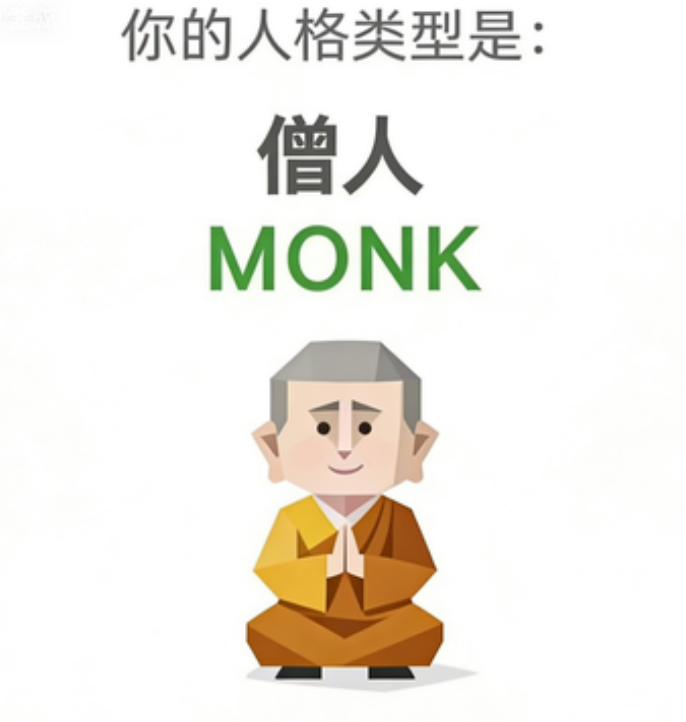
MONK Monk
MONK is a "negative entropy entity" in the SBTI personality spectrum—a special configuration that maintains psychological homeostasis by actively reducing system complexity. This personality is not a simple popular variant of "introversion" or "Buddha-like calm", but a cognitive architecture that takes "non-intervention" as its core survival strategy. The default mode network activity of the MONK brain is significantly lower than average, with weak explicit stimulus-seeking motivation, yet its internal psychological space exhibits highly structured characteristics—not empty, but a carefully curated minimalist garden. MONK has precise calculations for "enough": enough social interaction to maintain function, enough achievement to avoid crisis, enough emotion to confirm humanity—but any input exceeding the "enough" threshold is identified as noise and triggers defensive isolation.
Core Cognitive Architecture
The cognitive system of the MONK personality is built on a triple mechanism of "stimulus filtering - energy conservation - meaning compression". Stimulus filtering is the most explicit cognitive trait of MONK, manifested as highly selective information input. The regulatory pathway between the prefrontal cortex and amygdala in the MONK brain is unusually developed, enabling cognitive reappraisal before emotional responses are generated—not suppression, but a proactive "non-activation" strategy. From a neuroeconomic perspective, MONK regards cognitive resources as non-renewable scarce currency, and any input that may trigger emotional fluctuations is seen as a potential cost center, requiring strict cost-benefit accounting before being allowed into conscious space.
The energy conservation mechanism forms the behavioral economic foundation of MONK. Unlike ZZZZ (the Feigner) who passively saves energy, MONK's energy conservation is actively constructed—achieving psychological budget balance by systematically reducing "high-energy activities" such as relationship maintenance, social comparison, and future planning. MONK has an almost instinctive avoidance response to "trouble"; this response is not laziness or lack of ability, but based on profound self-awareness: MONK clearly knows that it is difficult to maintain boundaries after intervening in complex systems, so it chooses to refuse intervention from the source. This "preventive avoidance" is functional in the short term, but may lead to skill degradation in the long run—when intervention is necessary, MONK may find itself lacking the necessary skills and tolerance.
Meaning compression is MONK's deep psychological defense. Faced with existential anxiety, CTRL chooses to construct, DEAD chooses to abandon, while MONK chooses to compress—amplifying the granularity of meaning to make it no longer sensitive to subtle fluctuations. MONK's "lack of desire" is not truly absence of desire, but abstracting the object of desire into "calmness" itself, thereby reducing infinitely diverse worldly desires to a single-dimensional maintenance task. This compression strategy has a double-edged effect: on the one hand, it provides an unusually stable psychological baseline; on the other hand, it may lead to flattening of experience depth—when all stimuli are compressed into binary judgments of "enough/insufficient", the texture and richness of life may be significantly lost.
15-Dimension Typical Profile
MONK's confidence is built on "self-sufficiency"—believing that they can maintain function with minimal external input. This confidence does not rely on social comparison or achievement validation, but on cognitive confirmation of their low-demand nature. MONK rarely experiences inferiority because their value coordinate system is internal and self-sustaining.
MONK has precise mapping of their own demand boundaries, ability radius, and the edge of their comfort zone. This clarity stems from long-term self-observation and experimentation—testing functional status under different stimulus levels to finally determine optimal operating parameters. MONK's self-awareness is manual-style, not narrative.
MONK's value system exhibits "de-goalization" characteristics. Typical value dimensions such as growth, achievement, and influence are significantly weakened in MONK's weight matrix, replaced by maintenance values such as "calmness", "autonomy", and "simplicity". MONK does not pursue "better", only "undisturbed".
MONK exhibits a "de-investment" strategy in the attachment dimension. By reducing emotional investment in others to avoid attachment anxiety, MONK maintains a relational posture of "can withdraw at any time". This low attachment is not a mature manifestation of secure attachment, but an extreme form of avoidance strategy—avoiding loss by not participating.
MONK's emotional expression is highly regulated. Deep emotional experiences may exist, but explicit expression is strictly controlled at the minimum dose "required for function". MONK fears that emotional exposure will lead to boundary erosion, thus developing "emotional minimalism"—only maintaining the emotional exchange necessary to sustain relationships.
Boundary maintenance is MONK's core defense mechanism. MONK has a highly sensitive detection system for "intrusion", and any behavior crossing their psychological fence triggers a rapid withdrawal response. This high boundary is both protection and prison—it indeed blocks harm, but also blocks the possibility of deep connection.
MONK holds an "unknowable-unnecessary to know" attitude towards the world. Grand narratives, collective destiny, historical processes and other dimensions are actively faded out of attention, and the world is compressed into a binary structure of "direct influence circle" and "irrelevant background". This compression reduces cognitive load, but may also lead to local atrophy of reality testing ability.
MONK's attitude towards rules is "utilitarian"—identifying the boundaries of rules, operating under minimal compliance conditions, but never actively challenging or changing rules. MONK's flexibility is reflected in "exit" rather than "negotiation": when rules conflict with comfort, MONK chooses to leave the system instead of changing it.
MONK copes with existential anxiety through "de-meaningization". Life is not seen as a project to complete or a question to answer, but a state to maintain. "Having no meaning" itself becomes a defense—when one stops asking about meaning, the absence of meaning no longer causes pain.
MONK's motivation structure is dominated by "avoidance-calmness". Behavioral motivation mainly comes from avoiding disturbances rather than pursuing goals. This configuration provides a stable low-energy operating state, but may also lead to overall atrophy of the motivation system—when external pressure disappears, MONK may find themselves lacking spontaneous desire to act.
MONK's decision-making follows the "minimum change principle"—continuing on the existing trajectory unless there is clear evidence that change is necessary. This "inertial decision-making" reduces cognitive consumption, but may also lead to path dependence and neglect of opportunity costs. MONK's decision-making quality is acceptable in stable environments, but may lag in situations requiring rapid adaptation.
MONK's execution system is bounded by "maintenance tasks". They can reliably complete daily maintenance work, but show obvious initiation difficulties for innovative tasks requiring additional investment. MONK's execution consistency is high, but flexibility is low—when plans are interrupted, the recovery cost is significantly higher than average.
MONK has an extremely high threshold for social initiation. Social interaction is regarded as a high-cost activity, occurring only when functionally necessary (work, basic survival) or when energy is surplus. MONK's social network exhibits "minimum viable" characteristics—streamlined quantity, low-frequency interaction, automated maintenance.
MONK's interpersonal boundaries are dual physical-psychological fences. They not only restrict others' emotional approach, but also their own emotional investment. This two-way boundary creates a stable but thin relational model—relationships exist, but are maintained at a safe distance "where no harm can be done".
MONK's self-presentation is highly contextual, but this is not strategic disguise, but "layered disclosure of the true self". MONK shows different slices of themselves in different relationships; each slice is real, but incomplete. This "mosaic authenticity" protects the core self, but may also lead to integration difficulties.
Interpersonal Relationship Topology
MONK occupies the position of "peripheral node" in social networks—low connectivity but high stability. MONK's relational network is carefully curated, presenting a "few but refined" topological structure, but this "refinement" is not based on emotional depth, but on predictability and low maintenance costs. MONK's core relationships usually have the following characteristics: long-term stability (reducing the cost of building new relationships), low emotional needs (reducing emotional labor), functional complementarity (reducing interaction frequency), geographical or psychological distance (reducing real-time pressure of boundary maintenance). This relational strategy is efficient in the short term, but may lead to "relational capacity degradation" in the long run—when deep support is needed, MONK may find themselves lacking a reserve of relationships that can provide such support.
In the field of intimate relationships, the core tension faced by MONK lies in the "intimacy-autonomy paradox". Intimate relationships essentially require a certain degree of self-disclosure and interdependence, which is structurally incompatible with MONK's core defense mechanisms. High-functioning MONK resolves this tension by finding partners with equally high boundaries and low needs—establishing "parallel relationships" rather than "fusion relationships", where both parties operate independently in the same space, maintaining physical proximity but psychological independence. This relational model works well when both parties' needs match, but may collapse rapidly when one party's needs change (such as illness, crisis, emotional awakening), because MONK lacks the flexibility and willingness to adjust relational contracts.
MONK's conflict handling style is marked by "avoidance-withdrawal". MONK identifies conflict as system disturbance, and its primary response is to reduce its exposure in the conflict field. This strategy indeed reduces the probability of conflict escalation, but may also lead to accumulation of problems and chronic death of relationships. MONK needs to identify the boundary between "resolvable conflicts" and "must-accept differences", and develop the ability of "limited intervention"—participating in necessary negotiations with minimal dose without completely withdrawing.
Career Niche Analysis
Highly Suitable Fields
- Remote Technical Work: Independent work, asynchronous collaboration, results-oriented evaluation system
- Library/Archive Management: Low social demand, structured environment, predictable workflow
- Night Shift Positions: Minimized interpersonal contact, autonomous control of work rhythm
- Data Analysis/Research: Deep focus, independent output, limited team collaboration
- Freelance/Self-Employment: Autonomous control of workload, right to refuse clients
- Religious/Spiritual Institutions: Institutionalized low-desire environment, clear boundary rules
Challenging Fields
- Sales/Business Development: High social pressure, emotional labor, performance-oriented incentive mechanisms
- Management Positions: Continuous interpersonal coordination, conflict handling, emotional support needs
- Customer Service: Unpredictable emotional input, high risk of boundary erosion
- Entrepreneurship/Partnership: High uncertainty, resource competition, deep interest binding
- Education/Training: Continuous emotional investment, performance responsibility, public exposure
MONK needs to be vigilant against the "isolation trap" in career development—continuous contraction of ability scope and opportunity space due to excessive pursuit of low-stimulus environments. MONK's optimal career ecology is "protected independence": having clear responsibility boundaries, predictable workflows, limited team collaboration needs, and most importantly—access to "exit options". When environmental requirements exceed the comfort zone, MONK needs to be confident that they have the right to refuse or leave; this confidence itself can expand their actual functional boundaries.
In terms of career burnout, MONK exhibits unique "non-burnout" characteristics. Operating in a low-energy mode by nature, MONK rarely experiences traditional burnout, but may encounter "meaning evaporation"—when the repetitiveness of work content exceeds their tolerance threshold, MONK enters a state of "autopilot", with distorted subjective sense of time and fragmented work experience. The exit from this state is not "more rest", but introducing moderate cognitive challenges—task complexity just enough to break automation without triggering anxiety.
Developmental Risks & Shadow Side
The core risk of the MONK personality lies in the "graduality of ability atrophy". By avoiding high-stimulus situations for a long time, MONK's stress tolerance threshold continues to decrease, and challenges that were once manageable gradually become unbearable. This atrophy is implicit because MONK adapts through environmental selection rather than self-change, until one day they find themselves trapped in an overly narrow comfort zone, lacking psychological resources to cope with necessary changes. Preventive interventions include: regular "stimulus vaccination"—proactively entering moderately challenging situations to maintain basic functions of the psychological immune system.
"Emotional muscle disuse" is another key risk. MONK's emotional regulation strategy relies on avoidance rather than processing, leading to stunted development of emotional processing abilities. When unavoidable emotional events occur (such as the death of a loved one, major illness), MONK may find themselves lacking necessary emotional language and coping tools, falling into a long state of numbness or dissociation. MONK needs to develop the ability of "emotional micro-dose exposure"—practicing small-dose emotional expression and reception in safe relationships to gradually rebuild neural pathways for emotional processing.
On the existential dimension, MONK faces the risk of "meaning vacuum". When the "de-meaningization" strategy is overly successful, MONK may enter a state of "existential floating"—no longer suffering, but no longer feeling alive. The exit from this state does not lie in re-seeking grand meaning, but in rebuilding "physical anchoring"—establishing a direct connection with the world bypassing the meaning system through sensory experience, physical practice, contact with nature, etc. MONK needs to learn to enjoy "purpose-free existence" as an end in itself rather than a means.
MONK's "high boundaries" may evolve into "personality shell hardening" in extreme cases—boundaries solidify from protective functions into structural limitations, preventing any new experiences from entering. When MONK finds themselves having the same rejection response to all new relationships, new environments, and new challenges, they need to question whether this is a true preference or automated defense. The entry point for treatment lies in identifying the difference between "boundaries" and "shells": the former is flexible and adjustable protection, while the latter is rigid isolation.
Integrated Development Path
Stimulus Tolerance Reconstruction
Identify the edge of the current comfort zone and develop a gradual exposure plan. Start with low-stakes situations (e.g., attending small gatherings, trying new restaurants) to gradually expand the tolerance window. The goal is to establish implicit memories of "uncomfortable but not collapsing".
Emotional Micro-Dose Exposure
Practice emotional expression in safe relationships (therapists, long-term friends, pets). Start with identifying physical sensations, gradually naming emotions, and finally attempting limited emotional sharing. The goal is to rebuild neural pathways for emotional processing.
Meaning Granularity Adjustment
Without questioning grand meaning, attempt to expand the definition of "enough". Introduce new experience dimensions (art, nature, physical practice), allowing these experiences to carry their own meaning without being compressed into variants of "calmness".
Selective Deep Investment
Identify an area worthy of deep investment (work, relationships, creation), and attempt "over-investment" while maintaining boundaries—intentionally exceeding the "enough" threshold to experience the risks and rewards of high-investment states.
Boundary Wisdom
Develop the ability of "permeable boundaries"—identifying when strict protection is needed and when limited opening is possible. Shift from a binary mode of "always closed" or "always open" to dynamic regulation based on situational assessment.