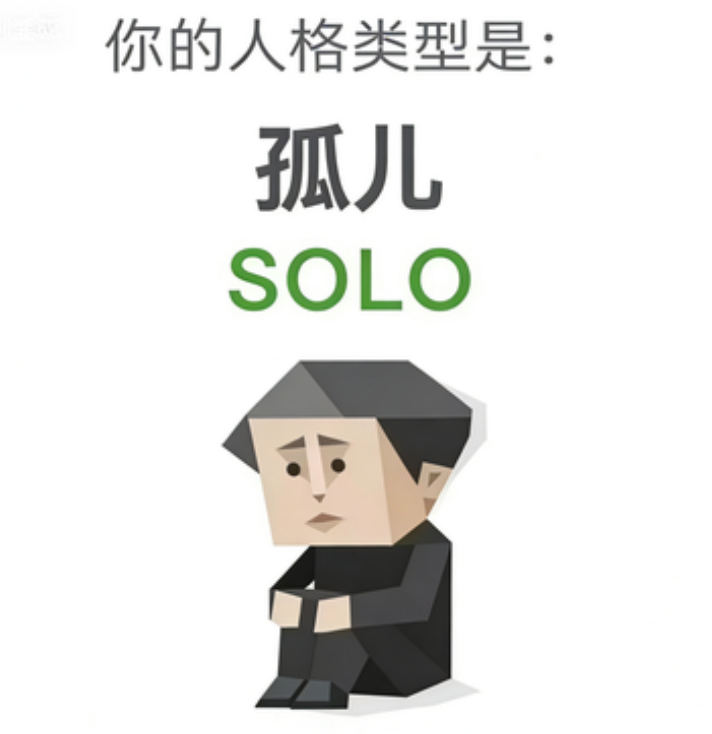
SOLO The Lone Wolf
SOLO represents an extremely discrete node in the SBTI personality spectrum, with a psychological structure exhibiting typical "atomization" characteristics—an impenetrable boundary barrier exists between the individual and the external world. This personality is not a mere popular variant of "introversion" or "social anxiety", but a defensive adaptive pattern that takes self-enclosure as the primary survival strategy. The nervous system of SOLO personalities shows a highly alert response to social cues: their amygdala activation threshold is significantly lower than the population average, while prefrontal inhibitory function is overdeveloped, forming a rapid "perception-inhibition" pathway that makes social avoidance an automated protective response.
Core Defensive Architecture
The psychological defense system of SOLO personalities is built on three mutually reinforcing levels: perceptual avoidance, cognitive alienation, and existential isolation. Perceptual avoidance manifests as an early filtering mechanism for social stimuli—before consciously processing social information, SOLO completes threat assessment and triggers avoidance responses at the pre-attentional stage. This "hyper-sensitive radar" pattern stems from inconsistent responses in early attachment experiences: caregivers' intermittent availability encoded "others" as unpredictable potential threats rather than resource providers in SOLO's nervous system. Neurobiologically, this corresponds to overactivation of the dorsal vagal complex, leading to "playing dead" responses (freezing, withdrawal, dissociation) in social situations that take precedence over social engagement responses.
Cognitive alienation constitutes the implicit working model of SOLO personalities. SOLO views interpersonal relationships as inherently uncontrollable, depleting, and ultimately harmful interaction patterns. This working model is not acquired through rational analysis but formed through somatic encoding of emotional memories—SOLO's body remembers the feeling of being ignored, misunderstood, and abandoned, even if specific events cannot be retrieved at the conscious level. Therefore, SOLO's belief of "I don't need others" is a protective cognitive restructuring: by devaluing relational value to reduce emotional impact when rejected. While this strategy effectively reduces SOLO's vulnerability exposure in relationships, it cuts off the possibility of reparative experiences, forming a self-reinforcing negative cycle.
Existential isolation is the deepest structural layer of SOLO personalities. The loneliness experienced by SOLO is not merely a state of social deprivation, but an ontological "unconnectability"—an existential certainty of "being unseen even in a crowd". This certainty makes SOLO skeptical of any attempt to penetrate their defenses: others' care is interpreted as temporary, conditional, and ultimately withdrawable; others' understanding is experienced as superficial, failing to touch the true self. The "orphan" identity of SOLO thus has duality: it is both a self-deprecating label ("unwanted child") and a self-protective armor ("since loneliness is inevitable, no need to expect anything"). Longitudinal tracking data shows that SOLO personalities demonstrate unique strengths in creative solitude, independent problem-solving, and emotional stability in crises, but their subjective well-being scores remain consistently below the population average, with a strong negative correlation to relationship satisfaction.
15-Dimension Typical Profile
SOLO's self-evaluation is built on accumulated "abandonment experiences", forming the core belief of "I am not worthy of being chosen". This low self-esteem does not stem from lack of actual ability, but from failed mirroring by early significant others—SOLO was never stably and accurately seen and affirmed. Their self-doubt is situationally persistent: even after achieving objective accomplishments, they still attribute success to luck or others' low standards.
SOLO's self-concept presents fragmentation and contradiction. On one hand, SOLO develops high introspective ability through long-term self-observation; on the other hand, this introspection lacks calibration from external feedback, potentially leading to biased and fixed self-perception. SOLO often experiences a disconnect between the "looking-glass self" and the "experiencing self"—not knowing how they appear to others, nor being certain if their feelings are "normal".
SOLO's value system is absolutely dominated by "safety first", with values like growth, achievement, and connection systematically downgraded. SOLO's decision algorithm takes "minimal harm" rather than "maximum gain" as the objective function. This conservative strategy indeed reduces risk exposure but leads to cumulative loss of opportunity costs. SOLO needs to develop "controlled risk-taking" ability to break this impasse.
SOLO's attachment system is in a constant state of alert, with fundamental distrust in others' availability. SOLO does not believe "someone will be there when needed"—this expectation is reinforced through self-fulfilling prophecy: because they don't believe others will respond, they don't send signals; because there are no signals, others indeed don't respond. SOLO needs to identify and break this cycle.
SOLO's emotional investment follows a "delay-test-withdraw" pattern. SOLO can show moderate investment in the early stages of a relationship, but once potential rejection signals are detected (often hypersensitive), they initiate emotional withdrawal mechanisms. This strategy of "abandoning others first to avoid being abandoned" protects SOLO's self-esteem but ensures relationship failure.
SOLO's boundary defense is the strongest in the SBTI spectrum. SOLO experiences dependency needs as dangerous vulnerability exposure, thus developing extreme self-reliance ability. SOLO would rather bear the huge cost of solving problems alone than endure the anxiety of "owing favors" from asking for help. This illusion of "omnipotent control" maintains a sense of self-integrity but consumes massive psychological resources.
SOLO tends to view the world as inherently indifferent, competitive, and lacking internal order. This "malevolent cosmology" is not a cognitive deficit but an adaptive response to an early neglectful environment. SOLO's worldview has self-consistency but limits their ability to extract supportive resources from the environment, forming a cognitive bias of "negative filtering".
SOLO's adherence to rules has compulsive characteristics—rules provide a certainty anchor in an unpredictable world. SOLO's lack of flexibility stems from anxious reactions to "accidents", which mean loss of control—a key resource for SOLO to maintain psychological homeostasis. SOLO needs to learn to treat flexibility itself as a controllable skill.
SOLO suffers from severe lack of meaning, often experiencing existential emptiness. SOLO struggles to derive meaning from relationships, contributions, or transcendent goals because these all require vulnerability exposure. SOLO's alone time is often "lonely" rather than "solitudinous", lacking internal richness. Meaning reconstruction is a long-term process for SOLO that requires external support.
SOLO's motivational structure is dominated by "avoidance-failure", with "approach-achievement" as secondary. SOLO is driven by "don't mess up" rather than "do well"—this defensive motivation leads to risk aversion and premature giving up. SOLO's motivation system needs recalibration to allow pursuit of positive goals rather than just avoidance of negative outcomes.
SOLO's decision-making process is plagued by "analysis paralysis"—infinite comparison of options, catastrophic imagination of consequences, anticipatory fear of regret. SOLO's decision delay is a protective strategy: avoiding responsibility for choices by not choosing, but also leading to missed opportunities and further reduced self-efficacy.
SOLO's executive ability shows "intermittent burst" characteristics—forced action when pressure accumulates to a critical point, rather than sustained progress based on plans. SOLO's execution mode lacks external structural support because SOLO refuses to seek support or cooperation. This "lone warrior" mode works for simple tasks but leads to exhaustion in complex projects.
SOLO faces extremely high social initiation costs, needing to overcome significant internal resistance to initiate social behavior. SOLO's social avoidance includes not only offline interactions but also online communication—any situation requiring self-disclosure triggers anxiety. SOLO's social skills may degenerate from lack of practice, forming a vicious cycle of "poor social skills → avoid socializing → worse social skills".
SOLO's boundary awareness is the most extreme in the SBTI spectrum, showing "electric fence" characteristics—physical contact or emotional closeness triggers alarms. SOLO's boundary defense targets not only others but also their own needs—SOLO systematically ignores, denies, and represses their attachment needs to maintain the self-narrative of "I don't need anyone".
SOLO's self-expression shows "over-control" characteristics—carefully screening displayable content, hiding anything that may be seen as weakness or weirdness. SOLO's "true self" is deeply buried under defensive layers, and even SOLO themselves may lose connection with it. This expressive inhibition ensures SOLO won't be rejected (since no one sees the real SOLO) but also ensures SOLO won't be truly accepted.
Interpersonal Relationship Topology
SOLO occupies an "edge-discrete" position in social networks—with few connections, mostly one-way or functional weak ties. SOLO's relationship network shows a typical "sparse graph" structure: few nodes, few edges, and long average path length. SOLO maintains relationships following the "minimal exposure" principle—investing just enough resources to maintain surface peace, avoiding any interaction that may lead to dependence or intimacy. This strategy ensures SOLO's autonomy but also leads to cumulative depletion of social capital—finding no one to turn to when support is needed.
In the realm of intimate relationships, SOLO faces a core tension of the "longing-fear" paradox. SOLO's longing for deep connection is equally strong as their fear of intimacy—this internal conflict leads to an "approach-avoidance" behavioral pattern: showing cautious interest in the early stages of a relationship, initiating withdrawal mechanisms as the relationship deepens, and experiencing mixed emotions of relief and loss when the relationship ends. SOLO's intimate relationship history is often repetitive—failing in similar patterns each time, reinforcing the expectation that "relationships will ultimately fail". Breaking this cycle requires SOLO to identify specific situations that trigger withdrawal and attempt to "stay" rather than "flee" in these situations to accumulate corrective experiences.
SOLO's conflict resolution style is marked by "complete avoidance". SOLO will not express dissatisfaction, make demands, or participate in negotiation—instead choosing silence, withdrawal, and ultimately cutting off the relationship. This "disappearing" strategy protects SOLO from immediate conflict pain but ensures problems are never solved and SOLO never learns conflict resolution skills. SOLO needs to develop "low-intensity self-assertion" ability—starting with expressing preferences and making small requests, gradually building implicit memories that "my needs can be heard without causing relationship breakdown".
Career Niche Analysis
High-Fit Fields
- Independent Creator: Solitary creative activities such as writing, painting, music
- Remote Technical Work: Technical positions with low social demand like programming, data analysis
- Night Shift/ Solitary Roles: Solitary jobs such as security guard, warehouse management, equipment monitoring
- Academic Research: In-depth thinking work requiring long-term independent focus
- Freelance Work: Work model avoiding organizational politics and mandatory socializing
- Nature-Focused Work: Jobs interacting with nature rather than people, such as forest ranger, field research
Challenging Fit Fields
- High Social Demand Careers: Fields requiring continuous interpersonal interaction like sales, PR, customer service
- Team Collaboration Roles: Project roles requiring frequent coordination, meetings, consensus-building
- Leadership Positions: Management roles requiring motivation, mentorship, and handling interpersonal conflicts
- Performance-Oriented Careers: Roles facing the public and receiving evaluation such as actor, lecturer, live streamer
- Relationship-Intensive Careers: Fields requiring deep emotional investment like counseling, social work
The core dilemma SOLO faces in career development is the "ability-opportunity" mismatch. SOLO often has high ability to complete tasks independently but lacks the social network needed to access opportunities. SOLO's career success is highly dependent on "visibility"—their work or achievements need to be discovered by others, a link that often requires self-promotion (SOLO's weakest skill). SOLO's optimal career strategy is to find "agent support"—one or a few trusted "broker" roles who handle external relationship maintenance while SOLO focuses on internal production. This division of labor allows SOLO to leverage their solitary strengths while bypassing their social weaknesses.
In terms of career stability, SOLO shows "high mobility" characteristics. SOLO struggles to stay long-term in organizations requiring continuous interpersonal adaptation—frequent career changes are both a result of SOLO's conflict avoidance and an attempt to explore an "ideal solitary environment". SOLO needs to identify the core source of job dissatisfaction—whether it's the work content itself or interpersonal pressure in the work environment—to avoid misjudging interpersonal problems as career direction issues. The popularization of remote work provides unprecedented career fit opportunities for SOLO, but complete social isolation may also lead to skill degradation and worsening mental health, requiring balance.
Developmental Risks & Shadow Aspects
The core risk of SOLO personality lies in the solidification of "self-imprisonment"—the short-term effectiveness of defensive strategies leads to overuse, ultimately becoming a cage limiting life possibilities. When SOLO's avoidance pattern shifts from "protective" to "habitual", SOLO loses the ability to distinguish between true preferences and fears, rationalizing all social avoidance as subjective choice rather than defensive response. This "false autonomy" makes it difficult for SOLO to recognize the need for change because they sincerely believe "I like being alone". Breaking this illusion requires SOLO to examine the quality of their alone time—whether it is fulfilling and restorative, or escapist and empty.
"Emotional muscle atrophy" is another key risk for SOLO. Long-term relationship avoidance leads to degradation of SOLO's emotional expression and reception abilities, similar to muscle atrophy in long-term bedridden patients. SOLO may find that even when they want to connect, they lack the language and behavioral patterns to express closeness; even when others express care, they cannot experience it as warmth but as pressure or threat. This loss of ability is reversible but requires systematic "emotional rehabilitation"—starting with low-intensity social interactions to gradually rebuild the plasticity of emotional neural circuits.
At the existential level, SOLO faces the risk of "meaning vacuum". When SOLO successfully isolates themselves from all external relationships, they also cut off the main sources of meaning—sense of contribution, belonging, and transcendent connection. SOLO may fall into existential depression, experiencing purposelessness in life and emptiness of self. This depression differs from clinical depression: it responds poorly to medication and needs to be addressed through existential exploration and relationship reconstruction. SOLO needs to recognize that their ideal of "self-sufficiency" is existentially unsustainable—human beings are social animals, and their meaning systems are inherently relational.
In extreme cases, SOLO's "orphan" identity may evolve into a "victim" narrative—attributing all life difficulties to early neglect or abandonment, thus exempting themselves from responsibility for change. While this narrative has elements of truth (SOLO did experience neglect), solidifying it as the core of identity hinders growth. SOLO needs to complete the identity transition from "abandoned child" to "adult who chooses how to respond"—a process that usually requires professional psychotherapy support.
Integrative Development Path
Defense Awareness
Identify specific trigger situations for social avoidance, distinguish between "true preferences" and "protective avoidance". Establish an observation gap between "urge" and "action"—pause when avoidance urges arise and ask: Is this a danger signal or an outdated alarm?
Low-Intensity Exposure
Start with the lowest-stakes social interactions (e.g., brief conversations with strangers, lurking observation in online communities) to gradually expand the tolerance window. The goal is to build corrective experiences that "socializing does not necessarily lead to harm".
Selective Trust
Identify and cultivate one or a few "safe base" relationships—attempt limited vulnerability exposure in these relationships to test the possibility of "being seen without being abandoned". This is a critical turning point for SOLO's change.
Self-Assertion Development
Learn to express needs, preferences, and boundaries—starting with low-conflict situations (e.g., returning defective goods) and gradually expanding to interpersonal areas. Build implicit memories that "my needs are reasonable and can be heard".
Relational Self-Reconstruction
Through continuous relationship investment, gradually integrate the "relational self" into the core identity—shifting from "I am lonely" to "I choose when to be alone and when to connect". Develop the dialectical ability of "lonely solitude" and "connected solitude".