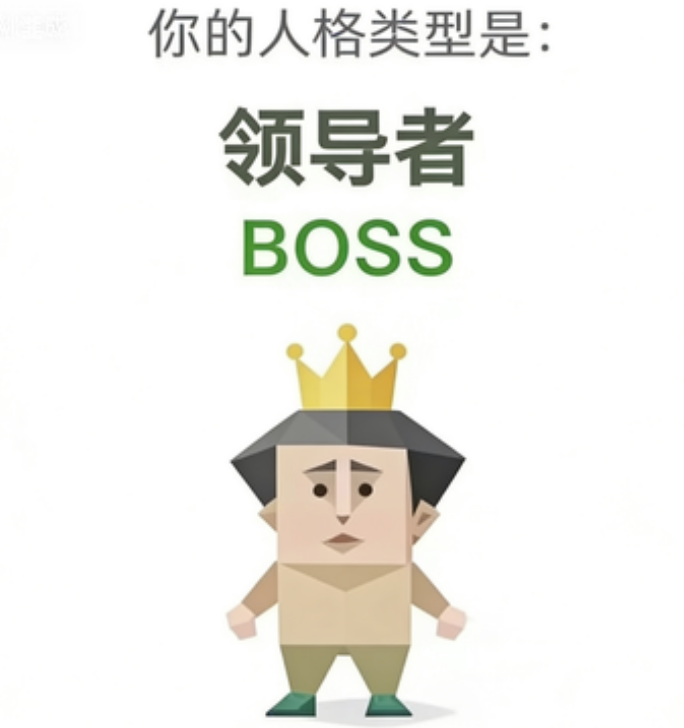
BOSS (The Boss)
BOSS is a directional vector in the SBTI personality spectrum, whose psychological structure revolves around the dual axes of "group-goal". Unlike CTRL's system control, BOSS's core anxiety does not stem from loss of control, but from loss of direction — when a group lacks clear goals or forward momentum, BOSS experiences existential emptiness and urgency. This high sensitivity to "directional vacuum" enables BOSS to quickly construct direction in ambiguous situations, but also leads to "useless anxiety" in stable environments. The leadership of BOSS personality is not an acquired skill set, but a natural overflow of its cognitive-affective system.
Core Cognitive Architecture
BOSS personality's cognitive system is built on the underlying algorithm of "maximizing group effectiveness". This algorithm is not a simple utilitarian calculation, but an identity structure that deeply binds individual value with collective achievement. BOSS's default mode network in the brain shows continuous monitoring of "group status" even at rest — variables such as member emotions, team motivation, and goal progress are refreshed at high frequency in BOSS's working memory. This cognitive configuration enables BOSS to quickly identify "energy low points" in social situations and automatically initiate intervention procedures, but also leads to significant cognitive unloading difficulties when alone.
Direction construction is the core functional module of BOSS personality. When facing complex or ambiguous situations, BOSS will quickly execute "narrative compression" — collapsing multiple possibilities into a single forward path. This compression is not information neglect, but a rapid decision-making based on pattern recognition: BOSS relies on its rich library of "situation-response" prototypes, maps the current situation to historically similar situations, and extracts effective responses. This decision-making style is highly adaptive in crisis or change situations, but may manifest as "premature closure" in situations requiring in-depth analysis or pluralistic inclusion — locking direction when information is insufficient, leading to subsequent path dependence and adjustment difficulties.
Responsibility-taking is the emotional anchor of BOSS personality. BOSS regards "being responsible" as the core way of existence, rather than an externally imposed obligation. The source of this sense of responsibility is not the pressure of the moral superego, but a natural emotional response after deep identification with the group — the failure of the group is the failure of the self, and the achievement of the group is the achievement of the self. This "expanded self" structure enables BOSS to withstand high-intensity pressure and sacrifice, but also leads to "meaning collapse" after the dissolution of the group or the achievement of goals. BOSS needs a continuous flow of goals to maintain psychological homeostasis, and static success may be a more dangerous threat to it than failure.
15-Dimension Typical Profile
BOSS's confidence is built on the experience of "being needed", rather than abstract self-evaluation. Its self-esteem has significant relational dependence — showing high confidence in supportive groups, and may experience drastic fluctuations in isolated or oppositional situations. This "situational self-esteem" makes BOSS highly sensitive to group feedback.
BOSS's self-concept is characterized by "definition through action". Its identity is highly dynamic, reconstructing with changes in the roles it undertakes and the groups it belongs to. This fluidity provides extremely strong adaptability, but may also lead to thinning of the "core self" — when all roles are stripped away, BOSS may struggle to answer "who am I".
BOSS's value system is anchored in "influence" and "legacy". BOSS is driven by a deep need to "leave a mark", which may manifest as the pursuit of power, fame, or tangible change. BOSS needs to feel that its existence has irreversibly shaped a certain part of the world.
BOSS's sense of security in intimate relationships is deeply intertwined with the experience of "being followed". BOSS needs to feel that their partner recognizes their direction and ability — pure emotional support without confirmation of their leadership may be experienced as insufficient. This configuration may lead to an imbalance in power dynamics in intimate relationships.
BOSS's emotional engagement has a "projective" characteristic — regarding its own emotional state as an indicator of the group's emotional climate and taking responsibility for regulation. BOSS's anger may be a proxy response to group frustration, and BOSS's excitement may be a shared experience of group achievement. This emotional fusion provides strong empathy, but also leads to blurring of emotional boundaries.
BOSS has contradictory needs for dependence. On one hand, BOSS needs to feel needed by the group to maintain self-worth; on the other hand, BOSS fears vulnerability exposure caused by over-dependence. This contradiction manifests as a "commitment-withdrawal" cycle pattern: sudden alienation after high-intensity investment.
BOSS tends to view the world as malleable material, rather than an established reality that must be adapted to. This "constructivist worldview" provides a strong belief in agency, but may also lead to underestimation of structural constraints. BOSS needs to learn to distinguish between "unchangeable" and "not yet attempted to change".
BOSS's attitude towards rules depends on the compatibility of rules with goals. When rules serve efficiency and order, BOSS is their staunch defender; when rules hinder goal achievement, BOSS will unhesitatingly promote change. This "goal-rule" instrumentalism makes BOSS highly situationally flexible between innovation and tradition.
BOSS's sense of meaning is deeply bound to the concept of "mission". BOSS needs to feel that it is executing a task that transcends the individual, which may come from an internal vision or external call. Static, personalized pleasure lacks meaning density for BOSS, whose happiness mainly comes from the "sense of progress" itself.
BOSS's motivational structure is absolutely dominated by "achievement-influence". BOSS's definition of "success" not only includes the achievement of personal goals, but also emphasizes the changes produced by this achievement on others. This "relational achievement view" makes BOSS unable to experience satisfaction in lonely success.
BOSS's decision-making follows the principle of "direction first", tending to make choices even when information is incomplete, and collect feedback for adjustment through subsequent actions. This "iterative decision-making" is highly efficient in rapidly changing environments, but may also lead to the sunk cost effect of early commitments.
BOSS's execution system has a "mobilization-advancement" dual-engine structure. BOSS can not only act efficiently on its own, but also excel at activating others' potential for action. This "energy amplifier" function makes BOSS show a multiplier effect in team environments, but may also lead to confusion in attributing personal contributions and team contributions.
BOSS's social behavior is highly purposeful and energetic. BOSS can quickly establish an influential position in unfamiliar groups, a capability stemming from its acute reading of group dynamics and low sensitivity to social risks. BOSS regards social interaction as a necessary channel for goal achievement, rather than a purely hedonic activity.
BOSS's interpersonal boundaries have a "functional penetration" characteristic. BOSS adjusts the degree of boundary penetration according to the functional importance of the relationship — maintaining high openness to core team members and clear boundaries to external relationships. This "gradient boundary" provides flexibility, but may also lead to uncertainty experiences in relationships.
BOSS's self-presentation has a "strategic authenticity" characteristic. BOSS does not deliberately pretend, but selectively emphasizes self-aspects compatible with situational goals. This "situational authenticity" is not experienced as false by BOSS itself, but as a serialized expression of its multiple real selves.
Interpersonal Relationship Topology
BOSS naturally occupies the "central node" position in social networks — this position is not obtained through strategic management, but through the natural attraction of its energy radiation and direction supply. BOSS's relationship network presents a "core-periphery" hierarchical structure: the inner circle consists of a few highly trusted "deputies", the middle circle is composed of functionally complementary partners, and the outer circle is a large number of followers and resource networks. BOSS maintains relationships according to an implicit "investment-return" calculation, but this calculation is not cold utilitarianism, but a natural way for it to ensure the sustainability of relationships.
In the field of intimate relationships, BOSS faces a core tension in the "leadership-equality" paradox. BOSS still tends to occupy the role of direction provider in intimate relationships, a tendency that may be experienced by partners as controlling or not intimate enough. High-functioning BOSS resolves this tension by identifying their partner as a "co-leader" — establishing a dual-core drive mode in which both parties take turns to occupy the direction leadership. However, when the partner's need for leadership conflicts with BOSS's direction-giving impulse, the relationship may fall into power struggles.
BOSS's conflict handling style is oriented towards "rapid resolution". BOSS can hardly tolerate an unresolved conflict state and will take the initiative to promote the externalization and resolution of conflicts. This style is highly valuable in situations requiring decision-making efficiency, but may be experienced as impetuous or dismissive in conflicts requiring emotional processing or in-depth understanding. BOSS needs to develop "conflict tolerance" — recognizing that some tensions need time to unfold and transform, rather than being resolved immediately.
Career Niche Analysis
High-Fit Fields
- Entrepreneur/Founder: Direction construction and team mobilization from scratch
- Executive/CEO: Strategic decision-making and organizational culture building
- Politics/Public Leadership: Vision mobilization and alliance building
- Sales Director: Team motivation and goal achievement
- Change Management Consultant: Direction reshaping in organizational transformation
- Military/Emergency Command: High-pressure decision-making and crisis leadership
Challenging Fit Fields
- Independent Professional Work: Lack of group interaction and leadership opportunities
- Highly Formalized Roles: Limited decision-making space leading to motivational exhaustion
- Supportive Function Positions: Lack of autonomy in direction construction
- Long-Term Stable Environments: Lack of change needs leading to boredom and restlessness
- Pure Research/Analysis Positions: Delayed feedback on influence leading to frustration
In career development, BOSS needs to be vigilant against "leadership addiction" — over-reliance on leadership positions leading to loss of function in situations without subordinates. BOSS needs to develop "titleless leadership" capabilities — mobilizing others through influence and vision without formal authority. This capability is increasingly important in matrix organizations, cross-functional cooperation, and flat teams.
In the leadership dimension, BOSS presents "charisma-task" dual-high characteristics. BOSS's leadership effectiveness depends on both its direction clarity and emotional appeal. High-functioning BOSS can coordinate the use of these two resources: activating charisma when mobilization is needed, and emphasizing tasks when execution is needed. However, when charisma conflicts with tasks (such as needing to make unpopular but correct decisions), BOSS may fall into identity crisis — fearing loss of followers' recognition.
Developmental Risks & Shadows
The core risk of BOSS personality lies in "direction illusion" — mistaking the direction constructed by oneself as the objectively optimal solution, ignoring the value of other possibilities. This cognitive bias may lead to serious decision-making errors in situations with incomplete information or diverse values. BOSS needs to develop "directional humility" — recognizing the constructive nature of its own direction and maintaining openness and respect for other directions.
"Group engulfing self" is another key risk for BOSS. When BOSS over-identifies with the role of group representative, its personal needs, emotions, and values may be systematically suppressed. This suppression provides leadership effectiveness in the short term, but may lead to "hollowing out" in the long term — a sharp contrast between external indicators of success and inner emptiness. BOSS needs to establish a "non-group self" — a personal identity foundation unrelated to any group role.
In the relational dimension, BOSS faces the "lonely peak" dilemma. As the leadership level rises, the number of relationships where BOSS can obtain sincere feedback decreases sharply. Subordinates' strategic presentation, peers' competitive relationships, and superiors' sense of distance together form a barrier to information filtering. BOSS needs to deliberately construct a "safe circle" — a small number of trusted relationships that can provide unfiltered feedback, and protect these relationships from contamination by power dynamics.
BOSS's "never satisfied" drive may evolve into "success addiction" in extreme cases — compulsive pursuit of the next goal, unable to experience satisfaction at any level of achievement. This addiction pattern has similar neural mechanisms to substance addiction: dopamine system imbalance leads to hypersensitivity to "novelty-reward" and insensitivity to "familiarity-satisfaction". Preventive interventions include: establishing "good enough" decision criteria, practicing deep immersion in the current state, and regularly disengaging from goal-oriented activities to enter existential mode.
Integrated Development Path
Direction Awareness
Identify one's own impulse to construct direction, and distinguish between "situational needs" and "self-needs". Practice pausing when the impulse to direct arises, and ask: Is this the real need of the group, or my need to avoid directional anxiety?
Listening Deepening
Develop the ability to listen "without immediate response", allowing others' sense of direction to unfold without being corrected or optimized. The goal is to establish a relationship model of "direction coexistence" rather than "direction replacement".
Non-Leadership Self-Exploration
Deliberately enter non-leadership situations (such as being a participant rather than an organizer), and practice self-experience when there is no responsibility for direction. Establish the positive value of the "follower" identity, rather than only regarding it as a prelude to leadership.
Vulnerability Integration
Experiment with vulnerability exposure in trusted relationships — acknowledging uncertainty, asking for help, and expressing needs. The goal is to break the implicit contract of "leaders must be strong" and establish a more authentic relational foundation.
Wise Leadership
Develop "situational leadership wisdom" — identifying when direction construction is needed, when direction suspension is needed, and when direction transfer is needed. Transform from "always leading" to "wisely choosing when to lead".