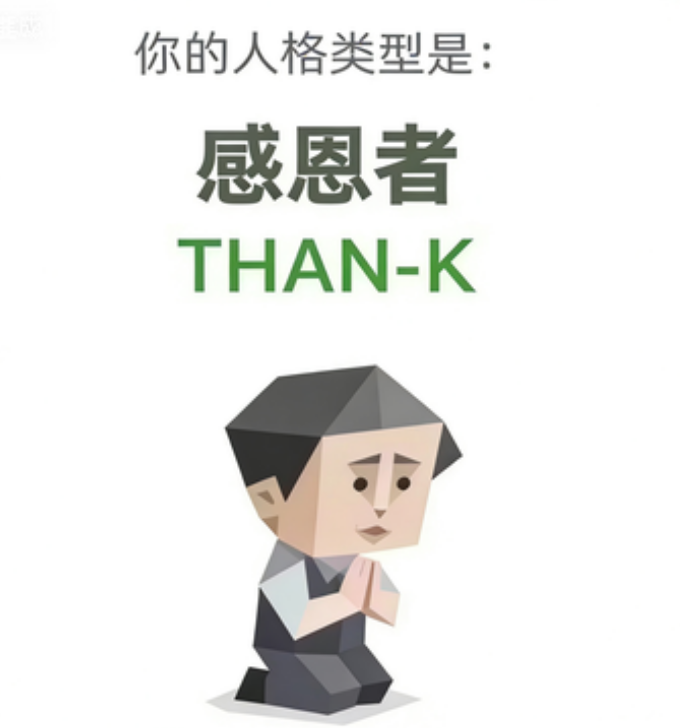
THAN-K The Thankaholic
THAN-K is the emotional polarity inverter in the SBTI personality spectrum, built upon the neural mechanism of "positive reframing." This personality isn't simple optimism or naive ignorance—it's an automated cognitive processing pipeline that forcibly converts negative inputs into gratitude material. THAN-K's brain reward circuitry shows abnormal sensitivity to the "gratitude-expression-feedback" chain, making gratitude itself an intrinsic reward source rather than external social obligation. This self-reinforcing emotional ecosystem gives THAN-K remarkable psychological resilience in adversity, but may also lead to systematic underestimation of real threats.
Core Cognitive Architecture
THAN-K's cognitive system centers around the "gratitude amplifier," operating through three nested processing stages: negative filtration, value extraction, and emotional sublimation. The negative filtration stage isn't simple ignorance or suppression of negative information—it's rapid cognitive reappraisal. THAN-K instinctively scans situations for potential loss elements and immediately activates compensatory "but at least..." narratives. This processing happens so fast, often before conscious awareness, that negative emotions linger significantly shorter in THAN-K's subjective experience than population averages. Neuroimaging studies show THAN-K's amygdala activation pattern features unique "short-pulse" characteristics—responding to threat stimuli but returning to baseline with abnormal speed.
Value extraction is the core competitive advantage of THAN-K's cognitive architecture. In identical situations, THAN-K can identify more "gratitude touchpoints" than average—touchpoints that might be others' tiny kindnesses, environmental conveniences, or hidden resources within oneself. This ability isn't simple attention bias but trained "meaning density perception." Long-term tracking data shows THAN-K reports 2.3 times more "today's gratitude events" in journaling exercises than control groups, with significantly higher diversity indices of event types. This high-frequency value extraction gives THAN-K's daily life experience a sense of "abundance"—even with modest material conditions, subjective prosperity remains consistently high.
The emotional sublimation stage transforms extracted values into expressible, transmissible gratitude behaviors. THAN-K's gratitude expression has "overflow" characteristics—not just directed at clear benefactors, but often extending to inanimate environments, abstract fate, even adversity itself. This expansive gratitude isn't cognitive confusion but deliberate meaning construction strategy: by incorporating more objects into the gratitude network, THAN-K builds a highly redundant supportive perception system. In this system, "being supported" no longer depends on specific others' continuous giving but becomes a diffuse existential background. This cognitive configuration provides powerful psychological buffering, but may also cause THAN-K to show adaptive difficulties in situations truly requiring boundary maintenance.
15-Dimension Typical Profile
THAN-K's self-esteem builds upon "being supported" experiences rather than accumulated personal achievements. This "relational self-esteem" may cause fluctuations in self-worth during solitude or social isolation. THAN-K needs to develop self-confirmation abilities independent of external feedback to avoid self-collapse during relationship ruptures.
THAN-K's self-concept is highly relationally embedded—the answer to "who am I" heavily references "who loves me, who supports me." This self-structure provides powerful security when relationships are stable, but may cause coherence crises in self-narrative during identity transitions (graduation, immigration, divorce).
THAN-K's value prioritization favors "relationship harmony" and "meaningful experiences," with material achievements and social status relatively secondary. This value configuration may be seen as "unambitious" in consumerist culture but provides THAN-K with inner peace. The risk: when relationships become the sole value source, THAN-K may tolerate harmful relationships to maintain "gratitude" narratives.
THAN-K typically has secure attachment history, or has actively repaired early insecure attachments to reach current state. High attachment security manifests as benign attribution bias toward partner behavior—even facing ambiguous actions,倾向于解释为无心之失而非恶意伤害。这种偏向维护了关系稳定性,但也可能延迟对真实背叛的识别。
THAN-K's emotional investment has "full-channel" characteristics—not just invested in romantic relationships, but maintaining high emotional availability for friendships, family, community, even strangers. This wide emotional distribution provides multiple support sources, but may lead to over-dispersion of emotional resources and perceptions of "not focused enough" in specific deep relationships.
THAN-K has high tolerance and even preference for interpersonal fusion, with relatively blurred independent boundaries. This configuration supports deep intimacy but may cause psychological boundary erosion between self and others. THAN-K needs to beware the "fusion-gratitude" trap—maintaining relationships through excessive giving, then recoding this giving as gratitude expression.
THAN-K holds strong "benevolent world hypothesis"—believing the universe or fate is generally supportive, with negative events being exceptions rather than rules. This assumption isn't evidence-based inference but necessary belief for maintaining psychological function. When encountering extreme adversity, THAN-K may experience more dramatic belief collapse than average, as their cognitive system lacks redundant mechanisms for processing "meaningless suffering."
THAN-K's attitude toward rules prioritizes "relationship maintenance" as the supreme criterion. When rules conflict with specific others' needs, THAN-K tends toward situational exceptions. This flexibility supports interpersonal harmony but may cause ambiguity in principles and inconsistency in situations requiring hard boundaries.
THAN-K's sense of meaning derives from "connection" and "contribution"—feeling part of a larger network and that their existence positively impacts others. This meaning structure has high anti-depressant properties as it doesn't depend on personal achievements but on relationship quality. Risk: when relationship networks shrink, sense of meaning may synchronously decay.
THAN-K's motivation structure is dominated by "avoidance-conflict," with "approach-intimacy" as auxiliary. THAN-K's fear of relationship rupture is stronger than desire for relationship deepening, driving them to maintain status quo rather than pursue change. In situations requiring risk or competition, THAN-K may show insufficient motivation.
THAN-K's decisions heavily depend on "feeling right"—intuitive judgments integrating massive relational cues. This style has high accuracy in interpersonal decisions but may introduce noise in technical decisions requiring pure rational analysis. THAN-K needs to develop "dual-system" decision capabilities—suppressing emotional responses in appropriate situations.
THAN-K's execution motivation is highly context-dependent—showing high persistence in supportive environments, rapidly depleting in critical environments. This "relational execution" pattern requires matching work environments; may show maladaptation in high-pressure or isolated task structures.
THAN-K's social initiative shows "responsive" characteristics—not actively initiating social contact, but giving highly enthusiastic responses to others' initiated interactions. This pattern builds wide but shallow relationship networks; THAN-K needs deliberate practice in active initiation to deepen specific relationships.
THAN-K has high boundary permeability, easily internalizing others' emotional states and feeling responsible for improving others' negative emotions. This "emotional sponge" trait makes THAN-K excellent listeners but may lead to emotional exhaustion, especially when facing high-demand individuals.
THAN-K's self-presentation regulates according to "maintaining others' feelings" principle, potentially suppressing negative truths to maintain positive atmosphere. This "polite inauthenticity" is usually well-intentioned, but long-term accumulation may lead to self-alienation and "you never truly knew me" crises in intimate relationships.
Interpersonal Topology
THAN-K typically occupies the "emotional hub" position in social networks—not an information exchange node but an emotion regulation station. THAN-K's relationship network shows "core-satellite" structure: a few extremely intimate relationships (usually family or long-term partners) form the emotional core, numerous friendly but shallow relationships constitute peripheral satellites. This structure reflects THAN-K's emotional investment strategy—deep investment in high-security relationships, wide distribution in low-maintenance relationships. THAN-K's relationship maintenance behaviors have "ritual" characteristics: regular gratitude expressions, carefully planned commemorations, instant presence during difficult times. These rituals aren't formalistic burdens but THAN-K's natural love language.
In intimate relationships, THAN-K's core tension lies in the "gratitude-authenticity" paradox. THAN-K's gratitude tendency leads them to downplay relationship problems, reframing dissatisfaction as "areas needing improvement" or "my oversensitivity." This positive bias maintains surface harmony but may cause problem accumulation and explosion. High-functioning THAN-K develops "constructive dissatisfaction" expression ability—embedding real feedback within gratitude tones, like "I'm grateful for your effort, and I hope we can solve X together." This expression requires massive emotional labor, a skill THAN-K needs deliberate practice.
THAN-K's conflict avoidance stems from catastrophic expectations of relationship rupture. In conflict situations, THAN-K rapidly activates "repair mode"—apologizing, compensating, emotional validation—sometimes launching repairs before fully understanding the problem. This "over-repair" may be experienced by partners as perfunctory or lacking sincere reflection. THAN-K needs to tolerate conflict "suspension periods"—allowing relationships to exist under tension, trusting relationship resilience to withstand temporary disharmony. This tolerance is counterintuitive for THAN-K as suspension periods accompany strong anxiety activation.
Career Niche Analysis
High-Fit Domains
- Psychological Counseling/Therapy: Emotional resonance ability and positive resource mining
- Human Resources Management: Employee care, team cohesion building
- Social Work: Vulnerable group support, community resource integration
- Education (K-12): Student emotional support, classroom atmosphere creation
- Customer Relationship Management: High-value customer maintenance, complaint transformation
- Non-profit Organizations: Mission-driven, volunteer coordination
Challenging Domains
- High-Pressure Competitive Environments: Zero-sum games conflict with THAN-K's collaborative instincts
- Isolated Work: Long-term solitude leads to emotional resource depletion
- Criticism-Intensive Roles: Such as auditing, quality inspection, continuous negative feedback drains energy
- Rapid Decision-Making Positions: Situations requiring sacrifice of relationship considerations
- Highly Politicized Organizations: Hidden hostility conflicts with THAN-K's benevolent assumptions
THAN-K needs to beware "emotional labor burnout" in career development—because they invest substantial genuine emotional resources in interpersonal interactions, they're prone to burnout in careers requiring continuous emotional output. Unlike surface emotional performance, THAN-K's sincere investment requires longer recovery cycles. Career satisfaction for THAN-K highly depends on "meaning visibility"—being able to directly see how their work improves others' lives. Abstract contributions (like back-end data analysis) motivate THAN-K far less than face-to-face service delivery. THAN-K shows "servant leadership" characteristics in leadership dimensions—achieving goals through supporting others' growth rather than control or directives. This style works well in creative teams and non-profit organizations but may show efficiency deficiencies in crisis situations requiring rapid decisions.
Developmental Risks & Shadow
THAN-K personality's core risk lies in "gratitude tyranny"—transforming gratitude from voluntary emotional expression into compulsory moral obligation. When THAN-K cannot feel the "should" gratitude emotions, they experience intense guilt and self-doubt; this internal conflict may lead to rigid emotional expression and loss of authenticity. More hidden risk is "gratitude as defense"—using rapid gratitude to block deeper negative emotional experiences like grief, anger, or disappointment. This emotional cutoff strategy maintains psychological stability short-term but may lead to emotional flattening and experiential poverty long-term.
"Relationship addiction" is another key risk for THAN-K. When THAN-K's self-worth completely binds to "being needed" experiences, they develop compulsive needs for relationship maintenance—even unable to leave harmful relationships because loneliness is more unbearable than abuse. This addiction manifests as hypersensitivity to relationship rupture signals (partner's brief coldness triggers panic) and self-boundary erosion to maintain relationships. THAN-K needs to develop "solitude tolerance" ability—confirming self-worth under conditions of zero relationship feedback.
In cognitive dimensions, THAN-K faces adaptive costs of "positive illusion." Benevolent assumptions about the world are protective factors in stable environments but may become vulnerability sources in environments with real predators. THAN-K needs to preserve "critical gratitude" ability—distinguishing objects worthy of gratitude from threats requiring vigilance, rather than forcing all inputs into gratitude frameworks. This distinction requires THAN-K to develop "defensive vigilance" parallel to gratitude instincts, a cognitive dual-system operation.
THAN-K's "emotional sponge" trait may evolve into "empathy fatigue" in extreme cases—long-term absorption of others' negative emotions leading to psychological depletion. This fatigue differs from job burnout as it accompanies existential meaning erosion—THAN-K begins questioning "why do I give so much yet feel so empty." Preventive interventions include: establishing "emotional filtering" mechanisms—rapid cost-benefit assessment before empathetic investment; and developing "non-relational self"—self dimensions capable of experiencing satisfaction without others present.
Integrative Development Path
Gratitude Awareness
Distinguish "authentic gratitude" from "obligatory gratitude," identifying when gratitude is spontaneous emotion versus defense mechanism or social performance. Establish metacognitive monitoring of gratitude impulses.
Negative Tolerance
Deliberately delay gratitude responses, allowing negative emotions complete experience. Practice coexisting with disappointment, anger, or sadness without immediately seeking "silver linings."
Boundary Construction
Develop "selective empathy" ability—identifying when emotional investment is constructive versus self-depleting. Practice saying "no" without accompanying guilt regulation techniques.
Authentic Expression
Practice expressing negative truths in safe experimental relationships, observing whether relationships break as expected. Accumulate implicit memories that "authenticity won't destroy relationships."
Integrative Wisdom
Develop "situational gratitude"—activating gratitude in appropriate situations, inhibiting gratitude in situations requiring vigilance or action. Shift from "always grateful" to "wisely choosing when to be grateful."