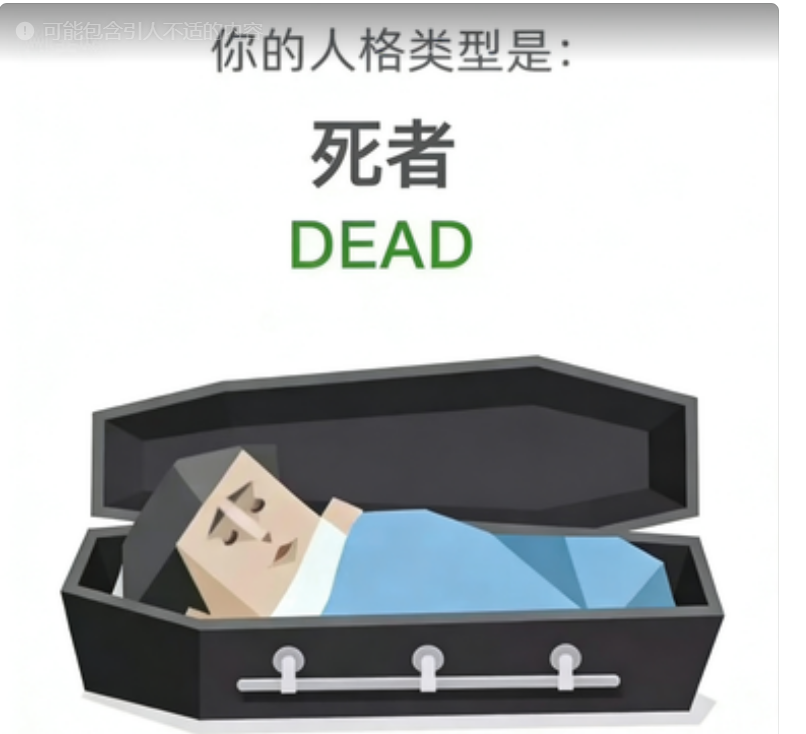
DEAD The Dead Inside
DEAD is a cognitive freeze sample in the SBTI personality spectrum, with psychological characteristics showing typical "low activation-high dissociation" mode. This personality isn't clinical depression or emotional disorder, but a fully rationalized existential strategy—by systematically reducing desire investment, emotional reaction, and goal-directed behavior, DEAD constructs a unique psychological steady state. This steady state's core mechanism lies in minimizing the self-world interaction interface, transforming the subject from "participant" to "observer," thereby avoiding existential risks and consumption brought by participation itself.
Existential Cognitive Architecture
DEAD's cognitive system is built on pre-blocking the "desire-disappointment" cycle. Unlike CTRL who manages uncertainty through control, DEAD eliminates uncertainty itself through non-participation. This strategy's rational basis: if desire is the root of suffering, then desire cessation is suffering elimination. DEAD's brain reward circuits show unique "anticipation-consumption" decoupling characteristics—significantly reduced sensitivity to potential rewards, making reward anticipation itself unable to produce sufficient motivational drive. Neuroeconomics research shows DEAD shows extreme "future devaluation" tendency in delay discounting tasks, but this isn't impulsivity—it's systematic underestimation of future utility.
Emotional isolation is DEAD's标志性防御机制 (signature defense mechanism). This isolation isn't emotional suppression (pushing emotions into unconsciousness), but emotional de-investment—emotional reactions are neutralized by cognitive evaluation before they even emerge. DEAD can identify emotional cues in situations, but these cues cannot trigger corresponding physiological-behavioral reaction sequences. This "emotional agnosia" makes DEAD show abnormal calmness in crisis situations, but also makes it difficult to provide emotional resonance in intimate relationships. DEAD's partners often complain they're "like a precise but cold machine"—can solve all problems, but cannot share any feelings.
Time experience in DEAD personality shows "de-purposified" characteristics. DEAD doesn't view time as resource leading to future, but experiences it as present container needing filling. This time view contrasts with ZZZZ's (The Sleeper) "deadline-driven" approach: ZZZZ is still defined by future (even if through avoidance), while DEAD fundamentally cancels future's weight. DEAD's present experience isn't the full presence advocated by mindfulness, but a "suspended present"—neither forward-projecting nor backward-recalling, just recorded as physical time passage. This time experience brings cognitive resource savings, but also leads to thinness of life narrativity.
Typical 15-Dimension Profile
DEAD's self-evaluation shows "de-valuation" characteristics—not negative evaluation, but cancellation of evaluation. DEAD rarely thinks "am I excellent," because the category "excellent" itself has been de-invested. This low self-esteem stems not from failure experiences, but from questioning the necessity of self-esteem construction.
DEAD's self-boundaries show fluidity and fuzziness. Due to lack of continuous desire and emotional reaction to anchor self, DEAD gives situation-dependent answers to "who am I." This low clarity isn't confusion, but deliberate cognitive saving—clear self requires continuous maintenance costs.
DEAD's value system is highly streamlined, usually only retaining basic survival-level needs. Value judgment is a cognitive burden for DEAD, so DEAD tends to adopt social default scripts or completely avoid value choices. This "value minimalism" makes DEAD show amazing consistency in moral dilemmas—non-participation means no mistakes.
DEAD shows "de-attachment" strategy in attachment dimension. By reducing emotional needs for others, DEAD avoids vulnerability exposure in attachment relationships. This strategy's cost is inability to establish intimate relationships—DEAD can have functional partners, but hardly emotional companions. Separation isn't trauma for DEAD, but expected return.
DEAD's emotional investment shows "all-or-nothing" fracture pattern—either completely uninvested, or brief emotional flooding under extreme pressure. This fracture isn't borderline personality's emotional instability, but system overflow after long-term suppression. DEAD needs to guard against destructive consequences of this overflow.
DEAD's boundaries are diffuse, but this diffusion isn't fusion-type intimacy, but alienation-type disregard. DEAD doesn't care whether others invade boundaries, because there's nothing inside boundaries needing protection. This "empty boundary" state makes DEAD neither control nor be controlled in relationships, just coexist as physical presence.
DEAD's basic assumption about world is "meaninglessness." This isn't pessimism, but metacognition of meaning construction behavior—realizing all meaning is human projection, thus choosing not to participate in projection games. DEAD's worldview has some kind of sober pain, similar to Camus's Sisyphus, but lacking his rebellious passion.
DEAD's attitude toward rules is "inertia obedience"—following rules not because of identification, but because violation costs higher than compliance. DEAD won't actively challenge rules, nor creatively use rules, just incorporating them as part of environmental resistance into behavior calculation.
Meaning deficiency is DEAD's core characteristic. DEAD doesn't seek meaning, because seeking behavior itself has been judged futile. This "meaning nihilism" isn't depression symptom, but existential stance—after recognizing universe's silence, choosing to respond to silence with silence.
DEAD's motivation system is in "standby mode." Reduced reward sensitivity combined with blunted punishment sensitivity makes DEAD's behavior mainly driven by external pressure rather than internal drive. DEAD's actions are "pushed" rather than "pulled," this passivity constitutes the basic tone of their existence.
DEAD's decision characteristic is "delay-avoidance." Facing choices, DEAD's first reaction is "whatever" or "doesn't matter," this reaction isn't easygoing, but refusal to pay decision costs. When forced to decide, DEAD tends to choose minimum resistance path, not optimal solution.
DEAD's execution shows "pulse" characteristics—long-term stagnation punctuated by external pressure-triggered brief bursts. This burst isn't CTRL-style sustained flow, but stress response, accompanied by significant physical-mental depletion. DEAD needs to guard against chronication of this pattern.
DEAD's social behavior is highly reactive, never actively initiating. Social interaction is energy consumption rather than energy gain for DEAD, so DEAD precisely calculates social input-output ratio, only participating when functionally necessary. DEAD's social network is usually sparse and outdated.
DEAD's boundary deficiency shows "passive penetration"—not actively opening, nor actively defending, just letting others enter or leave. This passivity stems from undervaluation of relationship value—since relationships aren't important, boundaries lose their protection objects.
DEAD's self-expression is highly suppressed, not because of disguise, but because "nothing to express." DEAD's inner experience is thin and undifferentiated, lacking raw materials to transform into symbolic language. This "inability to express" makes DEAD experience profound alienation in situations requiring self-presentation.
Relationship Topology & Emotional Ecology
DEAD occupies "edge node" position in social networks—low connectivity, low betweenness, low irreplaceability. This position isn't exclusion result, but active choice or passive default product. DEAD's relationship maintenance follows "minimum energy consumption principle": only investing minimum resources needed to maintain basic social functions. This strategy makes DEAD's social network highly stable (lack of change also means lack of conflict), but also extremely fragile—any key node failure may lead to systematic network collapse.
In intimate relationship domains, DEAD's core dilemma is "intimacy inability." Intimate relationships require emotional investment, vulnerability exposure, and future joint projection—these are precisely what DEAD's defense system aims to avoid. DEAD's partners often experience "dating a shadow" feeling—physical presence but psychological absence, functionally complete but emotionally hollow. High-functioning DEAD may maintain relationships through "role-playing"—playing good partner, good parent, good friend roles, but behind roles there's no corresponding emotional core. This "shell intimacy" can be maintained short-term, but long-term leads to partner's emotional depletion and relationship dissolution.
DEAD's conflict handling style is "disappearance." Facing tension, DEAD won't fight, negotiate, or compromise—just simply exit the situation. This "conflict avoidance" isn't strategic calm, but refusal to pay conflict's energy costs. DEAD's exit may be physical (leaving room), psychological (emotional withdrawal), or existential (suicidal ideation). Need to distinguish: DEAD's suicidal ideation is usually not impulsive, but fully rationally calculated "final exit option"—when existence's costs continuously exceed benefits, terminating existence becomes an option.
Career Niche Analysis
Relatively Suitable Fields
- Night Watch: Low interpersonal interaction, low decision pressure, regular rhythm
- Data Labeling: Repetitive, low cognitive load, clear instructions
- Archive Management: Dealing with things not people, low time pressure
- Remote Technical Support: Text interaction, problem-solution closed loop, low emotional labor
- Freelance (Low-Demand Type): Autonomous control of workload, right to refuse retained
High-Risk Fields
- High-Pressure Sales: Sustained motivation maintenance, rejection tolerance, goal-oriented
- Team Leadership: Emotional motivation, conflict mediation, vision construction
- Creative Industry: Intrinsic drive, emotional investment, evaluation sensitivity
- Nursing/Education: High emotional labor, empathy demand, meaning construction
- Entrepreneurship: Uncertainty tolerance, future discounting, failure recovery
DEAD faces core contradiction in career development: "survival needs vs. participation costs" trade-off. DEAD needs income to maintain physical survival, but any career participation carries psychological costs. High-functioning DEAD may find "low input-low output" balance point—doing work just enough to pay bills but not requiring emotional investment. However, this balance is increasingly difficult to maintain in modern career environments, because "emotional labor" has become implicit requirement in most service professions.
DEAD needs to guard against "ability atrophy" spiral. Long-term low activation state may lead to cognitive and social skill degradation, further limiting career choice space, reinforcing low activation strategy. Breaking this spiral requires rare resonance of external support (economic buffer, social support) and internal motivation. For DEAD, career development's primary goal isn't achievement or growth, but "sustainability"—finding a survival mode that can be maintained indefinitely without causing system collapse.
Existential Risks & Clinical Boundaries
Complex boundary relationship exists between DEAD personality and clinical depression. DEAD's "low activation" strategy overlaps with depression symptoms at functional level, but its kernel is existential rather than pathological—DEAD doesn't consider themselves "sick," but thinks the world "is just like this." However, long-term DEAD state maintenance significantly increases depression episode risk, because low activation strategy may lead to negative neuroplasticity changes (dopamine receptor downregulation, prefrontal function inhibition). DEAD needs regular self-assessment, identifying transition signals from "existential choice" to "pathological state."
"Emotional freeze" irreversibilization is DEAD's core risk. Emotional system follows "use it or lose it" principle, long-term suppression may cause structural damage to emotional reaction ability. DEAD may find themselves unable to emotionally invest even when they want to, similar to muscle atrophy in long-term bedridden patients. This "emotional disuse" makes DEAD unable to respond even when encountering theoretically "worthwhile" situations, forming a kind of existential regret.
Systematic loss of social support is another key risk. DEAD's alienation strategy will驱逐 (drive away) most social connections in long-term operation, leaving DEAD isolated and helpless when truly needing support (like illness, crisis). DEAD needs to maintain at least one "emergency exit"—a social connection that can be activated in extreme situations, even if normally dormant.
DEAD's "meaning nihilism" stance has some sobriety at philosophical level, but at practical level may lead to "self-fulfilling meaninglessness prophecy"—believing in meaninglessness so not acting, not acting so indeed meaningless. Breaking this cycle requires some "leap of faith"—trying to invest without guarantee, bearing risk of possible disappointment. This is the most difficult but also most transformative challenge for DEAD.
Existential Transformation Path
Freeze Awareness
Identify "non-participation" strategy's operation timing and costs. Establish metacognition of "desire rises-immediately suppressed" automated sequence, observing own defense mechanisms without judgment.
Tiny Investment Experiment
Select low-stakes domains (like taste preferences, leisure activities) for conscious investment, observing investment experience itself rather than results. Goal is rebuilding "investment-reward" neural connection.
Emotional Reactivation
Bypass cognitive inhibition through body practice (exercise, art, nature contact), directly activating emotional reaction system. Body is emotion's more ancient carrier, may be easier to break through freeze than language.
Relational Risk
Select a relatively safe relationship object, try limited emotional exposure and need expression. Accept possible rejection or disappointment as cost of participation, not reason to terminate participation.
Meaning Reconstruction
Don't seek universe-level ultimate meaning, but construct local, temporary, personal meaning projects. Accept meaning's instability and revocability, viewing them as features rather than defects.