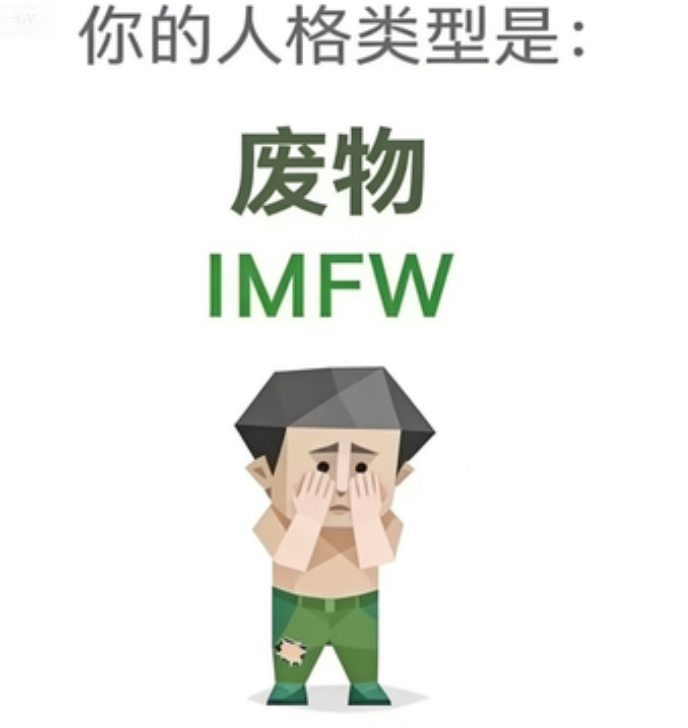
IMFW The Useless One
IMFW represents the dependent pole in the SBTI personality spectrum, with a psychological structure characterized by typical "external anchoring" traits. Their self-perception is highly reliant on feedback from external validation systems, while the internal self-evaluation mechanism is underdeveloped or suppressed. IMFWs are not lacking in ability, but their ability expression is blocked by "anticipatory failure anxiety" — the psychological simulation of failure is completed before action even begins. This "cognitive paralysis" creates a significant gap between IMFWs' potential abilities and actual performance, which further reinforces their self-label as a "The Useless One," forming a closed-loop self-fulfilling prophecy.
Core Psychological Dynamics
IMFW personalities exhibit a significant "defense-consumption" pattern in psychological energy allocation. A large amount of cognitive resources are invested in monitoring potential threats and generating avoidance strategies, rather than pursuing goals and developing abilities. This energy allocation stems from the implicit belief of "environmental uncontrollability" formed through early experiences — the world is perceived as a chaotic system filled with random punishment, rather than a predictable and influenceable ordered field. The "The Useless One" self-label of IMFW serves dual functions: first, as a cognitive defense mechanism, reducing the threat of external evaluation through preemptive self-deprecation ("I already know I'm no good, so your criticism won't hurt me"); second, as a relational strategy, triggering protective responses from others through showing weakness to establish dependent emotional bonds.
IMFW's dependency needs are not simply "laziness" or "avoidance of responsibility," but a coping mechanism for deep existential anxiety. When an IMFW attaches to a "stronger person" (protector, caregiver, decision-maker), they experience a compensatory sense of existential security — by surrendering self-decision-making power to others, IMFW temporarily escapes the anxiety of choice and the responsibility for choice consequences. This "proxy survival" model effectively reduces psychological tension in the short term but leads to the continuous atrophy of self-efficacy in the long run. IMFWs need to recognize that dependent behavior is adaptive in the short term, but long-term solidification forms neural pathways of "learned helplessness," further entrenching their "The Useless One" identity.
IMFWs' creativity and sensitivity are often overshadowed by their self-label. Clinical observations show that IMFW personalities often possess untapped talents in areas such as artistic creation, emotional resonance, and detail perception. This contrast between potential and appearance stems from IMFW's highly "receptive" cognitive style — high openness to external information, but blocked channels for information integration and action transformation. The key to IMFW's development lies in transforming "passive reception" into "active expression," and "dependent sensitivity" into "relational empathy." This is not a linear shift from "The Useless One to Strong Person," but a dimensional leap from "self-negation to self-acceptance."
15-Dimension Typical Profile
IMFW's self-esteem shows situational fluctuations — it may temporarily rise in familiar, protective environments but collapses rapidly in evaluative situations. Their self-evaluation lacks a stable internal benchmark and mainly relies on real-time weighting of external feedback. The effects of positive evaluation are short-lived, while negative evaluation has lasting effects, forming a cognitive bias of "negativity preference."
IMFW's self-concept exhibits "diffuse" characteristics — blurred boundaries, contradictory content, and loose structure. Their self-description often includes numerous negative labels ("I'm no good," "I don't know"), while positive self-statements are scarce. This self-blurriness is both a defense (a clear self is more vulnerable to attack) and a developmental block (lack of an integrated self-narrative).
IMFW's value system is anchored in external approval, lacking endogenous value standards. Their behavioral motivation is primarily "avoiding negation" rather than "pursuing affirmation," "avoiding failure" rather than "pursuing success." This defensive value orientation leads IMFWs to choose low-challenge tasks when setting goals, to maintain the psychological balance of "if I don't try, I won't fail."
IMFWs exhibit "anxious-ambivalent" traits in the attachment dimension. On one hand, they strongly desire intimacy and protection; on the other hand, the fear of abandonment is constantly activated. This fear is not based on realistic assessment but on the implicit working model formed by early attachment experiences. IMFWs may show an alternating "clingy-withdrawing" pattern in relationships, craving fusion yet fearing the loss of self after fusion.
IMFW's emotional investment is inhibited by "anticipatory harm." They may show high emotional availability in the early stages of a relationship, but fear of potential harm leads to emotional withdrawal as the relationship deepens. IMFWs may develop "pseudo-independence" as a defense — suddenly distancing themselves when feeling dependent, to preempt the pain of abandonment.
IMFWs have weak sense of boundaries, struggling to distinguish between their own and others' responsibilities, emotions, and needs. This boundary blurriness is both a sign of dependency ("your business is my business") and a risk of self-erasure ("I have no independent value of existence"). IMFWs need to learn "connected independence" — maintaining relational bonds while preserving self-integrity.
IMFWs tend to perceive the world as an unpredictable, potentially hostile environment. This "malignant environmental assumption" reduces selective attention to neutral or positive information, while maintaining high sensitivity to threatening cues. The world is encoded in IMFW's cognition as "something to adapt to" rather than "something to influence," leading to insufficient motivation for proactive behavior.
IMFWs' attitude toward rules is "compliant" rather than "instrumental." Rules are seen as non-negotiable directives from external authority, rather than resources that can be strategically utilized. This attitude stems from fear of punishment and idealization of authority. IMFWs show significant anxiety in situations with ambiguous rules or requiring active interpretation, as they lack internal standards to guide decision-making.
IMFW's lack of meaning manifests as "existential emptiness" — not the absence of specific goals, but doubt about the value of any goal. IMFWs may borrow meaning by attaching to others' goals ("I'll do whatever you do"), but this borrowing is fragile, leading to a crisis of meaning once the relationship breaks down. Developing endogenous meaning is IMFW's core growth task.
IMFW's motivational structure is dominated by "avoidance-failure," with "approach-achievement" as secondary. This configuration makes IMFWs extremely sensitive to negative feedback and desensitized to positive feedback. IMFWs' behavioral choices are mainly based on the "minimum risk" principle rather than "maximum gain," leading to continuous contraction of their activity range and experiential world.
IMFW's decision-making process exhibits "dependent-procrastinating" characteristics. When faced with choices, IMFWs tend to surrender decision-making power to others ("you decide") or avoid decision-induced anxiety through indefinite procrastination. This style reinforces IMFW's self-perception of "incompetence," forming a closed loop of "I don't make decisions → I lack decision-making ability → I can't make decisions."
IMFW's executive function is significantly affected by "initiation difficulty." The initial phase of tasks (starting) encounters greater resistance than the later phase (completion). This initiation difficulty stems from fear of "imperfect beginnings" — IMFWs tend to wait for a "ready" state that rarely arrives due to their overly high implicit standards.
IMFW's social behavior is primarily "reactive," rarely taking the initiative to initiate interactions. This passivity stems from anticipatory fear of rejection — initiating means exposing oneself to the risk of being evaluated and rejected. IMFWs may use the strategy of "waiting to be discovered" to balance connection needs and fear, but the success rate of this strategy depends on the environment's active scanning ability.
IMFWs exhibit a "fusion preference" in regulating interpersonal distance — craving highly intimate, low-boundary relationships with others. This preference stems from fear of loneliness and defense against existential isolation. However, fear of self-loss after boundary dissolution leads to contradictory behaviors in intimacy, forming a "approach-escape" cycle.
IMFW's self-expression is severely inhibited by "fear of evaluation." In most social situations, IMFWs present a "monitoring self" — continuously scanning others' reactions and adjusting self-presentation, rather than spontaneous expression based on internal true states. This monitoring consumes a large amount of cognitive resources, leading to post-social exhaustion and a sense of "inauthenticity."
Relational Attachment Topology
IMFWs typically occupy a "satellite" position in social networks — orbiting around one or more "planets" (protectors, caregivers, authorities). This position is not obtained through resource exchange or information advantage, but through continuous investment in emotional dependence and compliant behavior. IMFW's relational network exhibits a "single-center high-dependency" structure: high entanglement with one core person, and shallow connections with others. The risk of this structure is overloading the relationship — the core person bears excessive emotional needs of the IMFW, which may lead to relationship exhaustion or collapse.
In the field of intimate relationships, the core tension IMFWs face lies in the "fusion-separation paradox." IMFWs crave "symbiotic" intimacy with partners — shared thoughts, emotional synchronization, and unified decision-making. This desire stems from deep fear of loneliness, but its realization means complete dissolution of self-boundaries. When fusion is achieved, IMFWs experience temporary peace; but fear of self-loss after fusion is immediately activated, leading to sudden need for distance. This alternating "clingy-repulsive" pattern confuses and hurts partners, potentially triggering partner withdrawal, thus validating IMFW's "fear of abandonment." IMFWs need to develop the ability of "intimacy with separation" — tolerating differences and independence while maintaining connection.
IMFW's conflict resolution style is primarily "avoidant-compliant." When facing disagreements, IMFWs tend to immediately abandon their positions to restore harmony ("you're right," "we'll do it your way") or internalize conflicts into self-attack ("it's all my fault"). This style effectively reduces relational tension in the short term but leads to accumulated resentment and a sense of self-erasure for IMFWs in the long run. IMFWs need to learn "compliance with reservation" — acknowledging others' positions while maintaining the right to their own views, even if those views are not adopted temporarily.
Career Niche Analysis
Relatively Suitable Fields
- Support Roles: Administrative assistant, customer support, data entry, and other structured tasks
- Creative Execution: Artistic implementation, content creation under clear direction
- Caregiving Professions: Early childhood education, elderly care, pet care (low evaluation pressure)
- Behind-the-Scenes Work: Library management, archives organization, quality control
- Team Collaboration: Clear role division, highly supportive team environments
High-Challenge Fields
- Independent Entrepreneurship: High uncertainty, lack of external structural support
- High-Pressure Sales: Continuous rejection, performance-oriented evaluation
- Senior Management: Decision-making responsibility, conflict resolution, public exposure
- Competitive Industries: Zero-sum games, explicit comparison of abilities
- Remote Independent Work: Initiation difficulties due to lack of external supervision
IMFWs need to guard against the reinforcement of "dependency inertia" in career development. IMFWs tend to choose work environments that provide clear guidance, continuous feedback, and emotional support — this choice is adaptive in the early stages, but long-term stagnation in this niche leads to stunted ability development. The optimal career strategy for IMFWs is "scaffolded growth" — gradually taking on challenging tasks in a supportive environment, and correcting the "incompetent" self-perception through accumulation of "success experiences." The key is to continuously operate in the range of "slightly beyond comfort zone" but "not unbearable," avoiding the two extremes of "safety zone stagnation" and "panic zone collapse."
In terms of leadership, IMFWs typically do not pursue traditional authoritative positions but can develop a "supportive leadership" style under specific conditions. IMFWs' high sensitivity and empathy enable them to perceive team members' emotional needs and create an inclusive team atmosphere. However, IMFWs need to guard against the "over-accommodation" tendency — avoiding necessary conflicts and difficult decisions to maintain harmony. IMFW leaders need to establish "caring with boundaries" — supporting others while maintaining decision-making authority and performance standards.
Developmental Risks & Shadow Traits
The core risk for IMFW personalities is the materialization of the "The Useless One identity" — solidifying from a self-label into an identity, and ultimately becoming a self-fulfilling prophecy. When IMFWs continuously avoid challenges, rely on others, and abandon decision-making, their objective abilities do atrophy relatively, thus "proving" their initial self-label. This closed loop of "label-behavior-validation" is the biggest obstacle to IMFW's development. Breaking this loop requires questioning the absoluteness of the "The Useless One" label at the cognitive level, and accumulating "exception experiences" at the behavioral level — situational memories that prove "I am not always incompetent."
"Dependent depression" is another key risk for IMFWs. When core attachment figures are lost (breakup, resignation, death) or refuse to continue providing support, IMFWs may experience severe existential collapse. This collapse stems not only from grief over relationship loss but also from the interruption of attachment functions — IMFW's self-regulation mechanisms are excessively outsourced, leading to functional paralysis when alone. Preventive interventions include: establishing "multiple attachments" — diversifying dependence across multiple relationships and activities to avoid overloading a single attachment point; and developing "self-soothing abilities" — internal regulation skills when external support is lacking.
In relational dimensions, IMFWs face the risk of "exploitation." IMFW's dependency needs and compliant behavior may attract "exploitative personalities" (such as the dark side of certain CTRL or BOSS types), forming pathological symbiotic relationships. In such relationships, IMFW's continuous self-deprecation provides a sense of superiority and control for exploiters, while the exploiter's "care" satisfies IMFW's dependency needs. Signs of identifying such relationships include: IMFW feeling worse rather than better, further decline in self-evaluation, and continuous contraction of social circles. IMFWs need to establish "relationship audit" capabilities — regularly evaluating the impact of relationships on self-development, rather than just evaluating the continuity of relationships.
IMFW's "pseudo-independence" is a trap in development. When IMFWs realize the problematic nature of dependency, they may overcorrect by adopting an extreme independent stance of "refusing all help." This pseudo-independence is not true autonomy but a defensive response to fear of dependency. True independence includes "selective dependency" — identifying when others' support is needed, and having the ability to seek and accept that support, rather than equating asking for help with weakness. IMFW's developmental goal is "integrated dependency" — flexibly switching between independence and connection, rather than fixating on either extreme.
Integrated Developmental Path
Label Deconstruction
Identify the specific content and supporting evidence of the "The Useless One" narrative, and conduct cognitive restructuring. Distinguish the logical leap between "I perform poorly sometimes" and "I am a The Useless One," and collect counter-evidence (past successes, positive feedback from others, abilities in specific areas).
Micro-Action Experiments
Design "fail-proof" micro-challenges (e.g., making independent decisions for 5 minutes a day, asking strangers for the time) to accumulate experiential data of "I can do it." Focus on the action itself rather than the outcome, breaking the cognitive habit of "anticipatory failure."
Support Network Diversification
Shift from single attachment to multiple connections, meeting different needs (emotional support, information acquisition, entertainment companionship) in different relationships. Reduce dependency load on any single relationship and develop tolerance for "partial satisfaction."
Autonomy Reconstruction
Practice independent decision-making and taking consequences in low-risk areas, gradually expanding the scope of decision-making. Learn to recode "mistakes" as "information" rather than "self-definition," developing a "trial-error-adjustment" rather than "trial-error-collapse" response pattern.
Integrated Existence
Develop "independent with dependency" — maintaining autonomy while retaining the ability to seek and accept help. Establish relationships based on reciprocity rather than unidirectionality, finding dynamic balance between giving and receiving, and shifting from the "The Useless One" narrative to the "developing person" narrative.