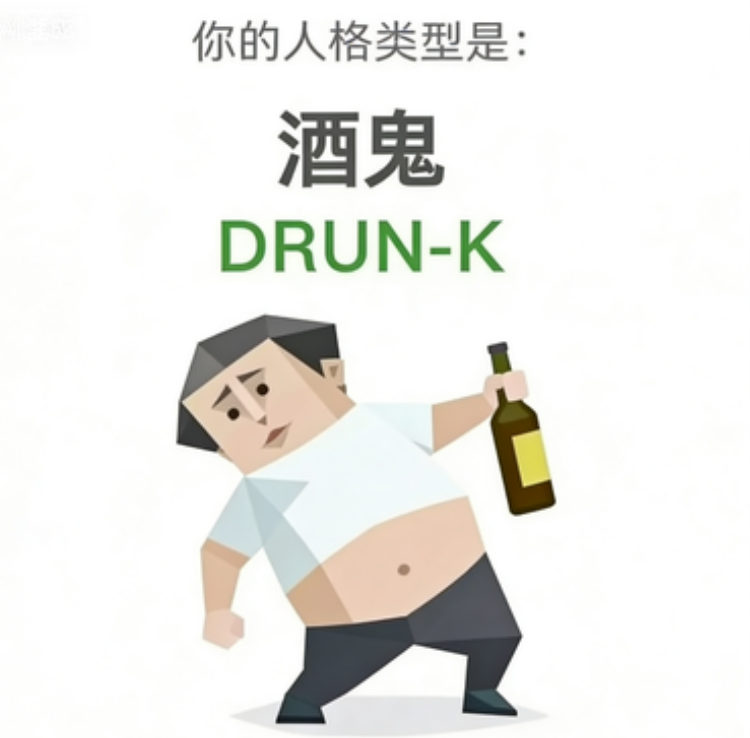
DRUNK The Drunkard
DRUNK is a hidden variable in the SBTI personality spectrum, unlocked through specific neurochemical preference pathways. This personality isn't simply a "drinker" label, but a cognitive-emotional regulation system mediated by ethanol molecules. DRUNK's nervous system shows abnormal sensitivity to gamma-aminobutyric acid (GABA) receptor modulators, making alcohol intake produce anxiety inhibition and self-boundary dissolution effects far exceeding population means. This neurochemical specificity distinguishes DRUNK from social drinkers or situational drinkers—for DRUNK, drinking isn't social lubricant or celebration tool, but an existential necessity, a self-regulation means for maintaining psychological steady state.
Neurochemical Basis & Addiction Mechanisms
DRUNK's neurobiological foundation involves multiple mutually reinforcing system abnormalities. Functional hypoactivation of prefrontal cortex-limbic system pathways is one core feature—DRUNK experiences continuous cognitive overload and emotional tension in sober states, with prefrontal inhibition functions in overdrive, leading to subjective experiences of "can't stop thinking" or "too much noise in the brain." Ethanol molecules enhance GABA_A receptor activity, temporarily reducing neuronal excitability, providing DRUNK with rare cognitive silence periods. This silence isn't simple "relaxation" but existential respite—under alcohol's influence, DRUNK experiences temporary shutdown of self-monitoring systems, liberation from continuous self-scrutiny.
The sensitization and desensitization paradox of dopamine reward systems constitutes the driving force of DRUNK's addiction cycle. Acute alcohol intake triggers midbrain limbic dopamine pathway enhancement, producing immediate pleasure and craving satisfaction. However, long-term exposure leads to dopamine receptor downregulation and baseline activity reduction, making DRUNK experience anhedonia and motivation failure in sober states. This neuroadaptive change transforms drinking behavior from "pursuing pleasure" to "avoiding pain"—DRUNK drinks not to get high, but to return to normal psychological baseline. This negative reinforcement mechanism explains why DRUNK cannot stop despite knowing consequences: stopping means entering neurochemical withdrawal, not simply "willpower test."
Dysregulation of endogenous opioid systems and stress response axis (HPA axis) is another key dimension of DRUNK personality. DRUNK typically shows elevated cortisol baseline and hypersensitive stress responses, this neuroendocrine feature possibly stemming from early life adversity or genetic susceptibility. Alcohol stimulates endogenous opioid release, providing primitive soothing effects—similar to mother-infant attachment soothing mechanisms. For DRUNK, drinking behavior may be an attempt at self-mothering, chemical compensation for early attachment deficits. This mechanism explains why DRUNK's drinking impulses are strongest in loneliness, rejection, or failure situations: alcohol becomes transitional object, substituting for incompletely internalized secure attachment.
Fifteen-Dimension Profile
DRUNK's self-esteem shows typical situation-dependent fluctuation. Sober states often accompany self-deprecation and shame; alcohol intake rapidly shifts to inflated confidence. This instability stems from excessive dependence on external regulation (alcohol) for self-evaluation, rather than internalized self-efficacy. DRUNK needs to develop self-confirmation ability independent of chemical assistance.
DRUNK's self-boundaries have permeability and fluidity. The "true self" experienced under alcohol differs significantly from sober self-sense, leading to identity fragmentation. DRUNK often reports "not knowing which is the real me," this dissociative experience is the core characteristic of self-clarity dimension.
DRUNK's value system is often colonized by drinking behavior, long-term goals yielding to immediate gratification. Existential values (meaning, connection, growth) are suppressed by instrumental values (obtaining alcohol, avoiding withdrawal). This inversion of value hierarchy is the core marker of DRUNK personality functional impairment.
DRUNK's attachment system shows typical anxious-avoidant mixed pattern. Desire for intimate relationships coexists with fear of being engulfed, alcohol becomes the means to regulate this tension—both lowering social inhibition to seek connection, and maintaining psychological distance through chemical barrier.
DRUNK's emotional experience intensity is extremely high, but regulation capacity is severely insufficient. This configuration leads to frequent emotional overwhelm, drinking becomes emergency emotion regulation means. DRUNK needs to develop ability to tolerate high-intensity emotions without immediate action (drinking).
DRUNK's psychological boundaries have fusion tendencies, often experiencing fear of self-loss in intimate relationships. Meanwhile, alcohol dependence constitutes another form of boundary dissolution—abandoning self-control through chemical means, obtaining temporary relief.
DRUNK's worldview often presents pessimistic or nihilistic coloring. This cognitive style may be adaptive response to early disappointment experiences, or cognitive bias from long-term alcohol use. Alcohol provides temporary optimism (liquid courage) contrasting sharply with sober pessimism.
DRUNK's impulse control function is impaired, showing immediate rule violation tendency. This violation isn't anti-authority stance but externalization of delayed gratification deficit. DRUNK needs external structures (like sobriety programs, monitoring systems) to compensate for insufficient internal control.
DRUNK's sense of meaning is severely impaired, often reporting existential emptiness and goal absence. Drinking behavior itself may provide alternative meaning structure (obtaining, preparing, drinking rituals), but this meaning is circular rather than developmental.
DRUNK's motivation system is dominated by negative reinforcement (avoiding discomfort), positive reinforcement (pursuing goals) function atrophies. This configuration leads to conservative and avoidant behavior patterns, innovation exploration and long-term planning abilities significantly impaired.
DRUNK's decision process is severely influenced by immediate emotions and availability heuristic, showing typical "present bias"—excessively discounting future consequences, overestimating immediate gratification. Alcohol use further impairs prefrontal function, forming decision-drinking-worse decision vicious cycle.
DRUNK's executive function presents typical "dual-mode" characteristics: impulsive action under alcohol influence and motivational paralysis in sober states. This fracture leads to discontinuity in goal pursuit, long-term projects difficult to maintain.
DRUNK's social initiative shows conditional characteristics: significantly elevated under alcohol anticipation or intake, reduced in sober states. This "chemical-dependent socializing" leads to superficial and situation-limited relationship quality.
DRUNK's boundary management is severely impaired under alcohol influence, showing excessive self-exposure, emotional fusion, or conflict escalation. Sober states may show excessive defense, forming all-or-nothing boundary patterns.
DRUNK often experiences self-expression under alcohol as "more authentic," but this authenticity is product of chemically modified neural states. The tension between sober inhibition and alcohol-induced disinhibition constitutes the core of DRUNK's authenticity paradox.
Alcohol's Social Functions & Relationship Dynamics
DRUNK's drinking behavior in social contexts serves complex functions far beyond simple "pleasure" or "addiction" explanations. In social anxiety regulation dimension, alcohol provides DRUNK with chemical social skills assistance—reducing sensitivity to others' evaluations, decreasing cognitive load of self-monitoring, transforming social interaction from "performance task" to "natural flow." This effect is often experienced in DRUNK's early drinking history as "discovering true self" or "finally able to relax," forming powerful positive reinforcement. However, long-term dependence on this chemical assistance leads to atrophy of natural social skills, DRUNK experiences significant decline in social ability in non-drinking states, further consolidating the conditional link between drinking and social success.
In group belonging and identity dimension, alcohol consumption often constitutes DRUNK's social currency and group admission credential. In specific subcultural groups (certain professional cultures, regional cultures, age cohorts), drinking ability is symbol of masculinity, toughness, or "knowing how to live." DRUNK may confirm group membership through drinking behavior, obtaining social capital and belonging. This function makes sobriety attempts face additional social pressure—not just overcoming chemical dependence, but renegotiating social identity and relationship networks. DRUNK needs to develop ability to establish group belonging without relying on alcohol symbols, or find supportive sober communities.
Alcohol use in intimate relationships presents more complex dynamics. For DRUNK, alcohol may simultaneously serve seemingly contradictory functions of intimacy seeking and intimacy defense. In seeking dimension, alcohol lowers inhibition of emotional expression, enabling DRUNK to speak emotional language difficult to articulate sober, conducting vulnerability display. In defense dimension, alcohol provides "not my fault"免责机制—post-drinking misconduct can be attributed to chemical substance rather than true self, providing cognitive buffer for conflict and harm in relationships. This dual function places DRUNK in paradox in intimate relationships: desiring true connection through alcohol, yet maintaining psychological distance and responsibility dispersion through alcohol.
Existential Dilemmas & Self-Paradoxes
DRUNK's core existential dilemma lies in the unlocatability of "true self." DRUNK often reports two completely different self-experiences: sober state's anxiety, inhibition, excessive self-monitoring; and alcohol state's relaxation, openness, emotional fluency. Both states are experienced as "me," yet so mutually exclusive, leading to profound identity confusion. DRUNK may idealize alcohol state as "true me," deprecating sober state as "socially conditioned fake me"; or conversely, view sober state as "rational true me," deprecating alcohol state as "out-of-control anomaly." Either attribution fails to integrate both states as different manifestations of same self, leading to self-concept splitting and fragmentation.
Distortion of time experience is another dimension of DRUNK's existential dilemma. Alcohol-induced time perception alteration (present expansion, future compression) and memory formation障碍 (blackouts) make DRUNK's life narrative discontinuous. DRUNK may experience "time black holes"—periods impossible to recall, or fragments reconstructible only through others' narratives. This narrative fracture damages self-identity maintenance, DRUNK may experience existential anxiety of "I'm not a complete person" or "my life has gaps." More seriously, this time experience fragmentation may generalize to sober states, leading to general derealization and depersonalization.
The paradox of free will vs. determinism presents sharp conflict in DRUNK personality. On one hand, DRUNK experiences compulsiveness of drinking behavior—"I know I shouldn't drink, but I can't stop," this experience supports determinism stance, viewing self as passive carrier of neurochemical processes. On the other hand, DRUNK must bear moral and legal consequences of drinking behavior, social and legal systems presuppose free will and responsibility capacity. This tension leads to profound shame and self-loathing—DRUNK feels both powerless to control and responsible for loss of control. Resolving this paradox requires transcending simple free will/determinism binary, developing "compatibilist" self-understanding: acknowledging reality of neurochemical constraints while taking responsibility for optimizing choices under constraints.
The entanglement of death consciousness and self-destruction is the darkest existential dimension of DRUNK personality. The relationship between alcohol use and death in DRUNK experience is paradoxical: on one hand, alcohol is defense against death anxiety—through numbing consciousness, compressing future视野, temporarily escaping existential pressure of mortality; on the other hand, long-term alcohol use is itself slow suicide, systematic destruction of body. DRUNK may unconsciously experience this self-destruction as mastery over death—"I choose how to die," rather than passively awaiting death. This "anticipatory grief" or "self-martyrdom" dynamic needs recognition and processing, developing more mature death coping strategies to replace chemical defense.
Withdrawal Dynamics & Integrative Recovery
DRUNK's recovery path needs to transcend simple "sobriety" goal, turning toward deeper neuro-psycho-social integration. In neurochemical dimension, recovery involves recalibration of dopamine system—tolerating baseline anhedonia period until receptor upregulation and natural reward sensitivity recovery. Cognitive reconstruction in this phase is crucial: recoding present discomfort as "nervous system healing" rather than "life deprivation," anticipating future natural pleasure as motivation to persist. Medication assistance (like naltrexone, acamprosate) can block alcohol's reward effects or reduce craving, creating window for psychological intervention.
The core of psychological dimension recovery is developing ability to "tolerate pain without action"—rebuilding emotion regulation skills. DRUNK needs to learn identifying emotional triggers, distinguishing "need action" from "just need to endure" emotional states, developing cognitive strategies for delay of gratification and impulse control. Mindfulness training has special value at this stage, through cultivating observational acceptance of present experience, DRUNK can learn to coexist with uncomfortable feelings without immediately seeking chemical relief. This "decentralized" self-observation ability is key to breaking stimulus-response automatic chains.
Social dimension recovery involves reconstructing relationship ecosystem. DRUNK needs to identify and distance from supportive drinking environments, establish new sober social networks. This process's challenge lies in requiring DRUNK to abandon original social identity and group belonging, facing threat of existential loneliness. Twelve-step groups or other sober communities provide transitional belonging sources, while supporting new identity narrative development—from "recovering alcohol dependent" to "sober lifestyle practitioner." Long-term recovery success depends on whether complete life structure independent of alcohol can be established: meaningful work, intimate relationships, creative expression, transcendental value pursuit.