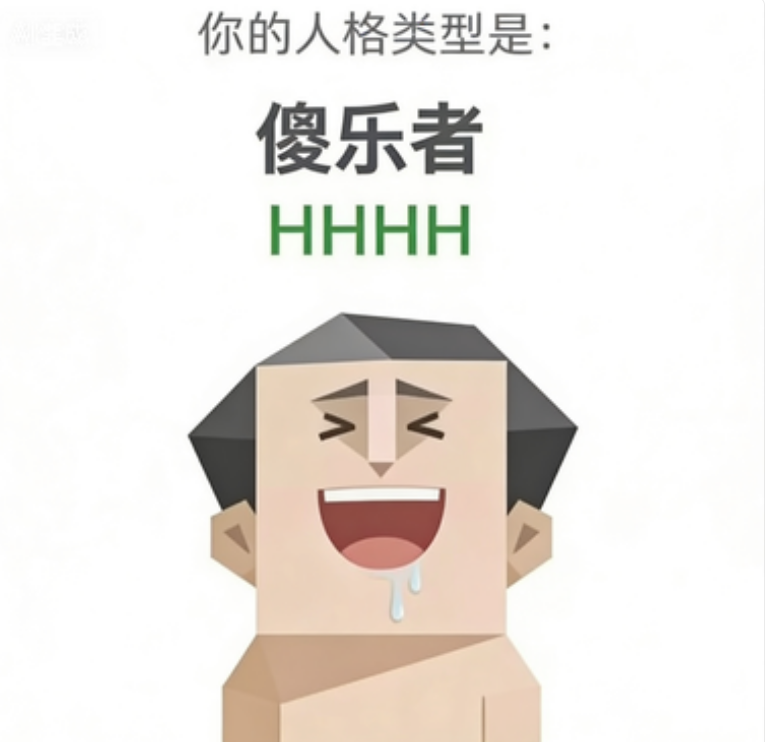
HHHH The Laughing Dumbass
HHHH is a unique existence in the SBTI personality spectrum—not generated through standard dimensional matching, but a system fallback mechanism triggered when none of the 27 standard personality types meet the 60% matching threshold. The appearance of this personality signifies that the tester's cognitive patterns, emotional responses, and behavioral traits exhibit high heterogeneity or contradiction, which cannot be captured by existing typological frameworks. HHHH is not an "invalid result" or "error output," but a special personality state with independent psychological significance, reflecting the individual's unique configuration in self-integration, social adaptation, or cognitive style.
System Trigger Mechanism & Cognitive Traits
The trigger condition for HHHH personality has a strict algorithmic definition: when the Euclidean distance between the tester's 15-dimensional vector and the pattern vectors of all 27 standard personalities exceeds the preset threshold, or the dimensional scores show an extremely discrete distribution (e.g., multiple Hs and multiple Ls coexist without intermediate transition), the system determines that the standard typological framework is invalid and activates the HHHH fallback protocol. The original intention of this mechanism is not to punish or belittle the tester, but to acknowledge the complexity of human psychology and the limitations of existing classification systems. The emergence of HHHH is essentially a "typological honesty"—rather than forcing mismatched data into the wrong model, it is better to acknowledge the boundaries of the model.
The cognitive traits of HHHH personality exhibit high situational dependence and framework fluidity. Unlike personalities with stable cognitive architectures such as CTRL, HHHH's thinking mode lacks a consistent core across situations, and its cognitive strategies flexibly switch according to situational needs, sometimes even showing contradictory characteristics. This "cognitive polymorphism" may stem from multiple underlying mechanisms: highly developed social adaptability (adjusting self-presentation according to situations), uncompleted identity exploration (in the transitional period of personality development), deliberately cultivated "anti-type" stance (resistance to classification itself), or genuinely cross-dimensional trait combinations (simultaneously having high and low polar traits on multiple dimensions).
Neurocognitive research shows that HHHH personality may be related to the special functional configuration of the prefrontal cortex. The formation of standard personalities relies on the stable dominance of specific neural circuits (e.g., dorsolateral prefrontal dominance in CTRL, ventromedial prefrontal dominance in LOVE-R), while HHHH may exhibit a "de-dominance" state of prefrontal function—multiple functional networks lack stable hierarchical relationships, showing dynamic competition and collaboration patterns. This configuration has advantages in situations requiring high flexibility and creativity, but may face challenges in situations requiring sustained focus and consistent execution.
15-Dimension Abnormal Profile
HHHH's self-esteem level may show situational fluctuations—highly confident in specific areas, yet significantly insecure in others. This inconsistency is not cognitive dissonance, but reflects the diversification of value sources: when the evaluation criteria themselves are unstable, the stability of self-esteem is naturally impaired.
Self-clarity is one of the dimensions where HHHH is most likely to score low. HHHH may experience a "multiple self" or "fluid identity," feeling completely different self-states in different relationships and roles, and struggling to integrate them into a coherent narrative. This "fragmented self" may be developmental (exploratory stage) or trait-based.
HHHH's value system may be in an understructured state, lacking clear value hierarchies and priority sequences. When facing value conflicts, HHHH may show decision-making difficulties or random choices—not because of a lack of principles, but because the principles themselves coexist and compete in multiple ways.
HHHH's attachment pattern may cross the boundaries of secure, anxious, and avoidant types, activating different attachment strategies in different relationships. This "attachment polymorphism" may be related to the complexity of early attachment experiences or the history of relational learning in adulthood.
HHHH's emotional engagement may be highly dependent on specific situational cues or traits of relational partners, rather than stable individual characteristics. In some relationships, they may show LOVE-R-level emotional intensity; in others, MONK-level emotional detachment.
HHHH may show internal contradictions in boundary needs: craving intimate fusion yet fearing loss of self; enjoying independent freedom yet experiencing loneliness and emptiness. This contradiction is not pathological, but reflects the tension structure of human attachment needs themselves.
HHHH's worldview may show "perspectivist" characteristics—rejecting a single, objective picture of the world and accepting the coexistence and competition of multiple interpretive frameworks. This cognitive style is philosophically close to pragmatism or constructivism, and cognitively manifests as high openness.
HHHH may show extreme situational flexibility in rule-following, lacking consistent behavioral norms across situations. This flexibility can be adaptive (high social intelligence) or maladaptive (trust loss due to lack of internal consistency).
HHHH's sense of meaning may be in an under-constructed state, or show a "polytheistic" style of multiple meaning sources. Lacking a single, overwhelming life goal, they may experience existential drift, or enjoy the richness and replaceability of meaning.
HHHH's motivational structure may include both approach and avoidance motivations simultaneously, with the weight between them dynamically adjusted according to situations. This mixed drive pattern may lead to behavioral inconsistency—the same goal may be supported by completely different motivational forces at different times.
HHHH's decision-making style may lack consistency—relying on quick intuition in some situations, while falling into over-analysis in others. This inconsistency is not a lack of ability, but reflects the situational sensitivity of decision-making strategies and the absence of metacognitive monitoring.
HHHH's executive function may show "intermittent outburst" characteristics—long periods of low activity alternating with short periods of intensive execution. This pattern stands in stark contrast to CTRL's sustained and stable execution, possibly reflecting the nonlinear dynamics of the motivational system.
HHHH's social initiative may be highly dependent on situational security, familiarity with topics, or traits of others present. In some situations, they may show GOGO-level social impulsivity; in others, SOLO-level social avoidance.
HHHH's interpersonal boundaries may lack stability, showing a continuum from over-fusion to over-detachment in different relationships. This dynamic adjustment may reflect the complexity of relational learning history or excessive sensitivity to others' needs.
HHHH's self-presentation may show high situational adaptability, even presenting contradictory "authentic selves" in different situations. This "multiple authenticity" phenomenon challenges the traditional assumption of personality consistency, reflecting the fluidity of self as a social construct.
Formation Mechanisms & Subtype Differentiation of HHHH
The emergence of HHHH personality is not random error, but may correspond to multiple distinct psychological development paths. The first path is "Exploratory HHHH"—individuals in the identity formation period (commonly late adolescence to early adulthood) whose personality structure has not yet been integrated, showing exploratory fluctuations across dimensions. This type of HHHH has developmental and temporary characteristics; with the accumulation of life experience and deepening of self-reflection, it may gradually condense into a standard personality type, or maintain a stable HHHH configuration.
The second path is "Adaptive HHHH"—highly socialized individuals develop the ability to flexibly switch personality masks according to situational needs through long-term learning and adjustment. Functionally similar to "High-Functioning FAKE," but this switching is not deliberate pretense, but an automated, internalized social adaptation strategy. Adaptive HHHH may show excellent abilities in professional fields (e.g., actors, salespeople, diplomats), but may face confusion about the "authentic self" in intimate relationships.
The third path is "Resistant HHHH"—metacognitive resistance to the typological framework itself, refusing to be classified into any preset category. This type of HHHH may have a strong need for a sense of uniqueness, viewing matching with standard personalities as a threat to individual uniqueness. Resistant HHHH may deliberately choose contradictory answers in tests, or refuse to identify with the results after presentation, maintaining an "unclassifiable" identity stance.
The fourth path is "Complex HHHH"—genuinely cross-dimensional trait combinations, with extremely high and low scores on multiple dimensions simultaneously, and no intermediate transition. This configuration may stem from high variability of genetic traits, extreme inconsistency of early environments, or trait reshaping caused by major life events. Complex HHHH is the hardest to capture through standard typological frameworks, and is the primary service object of the HHHH fallback mechanism.
Unique Value & Social Functions of HHHH
Although HHHH is positioned as a "fallback" or "residual category" in the SBTI system, it has undeniable unique value. In the field of innovation, HHHH's cognitive polymorphism and framework fluidity make it a natural carrier of "cross-boundary innovation." When problems require integrating knowledge frameworks from multiple fields or challenging the basic assumptions of existing paradigms, HHHH's "no fixed position" becomes an advantage—not bound by the thinking stereotypes of single-discipline training, able to move freely between different interpretive frameworks and discover connections ignored by conventional thinking.
At the social function level, HHHH may play the role of "cultural translator" or "social lubricant." Their high situational adaptability and perspective-taking ability enable them to build communication bridges between different social groups, understand and translate the language and concerns of different groups. In a post-modern society characterized by diversification and fragmentation, HHHH's "rootlessness" may be transformed into "multi-rootedness"—establishing partial identification with multiple groups rather than complete identification with a single group. This configuration may have adaptive advantages in a globalized and digital environment.
In the field of mental health, the existence of HHHH reminds us to guard against "typological violence"—forcing complex human experiences into simplified classification frameworks, ignoring or pathologizing individuals who do not fit the framework. As a legitimate, recognized personality state, HHHH provides identification possibilities for individuals who cannot be comfortably accommodated by standard types, reducing the risk of "mismatch anxiety" and "self-pathologization."
Developmental Risks & Integration Challenges
The core risk faced by HHHH personality lies in the "persistence of fragmented self"—without active integration efforts, HHHH may remain in a state of identity diffusion for a long time, unable to form a stable self-narrative and life direction. This fragmentation may lead to decision fatigue (each choice requires recalculation, lacking a stable preference structure), relationship difficulties (others cannot predict HHHH's reactions, making it hard to build trust), and existential anxiety (constant confusion about "who I really am").
"Social Mask Fatigue" is another key risk. Highly situational self-presentation requires continuous investment of cognitive resources, and long-term maintenance may lead to self-exhaustion and loss of authenticity. HHHH may experience a "hollow" state—while external functions are intact, internally experiencing emptiness of meaning and lack of connection. This "high-functioning depression" state is particularly dangerous due to its strong concealment, which is not easy to be recognized and supported by others.
HHHH also needs to guard against the "relativism trap"—excessive acceptance of multiple values may lead to loss of commitment ability, remaining open to all options but unable to choose any one. This "paralysis of choice" may manifest as stagnation in career development, avoidance of intimate relationships, or fragmentation of life projects. HHHH needs to develop the ability to "make commitments while acknowledging plurality," understanding that commitment is not the closure of possibilities, but the in-depth exploration of specific possibilities.
In the field of intimate relationships, HHHH may face the "paradox of being understood"—desiring to be truly understood by others, yet their fluidity itself makes the "authentic self" difficult to locate. Partners may experience difficulty in establishing deep connections with HHHH, because HHHH presents different aspects at different times and in different situations, making it hard to determine which aspect is "real." HHHH needs to learn "selective exposure"—continuously presenting specific self-aspects in specific relationships to establish predictability and trust, even if this continuity requires deliberate effort.
Integrative Development Path
Fragment Awareness & Documentation
Establish a "self-observation journal" to record self-states, emotional responses, and behavioral patterns in different situations—pursuing descriptive accuracy without judgment. The goal is to map the "topography" of the self and identify the trigger conditions and characteristics of different "self-fragments."
Narrative Construction Attempts
Attempt to integrate observed self-fragments into a coherent narrative, looking for deep themes, continuity clues, or transformation logic between different aspects. Accept the temporariness and revisability of the narrative, but pursue maximum integration at the present moment.
Core Commitment Selection
Make "experimental commitments" in career, relationships, values, and other fields—choose specific directions for in-depth investment, and observe the self-condensation effect brought by commitment. The selection criterion for commitment is not "optimal," but "revisable" and "exitable."
Integrative Dialogue Development
Develop "meta-communication" abilities in key relationships—discuss one's own fluid characteristics with others, negotiate rules of self-presentation in specific relationships, and establish "understood fluidity" rather than "misunderstood fluidity."
Wise Fluidity
Evolve from "passive fluidity" to "active fluidity"—treating fluidity as a conscious choice strategy rather than a default state. Being able to stabilize when needed and flex when needed, developing "situational wisdom" and "metacognitive control."