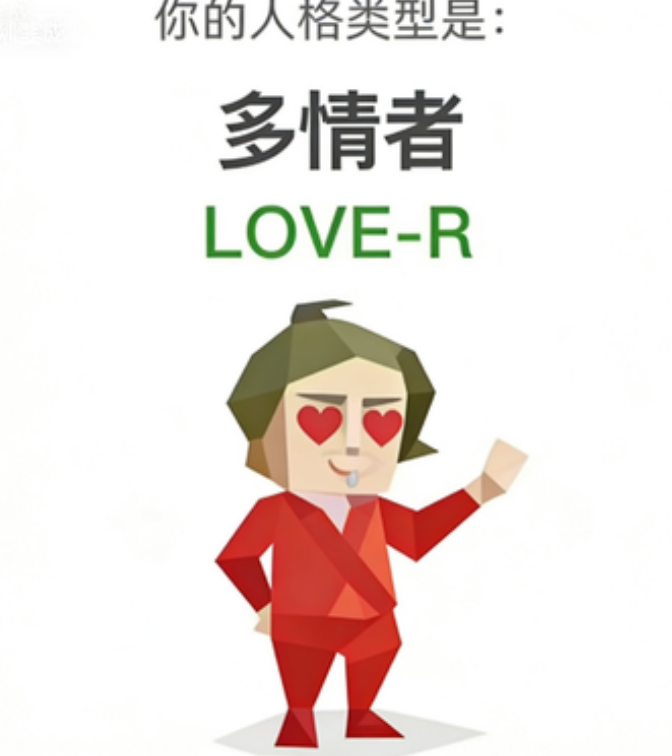
LOVE-R The Hopeless Romantic
LOVE-R is the extreme manifestation of emotional dimensions in the SBTI personality spectrum, with cognitive architecture centered on "emotion-meaning" coupling. This personality isn't simply a "romantic" or "hopeless romantic" pop culture label, but a metacognitive mode that treats emotional experience as the essence of existence. LOVE-R has abnormally dense neural connections between the limbic system and prefrontal cortex, enabling high-bandwidth real-time interaction between rational cognition and emotional experience. This neural configuration grants LOVE-R unique "emotional deep processing" capability—transforming daily experiences into meaning-laden existential events.
Core Emotional Architecture
LOVE-R's emotional system rests upon three mutually reinforcing foundations: idealized projection, emotional resonance amplification, and meaning encoding. Idealized projection manifests as highly selective attention to relationship objects and positive attribution bias—LOVE-R can construct internally representations with strong emotional attractiveness based on limited information. This ability isn't distortion of reality but prioritization of "potential possibilities." At the neurocognitive level, this corresponds to excessive coupling between the dopamine reward system and default mode network, giving LOVE-R strong motivational attention to relationship states that are "not yet realized but potentially achievable."
Emotional resonance amplification is LOVE-R's signature characteristic, but its core isn't "emotional" or "sentimental" in the traditional sense. LOVE-R's resonance ability stems from high reactivity of the mirror neuron system—simulated experience intensity of others' emotional states is significantly higher than population averages. This high reactivity gives LOVE-R deep empathic capabilities in intimate relationships, but also causes emotional boundary permeability issues: LOVE-R struggles to distinguish "others' emotions" from "my reactions to others' emotions." This differentiation difficulty may lead to emotional exhaustion or identity fusion in extreme cases.
Meaning encoding constitutes LOVE-R's closed-loop system. Unlike other high-emotion types (such as MUM), LOVE-R's processing of emotional events doesn't stop at the emotional level but automatically triggers meaning attribution processes—"what does this moment mean," "where this relationship stands in my life." This "existential encoding" gives LOVE-R's emotional experiences narrative density and philosophical depth, but may also cause overload of ordinary relationships—ordinary interactions are given existential weight, leading to rapid emotional resource consumption and relationship burnout.
15-Dimension Typical Profile
LOVE-R's self-evaluation is context-dependent, potentially experiencing self-inflation during emotional investment periods and self-devaluation during relationship setbacks. Their self-esteem isn't based on stable self-cognition but on reflective assessment of relationship status—significant identity gaps exist between "loved me" and "unloved me."
LOVE-R's self-boundaries have fluidity, potentially experiencing temporary dissolution of "self-other" boundaries during deep emotional investment. This fluidity is both the source of intimacy capability and the root of identity confusion. LOVE-R needs external relationships to confirm self-state, potentially experiencing existential emptiness during solitude.
LOVE-R's value system anchors on "connection quality," but this connection points to idealized emotional states rather than concrete personal achievements. When relationships are absent, LOVE-R may experience value vacuum states because their value generation mechanism is relationship-dependent—needing to "be needed" to confirm existential meaning.
LOVE-R shows typical anxious attachment characteristics in intimate relationships: high sensitivity to abandonment, excessive monitoring of relationship signals, and cyclical confirmation needs. This insecurity doesn't stem from realistic threat assessment but from internal working model presets—"deep connections inevitably carry the risk of loss."
LOVE-R's emotional investment shows "all-or-nothing" characteristics, lacking gradual emotional regulation capabilities. Once invested, cognitive resources, emotional energy, and attention allocation become highly concentrated on the relationship object. This concentration is both a manifestation of deep affection and a display of temporary self-function contraction—non-relationship domain functions may significantly decline.
LOVE-R has strong needs for fused intimacy, viewing independent space as a threat to relationships rather than a resource. This boundary permeability may be experienced as "soul resonance" in early relationship stages, but may lead to suffocation and autonomy loss conflicts in long-term relationships. LOVE-R needs to learn recoding "separation" as "preparation for better connection."
LOVE-R tends to view the world as a field full of potential meaning and connection possibilities, rather than a cold physical collection. This "meaning-abundant" worldview keeps LOVE-R highly sensitive to small events, but may also lead to underestimation of realistic constraints—not all stories have happy endings, not all encounters have deep significance.
LOVE-R's rule-following has emotional conditionality: when rules conflict with emotional needs, emotional needs usually gain priority. This "emotional pragmatism" gives LOVE-R situationalist characteristics in moral judgment—the same behavior may receive completely different moral evaluation under "done for love" versus "not done for love" frameworks.
LOVE-R's sense of meaning shows "relationship-dependent" fluctuations: experiencing strong meaning fulfillment in deep connections, falling into existential emptiness during relationship absence or distance. This volatility makes LOVE-R's life meaning unstable, requiring continuous relationship input to maintain the meaning system's operation.
LOVE-R's motivation structure is dominated by "avoidance-loneliness," with "approach-intimacy" as auxiliary. This configuration makes LOVE-R's pain experience intensity of relationship absence higher than satisfaction experience intensity of relationship gain, potentially leading to "entering relationships to escape loneliness" decision bias rather than rational choices based on relationship quality.
LOVE-R's decision process is significantly influenced by emotional states, potentially experiencing "emotional hijacking" during emotional activation states—rational evaluation functions temporarily go offline, dominated by immediate emotional reactions. This decision style is adaptive in romantic situations but may lead to regret in scenarios requiring long-term commitment or high-stakes decisions.
LOVE-R's executive function has "emotional fuel dependency"—task execution efficiency is highly correlated with emotional state. Showing high creativity and persistence in positive emotional states, potentially experiencing significant executive function decline in negative emotional states. This volatility poses challenges for LOVE-R in long-term project maintenance.
LOVE-R's social initiative has "depth-first" characteristics: lacking interest in large amounts of shallow socializing, but showing high alertness and rapid approach tendencies toward potential deep connection objects. This selective social strategy may lead to contraction of social network size but improvement in relationship quality.
LOVE-R lacks precision in interpersonal distance regulation, tending to quickly incorporate others into the "inner circle" and expecting reciprocal boundary permeability. This "fast intimacy" strategy may accelerate connection establishment in early relationship stages, but may also lead to boundary violation perceptions and premature relationship exhaustion.
LOVE-R's self-presentation has "emotional authenticity priority" characteristics: tending to express current emotional states even when such expression may not conform to social expectations or relationship strategies. This authenticity pursuit is both the source of intimacy capability and may cause impulsive harm in relationships—authentic negative emotional expression is equally destructive.
Intimate Relationship Dynamics
LOVE-R's core tension in intimate relationships lies in the persistent experience of "ideal-reality" gaps. LOVE-R enters relationships carrying highly idealized internal scripts—cognitive schemas about "what true love should look like"—which serve as both expectations for relationships and yardsticks for evaluating relationship quality. When real relationships deviate from ideal scripts, LOVE-R experiences "reality loss"—not objective assessment of the relationship but existential questioning of "whether this is the right relationship." This questioning mechanism subjects LOVE-R to continuous satisfaction challenges in long-term relationships, even when relationship quality is objectively good.
LOVE-R's attachment behavior shows "pursuit-withdrawal" cyclical patterns. In early relationship stages or separation situations, LOVE-R shows high-intensity pursuit behaviors—high-frequency contact attempts, escalated emotional expression, accelerated commitment needs. However, when relationship stability increases or partner availability is confirmed, LOVE-R may experience "intimacy fear" activation—anxiety about losing self, defensive withdrawal from fused dependence. This cycle isn't games or manipulation but the genuine tug-of-war between LOVE-R's internal "longing for intimacy" and "fear of being consumed" forces.
In conflict situations, LOVE-R tends toward "emotional flooding" reactions—intense emotional experiences activated by conflict rapidly exceed cognitive regulation resource capacity, causing temporary offline status of rational communication functions. This flooding experience may manifest as escalation of emotional outbursts (attack mode) or withdrawn silence (freeze mode), depending on LOVE-R's learned coping strategies. LOVE-R needs to develop "emotional regulation techniques"—physiological regulation programs (breathing, grounding techniques) activated during conflict activation to maintain cognitive function online status.
Career Niche Analysis
High-Fit Domains
- Artistic Creation: Music, literature, film and other emotional expression-oriented creative fields
- Psychological Counseling: Application of deep empathy capabilities in psychotherapy
- Social Work: Vulnerable group support, crisis intervention and other relationship-intensive work
- Education: Teaching positions requiring emotional investment and role modeling
- Brand Planning: Emotional narrative construction and consumer resonance stimulation
- Human Resources: Employee care, organizational culture building and other soft management areas
Challenging Domains
- Highly Rationalized Professions: Financial analysis, legal consulting and other emotion-detached work
- Repetitive Operation Positions: Lacking emotional stimulation and meaning generation space
- Competitive Sales Environments: Value conflicts between goal-orientation and relationship-orientation
- Remote Independent Work: Motivation failure caused by social absence
- High-Pressure Decision Positions: Emotional interference impact on rational judgment
LOVE-R needs to beware the "emotional over-investment" trap in career development—because they show natural adaptability in high-emotional-labor professions, easily falling into "burning oneself to illuminate others" exhaustion patterns. Long-term career satisfaction for LOVE-R depends on establishing "emotional boundary management" capability—maintaining empathic abilities while preventing excessive emotional resource expenditure. LOVE-R's optimal career ecology is "meaningful relationship density"—work content involves authentic interpersonal connections that are recognized and protected by organizational culture rather than viewed as efficiency obstacles.
In career transition decisions, LOVE-R is easily driven by "emotional impulses"—leaving current jobs due to interpersonal relationship problems, or joining new jobs due to romanticized imagination. LOVE-R needs to develop "emotional delay" capability—setting mandatory cooling-off periods before major decisions, allowing emotional intensity to naturally decay before conducting rational assessment. Meanwhile, LOVE-R needs to recognize the difference between "relationship repair" and "relationship escape"—whether current work relationship difficulties can be resolved through communication rather than necessarily leading to resignation.
Developmental Risks & Shadow
LOVE-R personality's core risk lies in "emotional addiction" cycle solidification—treating emotional activation states themselves as pursuit targets rather than byproducts of relationships. When LOVE-R treats "butterflies," "being needed feelings," or "deep connection feelings" as independent pursuit objects, they may fall into "relationship chasing" mode: constantly entering new relationships to obtain emotional peak experiences, but feeling bored after relationship stabilization and seeking exit. This pattern isn't fear of commitment but dependence on emotional intensity itself—the security provided by stable relationships cannot replace the neurochemical rewards provided by the passion period.
"Self-dissolution" is another key risk LOVE-R faces. When LOVE-R completely binds self-worth to relationship states, they experience "relationship-dependent self" contraction—self-experience during solitude becomes thin, empty, lacking substantial feeling. This contraction may lead to "boundary dissolution" in extreme cases—tolerating self-violation to maintain relationships, or experiencing identity collapse after relationship endings. LOVE-R needs to develop "solitude capability"—maintaining self-sense stability under conditions without relationship input, recoding solitude as an opportunity to "connect with self" rather than absence.
In cognitive dimensions, LOVE-R faces "meaning over-projection" risk—giving random, neutral events excessive emotional meaning and narrative weight. A falling leaf isn't just a physical phenomenon but "symbol of life's impermanence"; a delayed reply isn't just a technical issue but "evidence of love decay." This over-encoding leads to waste of cognitive resources and decline in emotional stability, keeping LOVE-R living in continuous "meaning overload" states. LOVE-R needs to learn "event de-meaning"—allowing certain events to maintain their physical properties without necessarily entering narrative systems.
LOVE-R's "idealized projection" in extreme cases may evolve into "obsessive attachment"—idealization of relationship objects continues despite contradictory evidence, or maintaining long-term "idealized nostalgia" after relationship endings. This obsessive attachment obstructs learning from experience, causing LOVE-R to repeat the same patterns across different relationships. Breaking this cycle requires development of "reality testing techniques"—actively collecting evidence contradictory to idealized scripts and allowing such evidence to correct internal representations.
Integrative Development Path
Emotional Awareness
Establish "emotion-behavior" gaps, inserting observation windows before emotionally driven behaviors. Practice metacognitive ability to recognize "is this current real need or byproduct of emotional activation state."
Boundary Construction
Develop "self-other" boundary perception and maintenance capabilities, distinguishing "me" independent experience from "we" fused experience. Practice maintaining autonomy expression in intimate relationships.
Reality Anchoring
Cultivate "evidence-first" cognitive habits, establishing verification mechanisms between idealized projection and reality feedback. Learn to collect evidence contradictory to internal scripts and allow it to correct beliefs.
Solitude Tolerance
Gradually expand solitude time and quality, recoding solitude from "absence state" to "abundance state." Develop self-value generation mechanisms independent of relationship input.
Wisdom Integration
Develop "emotional wisdom"—while maintaining emotional depth and authenticity, possessing emotional regulation, boundary management, and reality testing capabilities. Shift from "living for love" to "living with love."