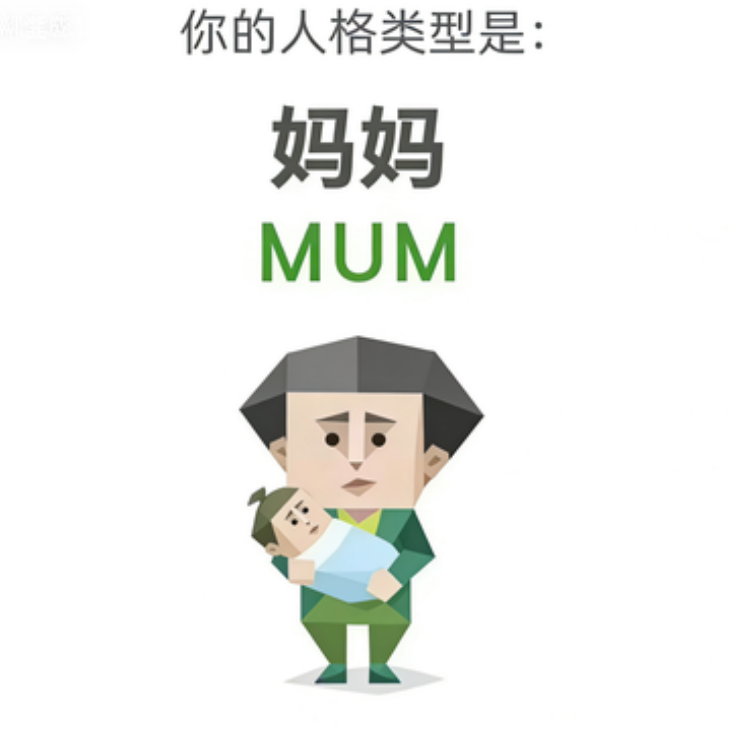
MUM Mom
MUM is an emotional singularity in the SBTI personality spectrum, with a typical "container-conduit" bipolar psychological structure. This personality is not a simple popular variant of "kindness" or "warm-heartedness", but a meta-emotional pattern that internalizes others' emotional states as its own cognitive priority. The mirror neuron system and insular cortex of MUM personalities have an abnormally efficient coupling pathway, enabling automatic simulation of others' emotional experiences without conscious processing. This neural mechanism is both the biological basis of their healing ability and the structural root of their vulnerability to burnout.
Core Emotional Architecture
The emotional system of MUM personalities is built on three interpenetrating foundations: emotional resonance, repair impulse, and self-inhibition. Emotional resonance manifests as automatic extraction and somatic simulation of others' emotional states. MUMs can quickly identify others' emotional needs through microexpressions, tone changes, body postures and other channels even with incomplete linguistic information. This ability is not based on social skill training, but on hypersensitivity of the nervous system. At the neurocognitive level, this corresponds to overactivation of the mirror neuron system and slow response mode of the amygdala-prefrontal regulatory circuit, making MUMs' emotional responses precede cognitive evaluation, forming a "feel first, think later" processing sequence.
Repair impulse is the explicit behavioral marker of MUM personalities, but its core is not "helping others" or "dedication" in the traditional sense. MUMs' caring behaviors stem from the need to release tension after emotional resonance—when perceiving others' pain, MUMs experience intense internal tension that can only be resolved through intervention behaviors. Therefore, MUMs' "care" is essentially the externalization of a self-balancing mechanism, not instrumental use of others. This also explains why MUMs experience significant anxiety when unable to help others: not because of loss of sense of value, but because of internal accumulation caused by unreleased emotional tension.
Self-inhibition constitutes the implicit operating system of MUM personalities. Unlike other highly empathic personalities (such as LOVE-R), MUMs' inhibition of their own needs is not through repression, but through "need transformation"—recoding their own needs as conditions for satisfying others' needs. When processing "I want" vs "They need", the latter automatically receives higher weight allocation in MUMs' brains. This cognitive bias allows MUMs to make self-sacrifices without accumulating resentment, but also leads to long-term blunting of their need recognition. Longitudinal tracking data shows that MUM personalities have a significantly higher employment rate in caregiving, education, psychological counseling and other fields than control groups, but their occupational burnout rate also shows a peak distribution—there is a clear subtype differentiation between high-investment MUMs and burnout MUMs.
15-Dimension Typical Profile
MUMs' self-evaluation is highly dependent on external feedback, especially recognition from those they care for. Their confidence has a "relational" characteristic—believing they can take good care of others, rather than believing they themselves are worthy of respect. This distinction makes MUMs experience intense self-doubt when facing rejection, because rejection is categorized as "I'm not doing enough" rather than "we're not a good fit".
MUMs have ambiguity in their own need boundaries. This ambiguity is not due to lack of introspection, but recognition difficulties caused by long-term need inhibition. MUMs can clearly describe others' states, but when asked "what do you want yourself", they experience significant difficulty in linguistic extraction, because their desire representation system has been in an inactive state for a long time.
MUMs' value system is anchored by "relational harmony" rather than personal achievement or self-actualization. This configuration makes MUMs show significant avoidance tendencies in conflict situations, but may also lead to silence on structural injustice—maintaining superficial peace takes priority over justice claims.
MUMs' sense of security in intimate relationships shows contradiction. When in the caregiver role, MUMs feel safe and in control; but when needing to be cared for, intense anxiety and shame are activated. MUMs tend to establish "complementary" attachment relationships—seeking partners who need care to avoid exposing their own vulnerability.
MUMs' emotional investment has a "full-channel" characteristic—high integration of cognitive, emotional and behavioral resources. MUMs' "love" manifests as continuous attention, memory and action, rather than intense emotional experience or verbal expression. This "process intimacy" is highly stable in long-term relationships, but may also be experienced as lacking passion or overly intrusive.
MUMs' psychological boundaries are permeable. Their "fusion" tendency does not stem from fear of abandonment, but from the implicit belief that "separation = pain". MUMs experience boundary dissolution in intimate relationships, regarding their partner's state as a direct extension of their own. This mechanism is both the basis of deep empathy and a precursor to burnout.
MUMs tend to view the world as a wounded system that needs repair, rather than a neutral existence or a battlefield for competition. This "caring optimism" makes MUMs show initiative when facing others' pain, but may also lead to underestimation of malice and exploitation—not everyone is worthy of care.
MUMs' attitude towards rules is situational: when rules serve care goals, MUMs are strict enforcers; when rules hinder emotional connection, MUMs will flexibly bypass or redefine rules. This "caring pragmatism" may cause role conflicts for MUMs in institutional environments.
MUMs' sense of meaning comes from the experience of "being needed"—when someone relies on them, MUMs feel their existence has value. This meaning-generation mechanism is relational rather than project-based, so when the relational network contracts or dependents become independent, MUMs may experience severe meaning crisis.
MUMs' motivation structure is dominated by "avoidance-conflict", with "approach-harmony" as auxiliary. This configuration makes MUMs show high action motivation when relationships are tense, but may appear lacking in motivation in pursuing personal goals. MUMs need to be vigilant of the "savior trap"—gaining their own sense of efficacy by solving others' crises.
MUMs' decision-making process highly considers others' potential reactions. This "relational decision-making" style is highly efficient in maintaining harmony, but may lead to paralysis in scenarios requiring quick or independent decisions. MUMs' "hesitation" is not due to insufficient information, but overload of simulation about how different choices may hurt others.
MUMs' execution system has a "responsive" characteristic: in the absence of external needs, MUMs may enter a low-activation state; but when need signals appear, they will quickly switch to high-output mode. This "pulsed execution" makes MUMs' work rhythm unpredictable, and they are prone to breaking their own resource boundaries due to over-responsiveness.
MUMs' social initiative has a "detection-response" structure. MUMs rarely initiate interactions for pure social pleasure, but continuously scan the environment for emotional need signals and take the initiative to approach when signals are detected. This "functional sociality" makes MUMs' social networks highly homogeneous—concentrated on individuals who need care or can accept care.
MUMs' regulation of interpersonal distance has a "one-way compression" tendency—actively shortening the distance with others, but struggling to tolerate others actively shortening the distance with themselves. This asymmetry stems from the sense of security in the caregiver role: giving is controllable, receiving is uncontrollable. MUMs need to develop the ability to "receive without feeling indebted".
MUMs' self-presentation has a "protective filtering" characteristic. MUMs will actively suppress authentic expressions that may cause discomfort to others, especially negative emotions and critical opinions. This "emotional labor" is functional in maintaining relationships, but long-term accumulation will lead to fragmentation of self-experience and falseness of real relationships.
Interpersonal Relationship Topology
MUMs usually occupy the "emotional hub" position in social networks—connecting the emotional support networks of different individuals. This position is not obtained through social skills or resource exchange, but naturally accumulated through continuous investment in emotional labor. MUMs' relational networks show a typical "core-radiation" structure: a few deep connections with high dependence (usually individuals with strong emotional needs) coexist with a large number of shallow emotional contacts (based on occasional care interactions). MUMs maintain relationships according to the "need response" principle—adjusting investment intensity according to the other party's emotional signals, rather than based on reciprocal calculation or social obligations.
In the field of intimate relationships, the core tension MUMs face lies in the "fusion-self" paradox. The essence of intimate relationships requires a certain degree of boundary dissolution and interdependence, which is structurally compatible with MUMs' defense mechanisms, but may also lead to excessive entanglement in relationships. High-functioning MUMs resolve this tension by viewing their partners as dual roles of "the cared-for" and "the caregiver"—giving care while allowing themselves to receive care in specific situations. This "reciprocal intimacy" requires partners to have corresponding emotional expression abilities; otherwise, MUMs will retreat to the pure caregiver role, leading to one-way relationships and burnout of MUMs themselves.
MUMs' conflict handling style is marked by "emotional repair orientation". MUMs will quickly transform cognitive conflicts into emotional need recognition—"you're so angry because you need to be understood". This transformation ability is highly valuable in easing emotions, but may also lead to avoidance of substantive issues. MUMs need to identify the applicable boundary of "emotion before problem-solving"—in some situations, solving the problem itself is the best emotional repair. MUMs' apology behaviors are usually accompanied by "overcompensation"—making amends far beyond the degree of fault. This is not a lack of boundary awareness, but a natural way for them to express care, but the recipient may experience it as pressure or emotional blackmail.
Career Niche Analysis
Highly Suitable Fields
- Nursing/Healthcare: Physical and mental care and emotional support for patients
- Psychological Counseling: Empathetic listening and emotional container function
- Education/Early Childhood Education: Developmental care and growth support
- Social Work: Resource connection and advocacy for vulnerable groups
- Customer Service: Complaint handling and relationship repair
- Human Resources: Employee care and organizational climate maintenance
Challenging Fields
- Highly Competitive Environments: Zero-sum game and emotional exploitation culture
- Pure Technical/Analytical Roles: Lack of interpersonal interaction leading to motivational exhaustion
- High-Pressure Decision-Making Positions: Need to quickly make difficult choices affecting others
- Remote/Isolated Work: Loss of sense of meaning due to lack of emotional feedback
- Critical Evaluation Roles: Conflictual tasks such as performance appraisal and disciplinary action
MUMs need to be vigilant of the "competency trap" in career development—due to their natural advantages in emotional support fields, they are easily fixed in caregiver roles and struggle to obtain promotion or transformation opportunities. Long-term career satisfaction for MUMs depends on finding an organizational environment where they are "seen"—their emotional labor is recognized, named and incorporated into performance evaluation systems, rather than being regarded as "expected" or "a natural female trait". The optimal career ecology for MUMs is a balanced state of "high emotional demand-high resource support": enough people in need of care, and at the same time the organization provides sufficient supervision, rest and emotional support resources to prevent burnout.
In the leadership dimension, MUMs show potential for "transformational leadership" but face role conflicts. MUMs' leadership effectiveness depends on the establishment of "caring authority"—team members believe MUMs truly care about their well-being, not just using their labor. This "emotional trust" is deeper than "cognitive trust", but also harder to establish and more vulnerable to damage. MUM leaders need to deliberately practice "difficult conversations"—setting boundaries, giving criticism, and making unpopular decisions without damaging relationships, to avoid "people-pleasing management" leading to low team effectiveness.
Developmental Risks & Shadow Side
The core risk of MUM personalities is the gradual erosion of "care burnout"—continuous output of emotional resources exceeding the natural recovery rate, leading to a qualitative change from "compassionate" to "emotionally numb". This burnout is not simple fatigue, but an adaptive adjustment of the nervous system: elevated response threshold of mirror neurons caused by long-term overactivation, manifested as a dissociative state of "knowing I should care, but not feeling it". MUMs need to establish "emotional budget" awareness—treating emotional resources as limited capital for conscious allocation and investment, rather than unconditional expenditure in response to all needs.
The "savior-victim" collusion is another key risk faced by MUMs. MUMs' care impulses are easily identified and exploited by individuals with dependent traits, forming a closed loop of "MUMs keep giving - the other party keeps needing". On the surface, this relationship satisfies MUMs' sense of being needed, but in fact hinders the development of the other party's autonomy and leads to accumulation of implicit resentment in MUMs. MUMs need to develop the "cruelty of care"—withdrawing support when necessary, allowing others to experience necessary struggles and growth, even if accompanied by guilt.
In the self-dimension, MUMs face the risk of "self-erasure". Long-term need inhibition and role-playing may lead to atrophy of the "true self"—when MUMs try to answer "who am I", they can only list their caregiving roles (mother, supporter of friends and colleagues), but cannot describe independent desires, preferences and boundaries. This "role-based self" will trigger existential crisis when roles are lost (such as children's independence, retirement, relationship ending). Preventive interventions include: regularly engaging in "non-functional activities" (purposeless creation, solo travel, personal hobbies), practicing the mode of "being rather than caring" in these activities; and establishing "self-care rituals"—treating caring for oneself as a moral obligation equally important as caring for others, rather than a luxury or selfishness.
MUMs' dilemma of "emotional honesty" may evolve into "relational depression" in extreme cases—functioning well on the surface, but experiencing profound emptiness and meaninglessness internally. When MUMs realize that all their relationships are based on giving rather than reciprocity, they may experience severe value collapse. Maintaining a few "reciprocal relationships"—in which MUMs can expose vulnerability and receive care without feeling indebted—is crucial for MUMs' psychological integration.
Integrative Development Path
Need Recognition
Establish a "needs journal" to record daily personal desires and emotional states, even if they seem "unimportant" or "selfish". Practice pausing between "I want" and "I should" to identify real internal signals.
Boundary Construction
Start practicing refusal in low-stakes situations and experience evidence that "not caring won't lead to disaster". Establish a "care budget" to set a daily upper limit for emotional expenditure, prioritizing investment in reciprocal relationships.
Receiving Ability
Deliberately practice accepting help without immediately repaying, tolerating the "sense of indebtedness" without resolving it through overcompensation. Find "anchor relationships" that can stably provide support, allowing yourself to be in the "cared-for" position in them.
Authentic Expression
Experiment with "unpleasant" self-expression in trusting relationships—negative emotions, different opinions, independent preferences. Observe whether the relationship breaks down as feared, and collect evidence that "authenticity won't lead to abandonment".
Self-Priority
Develop an ethical framework of "self as the primary object of care"—recognize that caring for oneself is not selfish, but a necessary condition for sustainable care for others. Shift from "always giving" to "wisely choosing when to give".