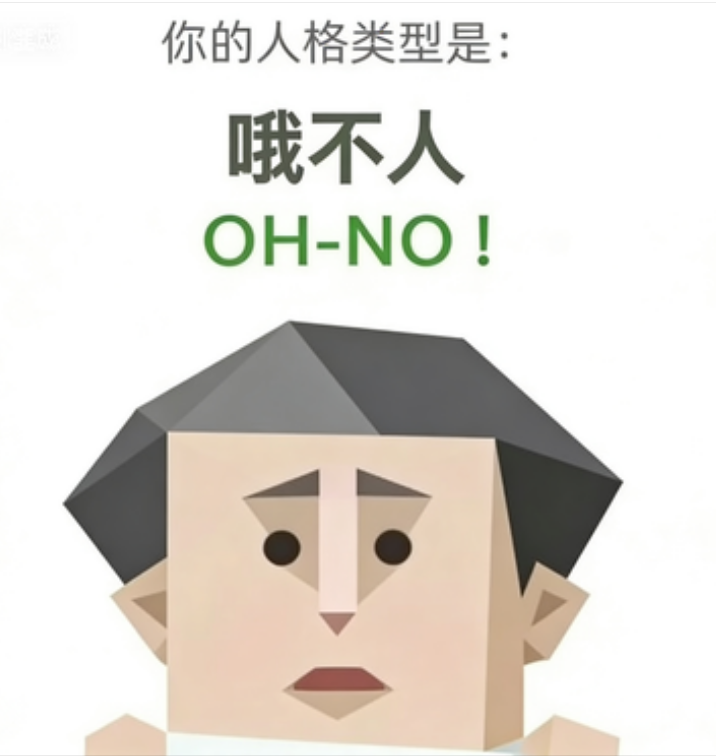
OH-NO The Oh-No Person
OH-NO is the risk early warning system in the SBTI personality spectrum, whose cognitive architecture presents a typical hypersensitive "threat-defense" response pattern. This personality is not simply a popular label of "pessimism" or "anxiety tendency", but a survival monitoring mechanism that continuously scans the world as a potential hazard source. The amygdala-prefrontal neural circuit of OH-NO personalities has an abnormally high baseline activation level, enabling them to trigger defensive responses even before threat signals are fully manifested. This "hypervigilance" has adaptive value at the evolutionary level but may lead to significant functional depletion in modern low-risk environments.
Core Cognitive Architecture
The cognitive system of OH-NO personality is built on three mutually reinforcing defensive levels: catastrophic imagination, preventive control, and boundary isolation. Catastrophic imagination is OH-NO's default thinking mode, manifested as the automatic extraction of negative outcomes from neutral or ambiguous situations. This imagination is not an intentional pessimistic construction but a cognitive habit—the brain tends to simulate the "worst possible scenario" as a baseline assumption. Neuroimaging studies show that when OH-NO personalities imagine the future, the coupling strength of the negative emotional network between their medial prefrontal cortex and posterior cingulate gyrus is significantly higher than that of the control group. This neural pattern makes negative scenarios have vividness and emotional impact similar to real experiences.
Preventive control is OH-NO's behavioral strategy to cope with catastrophic imagination. By identifying risk points in advance, formulating contingency plans, and establishing checklists, OH-NO attempts to convert uncertainty into controllability. This control behavior is compulsive—not because actual control needs exist, but because the control behavior itself can temporarily alleviate anxiety caused by uncertainty. OH-NO's control checklists often far exceed actual needs, forming an "over-preparation" mode: investing a lot of cognitive resources in low-probability events, leading to the accumulation of opportunity costs. Notably, OH-NO's control behaviors usually point to the ordering of the external environment rather than the regulation of internal emotions, which makes OH-NO appear "nitpicky" and "overly particular" in the eyes of others, but its core is the defense against the fear of losing control.
Boundary isolation constitutes OH-NO's third layer of defense. When neither catastrophic imagination nor preventive control can eliminate the sense of threat, OH-NO will activate psychological or physical isolation mechanisms—reducing potential loss scope by keeping distance, decreasing involvement, and limiting commitments. This "limited exposure" strategy manifests as being slow to warm up, cautious, and hard to trust in interpersonal relationships; an excessive preference for stability in career choices; and dependence on familiar environments in living spaces. OH-NO's sense of boundaries does not stem from the need for independence but from the "fear of being hurt"—boundaries are physical barriers to prevent the worst-case scenario from happening, rather than expressions of self-definition. Long-term tracking data shows that OH-NO personalities have a significantly higher proportion of employment in risk-sensitive industries such as medical care, law, and auditing, but their subjective well-being scores are generally low and negatively correlated with the degree of risk exposure.
15-Dimension Typical Profile
OH-NO's self-evaluation shows situational fluctuations. In familiar and controllable environments, OH-NO can exhibit stable self-efficacy; but in high-uncertainty situations, self-doubt quickly dominates. This fluctuation is not a variation of ability itself but a distortion of self-perception caused by over-weighting "potential failure". OH-NO needs to establish an "evidence library" based on historical success records to counter negative bias.
OH-NO's self-concept is often overshadowed by anxiety. When threat perception is activated, OH-NO struggles to distinguish between "I am afraid" and "I am vulnerable", leading to fluidity and situational dependence in self-definition. This low clarity makes OH-NO show significant hesitation and repetition in major decisions, as it cannot determine "what the real me wants".
OH-NO's value system is organized around the principle of "safety first", but this safety is not static conservatism but dynamic defense. OH-NO may be driven by "avoiding regret" rather than "pursuing satisfaction", leading to avoidance motivation overriding approach motivation in value ranking. When safety needs conflict with other values, OH-NO usually chooses the former, but with a significant sense of loss.
OH-NO exhibits a typical anxious-avoidant mixed pattern in attachment relationships. They both crave intimacy and dependence, yet fear abandonment or betrayal; they want to trust others, yet continuously scan for danger signals in relationships. This contradiction causes OH-NO to experience high-intensity cognitive dissonance in intimate relationships, manifested as a cyclical "approach-push away" behavioral pattern.
OH-NO's emotional investment is regulated by a "investment-loss" calculation. In the early stages of a relationship, OH-NO limits emotional investment to control potential losses; only when safety is fully confirmed will investment gradually increase. This gradual pattern makes it difficult for OH-NO to establish rapidly deepening relationships, but once established, they show a high degree of loyalty and persistence.
OH-NO's need for psychological boundaries stems from self-protection rather than independent identity. Boundaries are defensive fortifications to prevent being engulfed, hurt, or controlled, not expressions of self-definition. OH-NO experiences intense anxiety when boundaries are violated, but their expression of boundaries often takes a passive-aggressive form due to fear of conflict, leading to the accumulation of interpersonal tension.
OH-NO tends to view the world as a collection of potential threats rather than a field of opportunities. This "malignant worldview" is not a simple induction based on negative experiences but a cognitive filtering mechanism—neutral information is coded negatively, and positive information is discounted. OH-NO needs to develop "probabilistic thinking" to counter the all-or-nothing characteristic of "catastrophic thinking".
OH-NO has a high dependence on rules and structure. Rules provide predictability and a sense of control, serving as cognitive tools to cope with uncertainty. OH-NO performs efficiently and reliably in environments with clear rules but experiences significant anxiety in situations requiring improvisation or ambiguous rules. This "rule dependence" may evolve into excessive obedience to authority or resistance to innovation.
OH-NO's sense of meaning is often overshadowed by existential anxiety. When cognitive resources are largely occupied by threat monitoring, OH-NO struggles to engage in transcendent thinking or long-term meaning construction. Their sense of meaning often presents a "negative definition"—"avoiding pain" rather than "pursuing satisfaction", "not making mistakes" rather than "doing well". The limitations of this meaning model need to be broken through through value clarification work.
OH-NO's motivational structure is dominated by "avoidance-failure" with "approach-achievement" as auxiliary. This configuration makes OH-NO highly sensitive to negative feedback and unresponsive to positive incentives. OH-NO's behavioral maintenance relies on "avoiding punishment" rather than "gaining rewards", leading to insufficient intrinsic motivation and susceptibility to burnout. Deliberate practice of positive attention to progress is needed.
OH-NO's decision-making process presents "analysis-procrastination" characteristics. Excessive information gathering and option comparison lead to prolonged decision-making time, while rumination and doubt after decision-making further consume cognitive resources. OH-NO often experiences "decision paralysis" in major decisions, and may eventually terminate the painful process through external coercion or random selection rather than based on internal standards.
OH-NO's execution effectiveness presents a "check-recheck" mode. Task completion is accompanied by multiple verification behaviors to ensure no omissions or errors. This mode has advantages in quality-sensitive positions but leads to increased time costs and difficulty in initiation. OH-NO sets the standard of "good enough" too high and often falls into perfectionistic procrastination.
OH-NO's social initiation is significantly inhibited by "fear of evaluation". Excessive anticipation of negative evaluation makes OH-NO experience anticipatory anxiety in social situations, leading to avoidance behaviors or excessive self-monitoring. OH-NO's social network is usually small but deep, preferring one-on-one interactions over group settings.
OH-NO's regulation of interpersonal distance has defensive precision. Boundaries are not only spatial concepts but also multi-dimensional barriers of emotion, information, and time. OH-NO will strictly limit the depth and breadth of self-disclosure and react strongly to "crossing boundaries" behaviors. This high boundary awareness protects OH-NO's autonomy but also limits the deepening of intimate relationships and the acquisition of social support.
OH-NO's self-presentation has characteristics of "protective adaptation". To avoid negative evaluation or conflict, OH-NO will adjust the content of expression to meet situational expectations, but this adjustment is accompanied by significant cognitive load and authenticity anxiety. OH-NO craves to be truly understood but fears the risks brought by real exposure, leading to a continuous tension between "the desire to be seen" and "the fear of being hurt".
Interpersonal Relationship Topology
OH-NO usually occupies an "edge-observation" position in social networks—present yet keeping distance, participating yet ready to withdraw at any time. This position stems from the continuous assessment of relationship risks: OH-NO maintains an exit channel while establishing connections, and reserves judgment while expressing friendliness. OH-NO's relationship network presents a clear "core-periphery" stratification: a very small number of "safe bases" verified over a long period and a large number of "functional connections" maintaining polite distance. This structure provides a sense of security but also limits relationship diversity and the possibility of unexpected support.
In the field of intimate relationships, the core tension faced by OH-NO lies in the "intimacy-safety" paradox. Intimate relationships require vulnerability exposure and trust delegation, which have a structural conflict with OH-NO's core defense mechanisms. High-functioning OH-NO manages this tension through a "gradual exposure" strategy—conducting a large number of "safety tests" in the early stages of the relationship, evaluating trustworthiness by observing the other party's reactions in stressful situations, and only gradually increasing investment after the other party passes a series of "stress tests". This strategy effectively reduces the risk of being hurt but may also lead to slow relationship initiation, mechanical early interactions, and the other party feeling "judged" rather than accepted.
OH-NO's conflict handling style is dominated by "avoidance-suppression". OH-NO has a high aversion to conflict because it regards conflict as a precursor to relationship breakdown and a risky situation for self-exposure. OH-NO tends to terminate conflicts through compromise, concession, or silence, but with the accumulation of resentment. Long-term avoidance leads to accumulated relationship tension that may eventually erupt in the form of "sudden rupture"—when OH-NO determines that the relationship is irreparable, it will activate an "emotional circuit breaker", showing resoluteness that confuses the other party. OH-NO needs to develop "constructive conflict" capabilities: redefining conflict as an opportunity for relationship clarification rather than a threat, and learning to maintain connections while safeguarding boundaries.
Career Niche Analysis
Highly Suitable Fields
- Risk Management: Financial risk assessment, insurance actuarial science, compliance review
- Quality Control: Auditing, quality inspection, safety supervision, medical verification
- Legal Consulting: Contract review, risk early warning, compliance consulting
- Medical Diagnosis: Pathological analysis, imaging diagnosis, screening of difficult cases
- System Operation & Maintenance: IT security, network monitoring, fault early warning
- Editing & Proofreading: Fact-checking, text proofreading, content review
Challenging Fields
- Sales & Business Development: High-pressure rejection environment, uncertain income
- Entrepreneurship & Freelancing: Unstable income, lack of structural support
- Creative Industries: Subjective evaluation, exposure of vulnerability
- High-Pressure Decision-Making Positions: Time pressure, incomplete information, significant consequences
- Customer Service: Emotional labor, conflict handling, continuous social interaction
OH-NO needs to be vigilant against the "safety trap" in career development—limiting the space for ability development due to excessive pursuit of environmental safety. OH-NO is easily attracted to "predictable but non-growing" positions, gradually losing the ability to cope with uncertainty in the comfort zone, forming a vicious circle of "ability atrophy - more avoidance". Long-term career satisfaction for OH-NO depends on finding "structured challenges"—moderate uncertainty within a clear framework that provides both security and allows ability expansion. OH-NO's optimal career ecology is "protected risk": the organization provides stable support, and individuals explore within limited scope.
In team collaboration, OH-NO presents the functional value of a "risk early warning person". OH-NO's early identification of potential problems can avoid collective blindness of the team, but its early warning method is often experienced as "pouring cold water" or "creating anxiety" due to excessive negativity. High-functioning OH-NO needs to develop "constructive early warning" skills: presenting risk identification bundled with solutions, using probabilistic language rather than deterministic language, and expressing trust in the team's capabilities while expressing concerns. OH-NO's best role in the team is a "quality gatekeeper" or "process guardian"—exerting risk control value in the late innovation or execution stage, rather than acting as an evaluator in the early creative stage.
Developmental Risks & Shadow Side
The core risk of OH-NO personality lies in "anxiety generalization"—inappropriately transferring risk perception from specific areas to global life experience. When the threat monitoring mechanism transforms from an adaptive tool to a default mode, OH-NO will experience a state of "chronic anxiety": even in the absence of objective threats, the body remains in a physiologically activated state of high alert, leading to physical and mental symptoms such as sleep disorders, digestive system problems, and decreased immune system function. The continuous consumption of these "false alarms" is the main mechanism for the decline in OH-NO's quality of life.
Excessive development of "experiential avoidance" is another key risk. When OH-NO systematically avoids all situations that may trigger anxiety, it will experience "life scope contraction"—the acceptable activity space, social occasions, and geographical scope gradually narrow, forming a self-reinforcing avoidance cycle. Short-term anxiety relief reinforces avoidance behavior, but in the long run, it leads to the degradation of coping ability and loss of self-efficacy. OH-NO may develop "safety rituals"—specific sequences of checking behaviors, carrying lucky charms, adhering to fixed routes—these rituals have short-term functions in anxiety management but limit behavioral flexibility and life richness in the long run.
In the relational dimension, OH-NO faces the risk of "loneliness". Long-term relationship avoidance and boundary maintenance may lead to the gradual loss of social connections, and when OH-NO realizes the need for support, it finds that available resources have been exhausted. OH-NO's independence is often misread as not needing others, but its core is the fear of dependence rather than the enjoyment of autonomy. Preventive interventions include: establishing "micro-connection" practices—regular low-risk social exposure to maintain the function of social muscles without threatening the core safety zone; and identifying "good enough" relationship standards—abandoning the pursuit of a perfect safe base and accepting moderate uncertainty in relationships as a necessary cost of intimacy.
OH-NO's "catastrophic thinking" may evolve into "paranoid tendencies" in extreme cases—systematically interpreting neutral events as threat signals and attributing others' behavioral motives to malice. This cognitive distortion not only exacerbates anxiety but may also lead to relationship conflicts and impairment of social function. The core of cognitive restructuring technology is to develop the ability of "alternative explanation": generating multiple possible explanations for the same event and assigning weights based on probability rather than emotional intensity.
Integrated Development Path
Anxiety Awareness & Naming
Develop metacognitive ability for anxiety responses—identify the correlation between physical signals, emotional labels, and triggering situations. Establish an "anxiety journal" to track patterns, distinguish between "real threats" and "imagined threats", and break the automatic response chain.
Probabilistic Thinking Training
Replace "deterministic language" with "possibility language", conduct probability estimation and historical accuracy verification for worrying events. Practice ternary analysis of "worst case - best case - most likely case" to break the monopoly of catastrophic thinking.
Exposure Hierarchy Practice
Construct a hierarchical structure of anxiety-provoking situations and conduct systematic exposure starting from low-anxiety items. The goal is to establish implicit memory of "anxiety tolerance" rather than "anxiety elimination"—experience the natural extinction process of anxiety and break the secondary anxiety of "must control anxiety".
Value Clarification & Commitment
Identify core values sacrificed by anxiety avoidance and establish a clear trade-off between "values-fear". Through the imagination exercise of "what I would do if I were no longer anxious", rebuild approach motivation and shift behavioral orientation from "avoiding pain" to "pursuing meaning".
Wise Vigilance
Develop "situation-sensitive risk assessment"—distinguish between real threats and imagined threats, and flexibly switch between needing vigilance and needing relaxation. Transform from "always warning" to "wisely choosing when to warn", converting risk sensitivity into an advantage of accurate judgment.