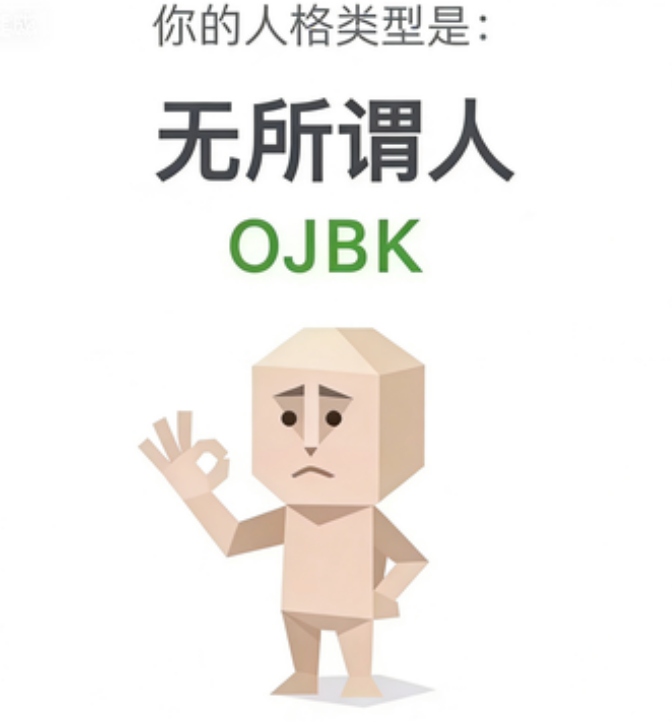
OJBK The Whatever
OJBK is a cognitive deconstructor in the SBTI personality spectrum, whose psychological defense mechanism is built on "meaning dissolution" rather than "meaning construction". This personality is not a simple colloquial variant of "laziness" or "lack of opinion", but a metacognitive strategy that decentralizes, dehierarchizes, and deteleologizes worldly experiences. There is an abnormal inhibitory connection between the default mode network and the salience network in the OJBK brain, enabling it to quickly activate the "desalience" program when facing high emotional load stimuli, reducing potentially threatening information to neutral background noise.
Core Cognitive Architecture
The cognitive system of OJBK personality is built on three mutually reinforcing foundations: emotional buffering, decision offloading, and meaning suspension. Emotional buffering manifests as the ability to rapidly attenuate emotion-arousing stimuli—OJBK can strip emotional labels from negative information within seconds and convert it into pure factual statements. This ability is not emotional suppression (which requires continuous energy consumption to maintain inhibition), but the weakening of emotional representation itself. At the neurocognitive level, this corresponds to low reactivity in the amygdala-prefrontal pathway and low insular sensitivity to bodily signals. OJBK rarely experiences intense emotional states, including negative emotions like anxiety and anger, as well as positive emotions like excitement and ecstasy—their emotional life exhibits a "low-saturation" grayscale characteristic.
Decision offloading is the overt behavioral marker of OJBK personality, but its core is not the traditional "lack of decisiveness" or "dependency on others". OJBK's "whatever" stems from a cold assessment of decision cost-benefit—when the differences between options fall below the cognitive resources required for decision-making in OJBK's value system, OJBK will rationally choose to cede decision-making power. This strategy has adaptive advantages in contexts with incomplete information or low-stakes consequences, avoiding decision paralysis caused by overthinking. However, when OJBK inappropriately generalizes this strategy to high-stakes situations, they exhibit confusing passivity, even showing an alienated "anything is fine" attitude in contexts involving core interests.
Meaning suspension constitutes the existential defense of OJBK personality. OJBK exhibits typical "cognitive avoidance" of "life meaning" questions—not by answering them, but by dissolving the legitimacy of the questions themselves. The meta-question "Why pursue meaning?" is, in OJBK's cognitive framework, a pseudo-proposition that needs to be suspended. This attitude is different from existential meaning construction or nihilistic meaning negation; it is a pre-reflective, pragmatic suspension of meaning: meaning is not discovered, nor created, but selectively ignored. Longitudinal tracking data shows that OJBK personalities have significantly higher psychological stability than control groups in high-pressure environments, complex interpersonal relationships, and meaning crisis situations, but there is a significant negative correlation between their long-term goal achievement rate and life satisfaction scores—OJBK is good at avoiding pain, but not at pursuing fulfillment.
15-Dimension Typical Profile
OJBK's self-evaluation exhibits "destabilization" characteristics—neither pursuing high self-esteem nor falling into low self-esteem, but maintaining a functional level of "good enough". Their confidence does not rely on achievement accumulation or social recognition, but on the underlying belief that "I can handle whatever comes". This "resilient confidence" makes OJBK unusually calm in the face of failure, but may also lead to a lack of motivation for self-improvement.
OJBK's self-perception is "contextual" rather than "essentialist". OJBK does not pursue a unified, cross-contextual self-narrative, but accepts the fluidity of the self in different contexts. This "de-essentialized self" reduces the risk of identity crisis, but may also lead to adaptive difficulties in situations requiring a firm self-position.
OJBK's value system is implicitly guided by the "path of least resistance"—but this guidance is not a conscious utilitarian calculation, but an internalized automatic response. OJBK's core value is "non-attachment"—attachment to any specific goal, identity, or relationship is seen as a source of pain. This "anti-attachment" itself may evolve into a hidden form of attachment.
OJBK's sense of security in intimate relationships is built on a cognitive contract of "low expectations - low disappointment". OJBK preemptively reduces their level of dependence on partners to avoid potential separation anxiety. This "emotional preventive withdrawal" makes OJBK exhibit confusing alienation in relationships, and partners often experience a sense of distance of "being unable to truly get close".
OJBK's emotional investment exhibits a "breadth-first" rather than "depth-first" characteristic. OJBK can maintain a large number of shallow relationships, but keeps emotional investment in any single relationship at a low level. This "emotional diversification strategy" reduces the psychological cost of relationship breakdown, but also limits the deep fulfillment that intimate relationships can provide.
OJBK's need for psychological boundaries is vague and fluid. Unlike high-boundary individuals who actively defend personal space, or low-boundary individuals who crave fusion, OJBK's boundaries are "reactive"—only passively established when intrusion actually occurs, and usually through withdrawal rather than confrontation.
OJBK tends to view the world as a complex system that "needs to be dealt with rather than understood". OJBK's curiosity about the world is instrumental—activated only when understanding helps reduce trouble, not out of intrinsic intellectual desire. This "pragmatic epistemology" makes OJBK show obvious lack of interest in philosophical and theoretical topics.
OJBK's attitude toward rules is "opportunistic": the motivation to follow rules is not identification, but avoiding trouble from violating them. OJBK is a skilled rule-bypasser, able to maximize personal convenience without triggering punishment mechanisms. This "gray area navigation ability" has survival advantages in rigid environments, but may also lead to gradual blunting of moral sense.
OJBK's sense of meaning is in an "inactive" state. OJBK does not question meaning not because they have found answers, but because they judge the question itself as invalid. This "meaning avoidance" has protective functions in the short term, but may lead to the accumulation of existential emptiness in the long run—a persistent, nameless feeling of "something being wrong".
OJBK's motivational structure is dominated by "avoidance-failure" and supplemented by "approach-achievement". OJBK's actions are mainly driven by "avoiding trouble" rather than "pursuing goals". This configuration makes OJBK excellent at maintaining the status quo, but shows motivational deficits in situations requiring active creation, competition, or risk-taking.
OJBK's decision-making process exhibits typical "satisficing" characteristics: not pursuing the optimal solution, but a "good enough" solution. OJBK makes quick decisions after gathering the minimum necessary information—this efficiency orientation has advantages in low-stakes situations, but may lead to underestimation of opportunity costs in high-stakes situations.
OJBK's execution system is "pulsatile" rather than "sustained". OJBK can burst out high-efficiency execution before deadlines, but this execution is driven by external pressure rather than intrinsic motivation. OJBK lacks the ability to sustain investment in long-term projects and is prone to stagnation in the absence of external supervision.
OJBK's social initiation requires external triggers. OJBK rarely takes the initiative to initiate social interactions, but does not refuse invitations from others either. This "passive social" mode makes OJBK's social network highly dependent on others' initiative, which may lead to gradual atrophy of social capital and hidden accumulation of loneliness.
OJBK's regulation of interpersonal distance is "fuzzy matching" rather than "precise setting". OJBK does not pursue a specific intimacy distance, but adapts to the distance set by others. This "mirror adaptation" makes OJBK show inconsistent intimacy levels in different relationships, which may be experienced as lack of authenticity.
OJBK's self-presentation is guided by "least resistance"—presenting the version that is least likely to trigger conflict, requires the least explanation, and best meets situational expectations. This "situational optimization" strategy reduces social friction, but may also lead to gradual blurring of OJBK's own "true self"—when all versions are strategic, no version is real.
Interpersonal Relationship Topology
OJBK usually occupies the "peripheral node" position in social networks—a position with low connectivity but high bridging potential. This position is not an active choice, but a passive result. OJBK's relationship network exhibits a typical "weak tie-dominated" structure: a large number of shallow acquaintance relationships coexist with very few deep relationships, with a serious lack of middle-layer relationships. OJBK's relationship maintenance follows the implicit assumption of "zero-sum game"—investing in one relationship means extracting resources from other activities, so OJBK minimizes relationship maintenance investment, only making remedial investments when the relationship is about to break.
In the field of intimate relationships, the core tension OJBK faces lies in the "intimacy-autonomy paradox". Intimate relationships require a certain degree of emotional exposure and interdependence, which is structurally conflicting with OJBK's core defense mechanisms. High-functioning OJBK resolves this tension by incorporating partners into their "low-demand alliance"—seeking partners who also have low emotional needs and high independence, and establishing "roommate-style intimacy" based on mutual respect rather than emotional fusion. This relationship model works well when both parties are low-attachment individuals, but experiences severe adaptation difficulties when one party's needs escalate. OJBK needs to develop "emotional responsiveness"—making recognizable responses to partners' emotional needs without losing autonomy.
OJBK's conflict handling style is marked by "avoidance-dissolution". OJBK quickly downgrades potential conflicts to "whatever" matters, avoiding confrontation through emotional detachment. This strategy effectively reduces relationship tension in the short term, but may lead to accumulation of unresolved issues and hidden resentment in the long run. OJBK's "reconciliation" behavior usually takes the form of "pretending nothing happened"—rather than problem discussion or apology. This "reset strategy" is feasible in relationships with low conflict frequency, but is experienced as irresponsible or emotionally cold in high-conflict environments.
Career Niche Analysis
High-Fit Fields
- Process-Oriented Roles: Standardized operations, repetitive work with low decision-making load
- Technical Support: Problem diagnosis and solution matching, non-creative problem-solving
- Administrative Coordination: Resource scheduling, calendar management, buffer role in multi-party communication
- Quality Inspection: Conducting inspections according to standards, low need for subjective judgment
- Night Shift/Rotational Work: Atypical working hours, low social density environments
- Freelance Work: Self-controlled work rhythm, avoidance of organizational politics
Challenging Fields
- Leadership Roles: Requiring vision setting, team motivation, conflict resolution
- Entrepreneurship: High uncertainty, high emotional investment, continuous decision-making pressure
- Sales/Business Development: Goal-oriented, rejection tolerance, in-depth relationship management
- Creative Industries: Intrinsically motivated, meaning-seeking, emotional expression
- High-Pressure Professional Roles: Medical emergency, crisis intervention, and other fields requiring rapid emotional responses
OJBK needs to be vigilant against the "comfort zone trap" in career development—due to their unusual adaptability in low-challenge environments, they are prone to long-term stagnation in roles at their ability lower limit, leading to skill degradation and hidden erosion of career competitiveness. Long-term career satisfaction for OJBK depends on finding a "sufficiently simple" problem domain—complex decision-making, emotional labor, and political games quickly consume OJBK's psychological resources. OJBK's optimal career ecology is "bounded predictability": clear tasks, immediate feedback, low conflict frequency, and autonomous control.
In the dimension of team collaboration, OJBK exhibits the characteristic of "invisible contributor". OJBK does not actively seek recognition or leadership positions, but shows reliable stability in behind-the-scenes work requiring execution, coordination, and maintenance. OJBK's team value does not lie in innovation or breakthrough, but in "not causing trouble"—low conflict, low maintenance needs, and low emotional volatility. OJBK needs to deliberately practice "visibility management"—externalizing their contributions to avoid systematic underestimation in performance evaluations.
Developmental Risks & Shadow Traits
The core risk of OJBK personality lies in "emotional muscle atrophy"—long-term emotional avoidance leads to gradual degradation of emotional recognition, expression, and regulation abilities. When OJBK encounters situations that truly require emotional responses (such as the death of a loved one, major loss), they may find themselves lacking corresponding emotional resources, experiencing an alienated pain of "knowing I should grieve but being unable to". This "emotional aphasia" is not limited to negative emotions, but also positive ones—OJBK may gradually lose the ability to experience joy, excitement, and love, reducing life to a binary judgment of "okay" and "not okay".
"Decision-making ability degradation" is another key risk. When OJBK relies on the "whatever" strategy to avoid decision-making for a long time, their decision-making-related cognitive skills—information gathering, option evaluation, consequence prediction, and bearing uncertainty—degenerate due to disuse. This degradation forms a vicious circle: the less one decides, the worse one becomes at decision-making; the worse one is at decision-making, the more one avoids it. Eventually, OJBK may lose any sense of control over their life direction, becoming pure environmental responders, swept along by others' decisions.
In the relational dimension, OJBK faces the risk of "existential loneliness". OJBK's instrumental handling of relationships reduces conflict probability in the short term, but may lead to systematic lack of relationship depth in the long run. OJBK may find themselves at the center of numerous relationships yet feel completely lonely—no one truly understands their inner self, because their inner self has never been shown. Preventive interventions include: regularly entering "high-exposure relationships"—selecting a small number of trustworthy individuals to practice emotional expression and demand statement; and finding "anchor relationships" that can tolerate their avoidance patterns—in which OJBK feels safe enough to attempt non-avoidant self-presentation.
OJBK's "meaning suspension" may evolve into "existential vacuum" in extreme cases—when external structures (work, relationships, routines) collapse suddenly, OJBK may find themselves lacking any internal resources to cope with the absence of meaning. Unlike CTRL's "post-achievement emptiness", OJBK's crisis is the regret of "never starting"—realizing that they missed life itself in avoidance. Maintaining a "minimal meaning framework"—a bare minimum narrative about what one values, what one is willing to work for, and how one hopes to be remembered—is crucial for OJBK's psychological integration.
Integrative Development Path
Emotional Recognition
Establish connections between emotional vocabulary and bodily sensations, progressing from vague experiences of "discomfort" to precise naming of "anxiety/sadness/anger". Practice pausing when emotions arise and asking: What is this emotion trying to tell me?
Decision Reconstruction
Start with low-stakes decisions, forcing yourself to make choices within a limited time and take responsibility for the consequences. The goal is to establish a bodily sense of the "decision-consequence" causality and restore trust in self-efficacy.
Meaning Exploration
Allow yourself to ask "What do I want?" without immediately dissolving the question. Construct a minimal personal meaning framework through value ranking exercises, life review, and future projection.
Relationship Deepening
Select 1-2 trustworthy individuals to practice emotional exposure and demand expression. The goal is not to establish dependence, but to experience the connection of "being known without being judged".
Active Participation
Shift from passive reaction to active creation—set a long-term goal of autonomous choice, and experience the mode of existence of "pursuing" rather than "coping". Find a dynamic balance between investment and detachment.