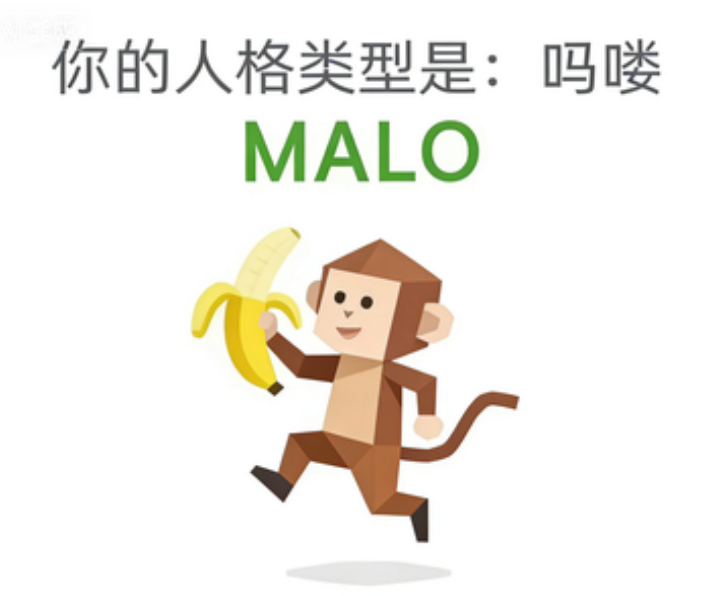
MALO Malu
MALO represents an atavistic phenomenon in the SBTI personality spectrum, with a cognitive architecture displaying typical "pre-civilization" characteristics. This personality type is not merely a popular variant of "immaturity" or "irresponsibility", but a complete rejection of modern disciplinary systems. There exists a unique decoupling pattern between the brain's reward circuitry and the prefrontal cortex in MALO individuals, enabling them to exhibit unusual calmness when faced with delayed gratification tasks—not due to strong self-control, but because future representations inherently lack emotional weight in their cognitive system. MALO lives in the moment, yet this "moment" is not the mindful awareness pursued by mindfulness practices, but a structural narrowing of time perception ability.
Core Cognitive Architecture
MALO's cognitive system is built on three mutually reinforcing foundations: sensation priority, impulsive action, and emotion dominance. Sensation priority manifests as high sensitivity and immediate responsiveness to external stimuli—MALO's attention system acts like a searchlight, captured by brightness, novelty, and intensity, while showing significant filtering effects on repetitive, abstract, and delayed information. At the neurocognitive level, this corresponds to overactivation of the thalamic-amygdalar pathway, resulting in MALO encoding immediate sensory experiences with significantly higher density than the population average, while encoding abstract representations requiring working memory maintenance sparsely.
Impulsive action is the overt behavioral hallmark of the MALO personality, yet its core is not "lack of self-control" or "short-sightedness" in the traditional sense. MALO's action impulses stem from an immediate matching mechanism between internal states and external opportunities—when internal needs (hunger, boredom, curiosity, libido) align with external satisfaction opportunities, MALO experiences an irresistible drive to act. This drive does not arise through a "decision-making" process, but is activated through a "recognition" process. Thus, MALO's "impulsiveness" is essentially a highly contextual adaptive strategy: in environments with uncertain resources and unstable rules, immediate acquisition holds higher survival value than delayed waiting. This also explains why MALO may exhibit significant depressive or anxious reactions in highly structured environments—not due to lack of freedom, but energy stagnation caused by suppression of their action trigger mechanism.
Emotion dominance constitutes MALO's evaluation system. MALO's value judgments are not based on cost-benefit calculations or internalized social norms, but on immediate emotional tone—act if it "feels right", flee if it "feels wrong". This "affect heuristic" allows MALO to make surprisingly fast decisions in complex situations, but may also lead to systematic biases. Longitudinal tracking data shows that MALO individuals demonstrate significantly higher engagement in creative industries, emergency rescue, extreme sports, and other fields compared to control groups, yet their occupational stability scores show extreme distribution—there is a clear differentiation in living conditions between highly adaptive MALOs and drifting MALOs.
Typical 15-Dimension Profile
MALO's self-evaluation shows situation-dependent fluctuations rather than a stable trait level. In moments of feeling good, MALO may exhibit excessive self-aggrandizement; in moments of feeling bad, they may spiral into self-deprecation. This instability stems from over-coupling between their self-concept and immediate emotional states, lacking a core sense of self independent of emotional fluctuations.
MALO has intuitive understanding of their sensory preferences and behavioral patterns, yet this understanding is implicit and non-verbal. When asked to "describe yourself", MALO often struggles—not due to lack of self-awareness, but because their self-knowledge is stored as procedural memory rather than declarative memory, making it difficult to translate into abstract labels.
MALO's value system is anchored in "experience maximization" rather than "achievement accumulation" or "moral perfection". This value orientation makes MALO confused or annoyed by inquiries into "the meaning of life"—meaning is not obtained through construction, but emerges naturally through immersive experience. MALO is driven by "fun" itself, even if the experience brings no long-term benefits.
MALO's sense of security in intimate relationships shows contradictions. On one hand, MALO has high tolerance for separation and does not feel anxious when alone; on the other hand, MALO is highly sensitive to emotional climates in relationships, with conflict or coldness quickly triggering avoidance responses. MALO needs partners to provide a "secure base" function, yet struggles to fulfill this function themselves.
MALO's emotional engagement intensity is extremely high, yet duration is variable. MALO can experience profound joy, sadness, anger, and love, yet these emotional states change unpredictably like the weather. MALO's "falling out of love" is not a rational exit decision, but a natural result of emotional tone shift—often experienced by partners as cold or irresponsible.
MALO has vague perception of psychological boundaries, easily forming fusion states with others and equally easily withdrawing suddenly when feeling suffocated. This "fusion-escape" cycle is not conscious manipulation, but a natural manifestation of immature boundary regulation ability. MALO experiences no significant cognitive dissonance when depending on others, yet also fails to form stable attachment objects.
MALO tends to view the world as a sensory playground full of opportunities and threats, rather than a system to understand or an opponent to conquer. This "phenomenological worldview" makes MALO naturally indifferent to abstract theories, long-term planning, and systematic analysis—these activities produce no immediate sensory feedback.
MALO's attitude toward rules is instrumental, yet unlike CTRL's strategic utilization, MALO's instrumentality is immediate—rules are broken when hindering immediate gratification, and ignored when not obstructive. MALO lacks interest in exploring the logic behind rules, as well as forward-looking assessment of consequences of rule-breaking.
MALO's sense of meaning derives from the act of "experiencing" itself—playing, exploring, feeling, creating. MALO rarely falls into existential emptiness, because their meaning-generation mechanism is immediate and non-reflective. However, when experiential opportunities are deprived or the sensory system declines, MALO may experience intense existential panic.
MALO's motivational structure is dominated by "avoidance-boredom", with "approach-novelty" as auxiliary. This configuration makes MALO highly persistent when pursuing stimulation, yet may also lead to complete neglect of long-term goals. MALO needs to guard against "novelty addiction"—deficiency in deep relationships and professional abilities caused by excessive pursuit of freshness.
MALO's decision-making process exhibits typical "affect heuristic" characteristics: rapid formation of emotional preferences, verification through action, and adjustment based on feedback. This decision-making style is highly efficient in environments with incomplete information and time pressure, yet may lead to regret cycles in scenarios requiring long-term commitment or high-stakes choices.
MALO's execution system has "pulsatile" characteristics: alternating between high-intensity bursts and complete stagnation. MALO struggles to maintain moderate-intensity sustained effort, as their reward system requires novelty or intensity to activate. This "all-or-nothing" pattern makes MALO perform poorly in long-term projects requiring patience.
MALO's social behavior is highly emotion-dependent. When feeling good, MALO can proactively initiate social interactions, displaying charm and humor; when feeling down, they may withdraw completely. MALO's social network shows characteristics of "broad yet shallow"—numerous superficial connections, few stable friendships.
MALO's regulation of interpersonal distance is contextual. MALO can quickly switch intimacy levels based on immediate comfort, yet this switching often lacks advance warning, confusing relationship partners. MALO's boundaries are "skin-like"—blurred lines between physical contact and emotional exposure, rather than "wall-like" clear separation.
MALO's self-presentation has high emotional authenticity—expressing exactly what is felt in the moment, yet this authenticity lacks temporal consistency. MALO's "authenticity" is snapshot-like rather than narrative, which may lead others to question their credibility—the MALO of yesterday seems not the same person as the MALO of today.
Interpersonal Relationship Topology
MALO typically occupies the "atmosphere regulator" position in social networks—influencing group tone through emotional contagion, rather than through information or power. This position makes MALO extremely popular in scenarios like parties, travel, and creative collaborations, yet encounters difficulties in relationships requiring reliability, consistency, and long-term commitment. MALO's relationship network exhibits a typical "fluid" structure: continuous establishment of new connections and natural attenuation of old ones, lacking deliberate maintenance behaviors.
In the realm of intimate relationships, the core tension MALO faces lies in the "freedom-intimacy paradox". The essence of intimate relationships requires a certain degree of predictability and commitment, which structurally conflicts with MALO's core needs. High-functioning MALOs resolve this tension by seeking "playmate-type partners"—relationships built on shared activities and experiences, rather than emotional dependence or future planning. This "activity-based intimacy" works well when both parties are highly autonomous individuals, yet may lead to compatibility issues when one party needs emotional stability. MALO needs to develop "emotional endurance capacity"—maintaining relationship presence during emotional lulls, rather than only investing during peak experiences.
MALO's conflict resolution style is marked by "avoidance-outburst". MALO will suppress dissatisfaction for long periods until emotional accumulation reaches an unsustainable threshold, then release it in an intense manner. This "emotional debt" pattern is highly destructive to relationships, as conflict triggers are often disproportionate to current events. MALO needs to learn "emotional installment payments"—expressing dissatisfaction immediately and gently when it arises, rather than accumulating it to the breaking point. MALO's apology behaviors are usually accompanied by "compensatory over-investment"—making up for harm by creating new peak experiences, yet this pattern may mask rather than resolve fundamental issues.
Career Niche Analysis
Highly Adaptive Fields
- Creative Industries: Advertising, content creation, art & design, and other fields requiring inspiration and improvisation
- Emergency Services: First aid, firefighting, search and rescue, and other high-intensity scenarios requiring immediate response
- Experience Economy: Tourism guiding, event planning, entertainment industry, and other sectors creating peak experiences
- Freelance Work: Independent creators, digital nomads, and other models with self-managed work rhythms
- Sales & Promotion: Roles relying on emotional contagion and ability to build immediate connections
- Extreme Sports: Professional athletes, outdoor guides, and other paths turning stimulation into career
Challenging Adaptive Fields
- Highly Regulated Roles: Accounting, auditing, compliance, and other professions requiring repetitive precision
- Long-Term Project-Based Work: Academic research, architectural engineering, and other fields with delayed feedback
- High Emotional Labor Professions: Service industries requiring continuous emotional regulation and mask maintenance
- Hierarchical Organizational Environments: Strict reporting relationships and promotion paths limiting autonomy
- Remote Independent Work: Lack of social stimulation and immediate feedback leading to motivational exhaustion
In career development, MALO needs to guard against the "experience trap"—due to their ability to quickly pick up skills in multiple fields, they easily fall into a "jack of all trades, master of none" state of superficial engagement. Long-term career satisfaction for MALO depends on finding a "sufficiently interesting" problem domain—simple repetitive tasks lead to rapid boredom, while completely feedback-free solitary exploration triggers existential anxiety. MALO's optimal career ecosystem is "high variability-high feedback": diverse tasks, immediate feedback, visible outcomes, and frequent social interaction.
In team collaboration, MALO exhibits characteristics of a "catalyst" rather than a "stabilizer". MALO can activate team emotions, break deadlocks, and propose unconventional solutions, yet struggles to take on execution roles requiring sustained investment. MALO's team effectiveness is highly dependent on team composition—in highly structured teams, MALO may be seen as a disruptor; in creative teams, they may become core assets. MALO needs to find organizational cultures that tolerate or even appreciate their unpredictability, or build a personal brand to gain sufficient autonomy.
Developmental Risks & Shadow Traits
The core risk of the MALO personality lies in the excessive expansion of the "tyranny of the present"—inappropriately applying the principle of instant gratification to fields requiring delayed rewards. When MALO faces situations truly demanding long-term investment (such as health maintenance, relationship management, skill accumulation, financial planning), their usual avoidance strategies fail, potentially triggering existential anxiety or depressive reactions. MALO needs to develop "delayed gratification ability"—identifying conflicts between immediate desires and long-term interests, establishing institutional arrangements to support the future self (such as automatic savings, appointment-based commitments, external accountability).
Excessive development of "emotional dependence" is another key risk. When MALO takes emotional states as the sole basis for action, they experience "emotional tyranny"—completely dominated by current feelings, losing autonomy of action. This domination manifests as impulsive behavior during intense emotions, and action paralysis during emotional lulls. MALO needs to establish an observation gap between "emotion-action"—acknowledging the existence of emotions without being completely determined by them, developing the executive ability to "do even when not feeling like it".
In relational dimensions, MALO faces the risk of "depth capacity atrophy". Long-term superficial interaction patterns may lead to degradation of intimate relationship skills—when MALO truly needs emotional support or needs to support others, they may find themselves lacking the ability to maintain long-term relationships. Preventive interventions include: regularly engaging in "deep relationships" (such as therapeutic relationships, spiritual friendships, family commitments), practicing "boredom tolerance" and "presence during emotional lulls" in these relationships; and finding "anchoring relationships" that can accommodate their volatility—usually partners or friends with high inclusiveness and stability.
MALO's "phenomenological self" may evolve into a "fragmented self" in extreme cases—identity diffusion caused by lack of narrative continuity. When MALO's self-versions across different contexts lack integration, they may experience existential confusion of "which one is the real me". Maintaining a "core preference"—stable knowledge about what one likes, dislikes, and values—is crucial for MALO's psychological integration, even if these preferences are difficult to translate into long-term goals.
Integrative Development Path
Impulse Awareness
Identify situational triggers of action impulses, establish an observation gap between "impulse-action". Practice pausing when desires arise, asking: Is this a genuine need, or a habitual situational response? Can I delay the decision by 15 minutes?
Emotion Regulation
Develop non-action-oriented emotional coping strategies, starting with low-stakes situations (such as sitting with boredom, breathing through anxiety instead of escaping). The goal is to build "emotional presence" ability—feeling without immediately eliminating or acting out emotions.
Commitment Practice
Start with small commitments (such as fixed weekly activities, short-term courses), practicing behavioral consistency during emotional lulls. Build successful experiences of "commitment-fulfillment", gradually expanding the time span of commitments.
Depth Exploration
Choose one field for deep investment, accepting the "boredom phase" as an inevitable stage of deep learning. Experience the unique satisfaction brought by delayed gratification through mastering a skill or building a long-term relationship.
Wisdom Integration
Develop "contextual wisdom"—making context-sensitive choices between instant gratification and delayed rewards, freedom and commitment, experience and accumulation. Transforming from "always now" to "wisely choosing when to be present".