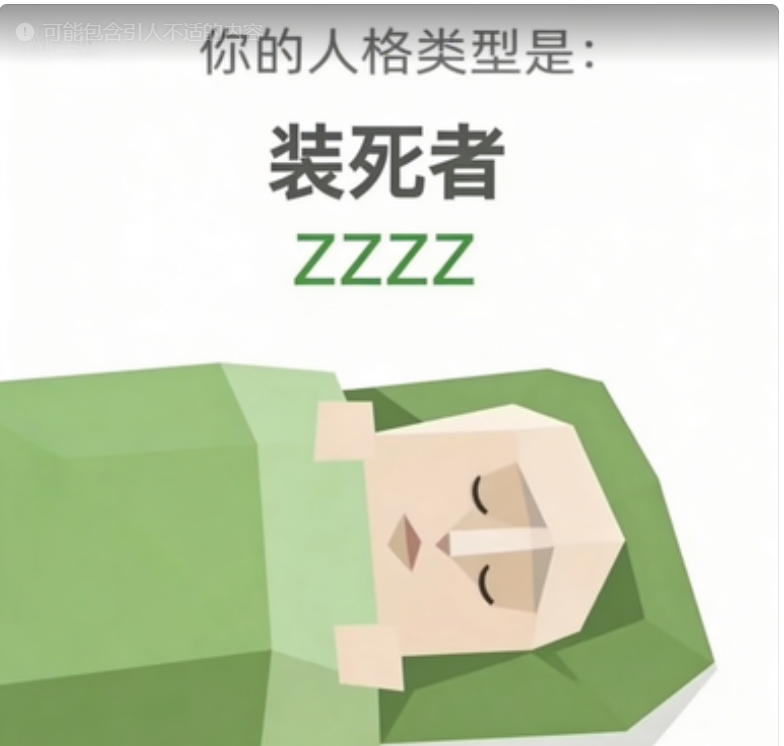
ZZZZ The Ghoster
ZZZZ is the master of cognitive energy conservation in the SBTI personality spectrum, with a psychological operating system optimized for "minimizing energy expenditure" as its highest goal. This personality type is not merely a pathological label of "laziness" or "procrastination", but a highly adaptive survival strategy—in environments with limited resources or thin sense of meaning, it maintains system survival by actively reducing metabolic rate. ZZZZ's Default Mode Network (DMN) in the brain shows significantly higher activity than the Executive Control Network, presenting a typical "introverted-spontaneous" neural coupling pattern. This allows ZZZZ to enter deep cognitive wandering states when there is no external task pressure.
Core Cognitive Architecture
ZZZZ's cognitive system is built on three mutually reinforcing energy-saving mechanisms: Delayed Response, Threshold Triggering, and Burst Compensation. Delayed Response is ZZZZ's default operating mode—when faced with external inputs (tasks, requests, information), ZZZZ's cognitive system does not allocate processing resources immediately, but temporarily stores them in a "pending buffer" to wait for a better processing opportunity or higher-priority signal. This delay is not a decision-making difficulty or execution barrier, but an active cognitive resource management strategy. Neuroeconomic research shows that ZZZZ's anterior cingulate cortex has a unique weight distribution for cost-benefit calculations of "act now-delay action": immediate costs (effort, anxiety) are over-weighted, while delayed costs (opportunity loss, time pressure) are systematically underweighted, forming a stable "inaction now" preference.
The Threshold Triggering mechanism is the key converter that switches ZZZZ from hibernation to activation. ZZZZ does not respond to gradual, vague pressure signals, but only reacts to strong stimuli that cross a specific threshold. This "all-or-nothing" response pattern is similar to the action potential mechanism of neurons—inputs below the threshold cannot trigger output no matter how much they accumulate, and once the threshold is crossed, the system responds with maximum intensity. Behaviorally, this manifests as ZZZZ's extreme sensitivity to "deadlines": when a deadline is a week away, ZZZZ may be completely unable to start a task; but when time pressure reaches a critical point, ZZZZ will burst out with astonishing work efficiency, completing output that would take ordinary people several times longer to achieve. This "deadline warrior" phenomenon is not a failure of time management, but an inherent feature of ZZZZ's cognitive architecture.
Burst Compensation is the typical behavioral pattern of ZZZZ after crossing the threshold. Since the activated state is an energy-intensive abnormal state for ZZZZ, the system generates a strong urge to "shut down immediately upon completion"—once the task meets the minimum acceptable standard, ZZZZ will immediately terminate all related cognitive activities and enter a deeper recovery period. This "sprint-collapse" cycle makes ZZZZ's output curve show extreme peak-valley patterns: long periods of zero output alternate with short periods of excessive output. From an evolutionary psychology perspective, this pattern may be adapted to environments with volatile resources—in ecological niches where food/opportunities are unpredictable, conserving energy to wait for certain opportunities is better than continuous inefficient foraging.
15-Dimension Typical Profile
ZZZZ's self-esteem level shows situational fluctuations. In the short window after "successfully completing a deadline task", ZZZZ experiences peak confidence from competence confirmation; but during long hibernation periods, self-evaluation slides into "lazy self-criticism". This fluctuation stems from ZZZZ overbinding self-worth to output events rather than stable self-efficacy.
ZZZZ's self-concept is highly fluid and situationally embedded. Due to the lack of continuous self-reflection practices (which require cognitive resource investment), ZZZZ often gives contradictory or vague answers to the question "who am I"—being both a high-potential capable person and a failure who cannot start. This self-ambiguity is a byproduct of energy-saving strategies.
ZZZZ's value system is anchored around "comfort maintenance" rather than achievement acquisition or self-actualization. This value configuration makes ZZZZ appear alienated or indifferent to mainstream success narratives (wealth, status, recognition), but may also lead to existential emptiness—when comfort itself becomes the only goal, the goal loses its transcendent dimension.
ZZZZ often plays the "low-maintenance" role in intimate relationships, but this low demand may stem from fear of dependence rather than true independence. ZZZZ worries that their "inactive" traits will become a burden on relationships, thus preemptively reducing intimacy investment, forming a defensive pattern of "I leave first to avoid being left".
ZZZZ's emotional expression has characteristics of "energy-saving mode"—deep emotional experiences exist, but expression is highly compressed. ZZZZ avoids high-energy scenarios of emotional conflict, tending to use silence, avoidance, or humor to defuse instead of direct emotional communication. Long-term avoidance may lead to disuse atrophy of emotional muscles.
ZZZZ's needs for interpersonal distance are contradictory: craving understanding and acceptance while fearing excessive energy extraction. ZZZZ's boundary setting is often "passive defensive" rather than "active declarative"—maintaining distance through delayed responses, vague commitments, or physical avoidance instead of clear communicative negotiation.
ZZZZ's worldview has a color of "mild pessimism" or "existential burnout". ZZZZ tends to believe that most efforts ultimately amount to nothing, so investment itself is irrational. This cognitive pattern is both a rationalization of energy-saving strategies and a cognitive product of long-term low dopamine states.
ZZZZ's attitude toward rules is "instrumental disregard"—rules are neither internalized nor resisted, but ignored until actual consequences arise. ZZZZ is adept at finding enforcement loopholes and supervision blind spots in rules, maintaining minimum compliance in gray areas. This "rule arbitrage" ability is an advantage in loose environments but a risk in strict ones.
ZZZZ's sense of meaning is thin and fragmented. ZZZZ rarely has a coherent life narrative or long-term goals, with time perception focused on "present-near term", and distant future appearing as vague gray noise. This "temporal myopia" is both an energy-saving strategy (long-term planning consumes cognitive resources) and a source of existential risk.
ZZZZ's motivational structure is dominated by "avoidance-failure" with "approach-achievement" as auxiliary. This configuration means ZZZZ can only activate action when the threat of failure is imminent, while remaining stationary during opportunity windows. ZZZZ needs to learn to use "wanting" rather than "having to avoid" as a starting signal.
ZZZZ's decision-making process shows characteristics of "infinite delay"—avoiding irreversible choices by continuously collecting information, waiting for better timing, and considering more options. This "decision paralysis" is a manifestation of ZZZZ's hypersensitivity to choice costs (opportunity cost, regret risk), which needs to be resolved by setting "good enough" standards.
ZZZZ's execution system is characterized by "pulsatile" rather than "sustained" mode. ZZZZ struggles to maintain long-term, low-intensity effort but can concentrate all resources for explosive output in a short time. This execution mode requires specific environmental coordination—clear deadlines, low-distraction environments, and task divisibility.
ZZZZ has extremely high social activation costs, needing to overcome significant psychological inertia to enter social scenarios. But once activated, ZZZZ can maintain basic social functions and even show repressed social needs. ZZZZ's social mode is "low-frequency-high depth"—a small number of deep connections are better than an extensive shallow network.
ZZZZ's boundary awareness is dominated by "physical-energy" dimensions rather than "emotional-psychological" ones. ZZZZ is highly sensitive to spatial intrusion (unexpected visits, forced coexistence) and energy extraction (being required to respond immediately, continuous output), but has vague boundaries for emotional intimacy or self-disclosure.
ZZZZ's self-presentation has "low-energy authenticity"—not actively pretending, but also not actively clarifying. ZZZZ tends to let others form impressions of themselves rather than managing those impressions. This "passive authenticity" may lead to being misunderstood as indifferent or uncaring, which is actually a byproduct of cognitive resource conservation.
Time Perception & Subjective Tense
ZZZZ's time experience has systematic deviations from the norm, which is the deep foundation of their cognitive energy-saving strategies. In ZZZZ's subjective time map, "now" is over-expanded, "future" is compressed and vague, and "past" is selectively forgotten to maintain the consistency of self-narrative. ZZZZ's "now" is not an instantaneous present, but an extended, low-intensity continuous state—in this state, the speed of time passing is subjectively slowed down, and urgency signals from the external world are attenuated and filtered. This "temporal viscosity" experience allows ZZZZ to maintain psychological time stillness amid the passage of physical time, thereby delaying the accumulation of anxiety.
ZZZZ's representation of "future" has a unique topological structure. Unlike goal-oriented personalities such as CTRL, ZZZZ's future is not a path composed of a series of achievable milestones, but a uniform, undifferentiated gray area. In this future view, tomorrow is essentially no different from next year, both coded as the same category of "I'll deal with it later". This "temporal flattening" is both an energy-saving strategy (detailed future planning consumes a lot of cognitive resources) and the reason why ZZZZ struggles to start long-term projects—when the future lacks structure, present actions lose direction vectors. ZZZZ needs to use external deadlines to artificially create topological differences in the future, cutting uniform time into urgent intervals of "before-after".
ZZZZ's memories of the "past" are highly plastic, serving the maintenance of current self-states. After successfully completing a deadline task, ZZZZ will strengthen the narrative of "I always burst at critical moments"; during long hibernation periods, ZZZZ will forget past successful experiences and strengthen the self-label of "I just can't start". This "state-dependent memory" makes it difficult for ZZZZ to form stable self-continuity, with identity showing fragmented characteristics at different time points. ZZZZ needs to establish an external achievement recording system (such as completion logs, portfolios) to counteract this memory plasticity and maintain the coherence of self-narrative.
Cognitive Output During Hibernation
ZZZZ's long hibernation period is not cognitive idling, but a special form of "default mode innovation". Neuroimaging studies show that when external task demands decrease, the brain's Default Mode Network shifts to internal memory integration, future simulation, and creative association. ZZZZ's extended hibernation period actually provides a lot of "cognitive wandering" time—in this state, the stream of consciousness freely connects without goal constraints, generating distant associations and paradigm breakthroughs that are difficult to appear in conventional focused states. Many creative breakthroughs in history (such as Kekulé's discovery of the benzene ring structure, Descartes' invention of coordinate systems) have been reported to occur in relaxed non-working states, suggesting that ZZZZ's cognitive mode may have untapped creative potential.
ZZZZ's "procrastination" behavior often embeds "latent preparation"—apparent inaction masks subconscious information accumulation and problem deconstruction. While waiting for deadlines, ZZZZ is actually unconsciously collecting materials, switching perspectives, and rehearsing solutions, only this preparation does not appear in explicit, reportable forms. When the deadline finally triggers action, ZZZZ's burst output does not start from scratch, but is a rapid assembly based on this latent preparation. Understanding this is crucial for ZZZZ's self-acceptance: your procrastination is not pure waste, but a special cognitive rhythm—only this rhythm conflicts with the time discipline of industrial society.
However, ZZZZ needs to guard against the self-deception of "latent preparation"—when all delays are rationalized as "I'm thinking subconsciously", ZZZZ may lose the ability to distinguish between genuine cognitive accumulation and pure avoidance behavior. Establishing externalization practices such as "preparation logs" or "thinking drafts" can help ZZZZ transform latent preparation into traceable, evaluable explicit progress, thereby enhancing self-efficacy while maintaining cognitive rhythm.
Career Niche Analysis
High-Fit Fields
- Creative Writing/Artistic Creation: Deadline-driven inspiration bursts and deep immersion
- Freelance/Project-Based Work: Self-arranged work rhythm, avoiding continuous office hours
- Crisis PR/Firefighter Roles: Rapid response and high-load tolerance in emergency situations
- Academic Research (Specific Stages): Paper sprints after long-term thinking
- Night Shift/Rotating Shift Work: Non-standard time structures, avoiding morning pressure
- Independent Game Development: Long-cycle latent preparation and pre-release bursts
Fit Challenge Fields
- Standardized Process Positions: Conflicts between continuous stable output requirements and ZZZZ's rhythm
- Customer Service/Reception: Contradictions between immediate response requirements and delay preferences
- Early-Morning Organizational Culture: Mismatch between biological rhythm and social expectations
- Long-Term Monotonous Projects: Motivation exhaustion due to lack of deadline feedback
- High-Visibility Management Roles: Conflicts between continuous performance pressure and energy-saving needs
The core tension ZZZZ faces in career development lies in the "rhythm-institution" conflict. Modern work systems are built on the assumption of "continuous stable output", while ZZZZ's cognitive architecture is characterized by "pulsatile output". Forcing adaptation to standard work systems leads to chronic burnout and self-alienation for ZZZZ, while completely rejecting institutional constraints may result in economic insecurity and social marginalization. ZZZZ's optimal strategy is to find "rhythm-friendly" career ecosystems: project-based rather than process-based, result-oriented rather than time-based assessment, asynchronous collaboration rather than synchronous response, remote work rather than physical presence.
In team collaboration, ZZZZ needs to establish "expectation management" mechanisms—proactively communicating their work rhythm and response delays to avoid being misunderstood as irresponsible due to silence. ZZZZ can develop "predictive response" skills: even if the task is not completed, provide progress updates within a reasonable time after receiving requests to maintain relational trust. ZZZZ's best team role is a "key node contributor"—investing high-intensity resources in specific project stages (such as idea generation, crisis handling, final integration) rather than a "daily maintainer".
Developmental Risks & Shadow Traits
The core risk of ZZZZ personality lies in the self-reinforcement of the "energy-saving trap". Energy-saving strategies effectively reduce psychological costs in the short term, but long-term implementation leads to the degradation of "energy-saving capacity" itself—ZZZZ becomes increasingly unable to activate high-energy states, with the energy-saving threshold continuously lowering, eventually falling into depressive numbness of "too lazy to even save energy". This variant form of "learned helplessness" does not stem from accumulated failures, but from excessive reinforcement of successful energy-saving. ZZZZ needs to regularly make "energy expenditure investments"—proactively entering high-challenge situations to maintain muscle memory of activation ability and prevent excessive rigidity of the energy-saving system.
Compound accumulation of "time debt" is another key risk. ZZZZ's delay strategy may be optimal in a single decision, but multiple delays lead to irreversible loss of time resources—closing opportunity windows, exhausting relational trust, and declining physical capacity. ZZZZ often underestimates the compound effect of time debt, regarding "I'll deal with it later" as a zero-cost option, while in fact each "later" compresses the future possibility space. Establishing "time cost visualization" tools (such as opportunity cost calculators, remaining time estimates) can help ZZZZ more realistically perceive the cost of delay.
In the dimension of self-identity, ZZZZ faces the risk of internalizing the "loser narrative". When society continuously pathologizes ZZZZ's rhythm as "procrastination", and when ZZZZ repeatedly compares their output curve with "normal" others, profound self-negation arises. This self-negation itself becomes a new energy-saving barrier—if I'm a loser, why bother trying? ZZZZ needs to develop a cognitive framework of "rhythm pluralism": understanding that their pulsatile output is a legitimate form of cognitive diversity rather than a defect to be cured. Seeking identity support from ZZZZ communities or similar personalities to counter the hegemony of mainstream narratives.
ZZZZ's intimate relationships may fall into the dual fear of "energy vampire" or "abandonment". ZZZZ fears both being excessively drained of energy by partners (leading to deeper hibernation) and being abandoned due to their low responsiveness. This dual fear causes ZZZZ to adopt a "preemptive alienation" strategy in relationships—leaving before potential harm or refusing to enter deep commitment. ZZZZ needs to find partners who understand and respect their rhythm, establishing an intimate mode of "low-frequency-high quality" rather than forcing themselves to adapt to the mainstream template of "high-frequency-continuous presence".
Integrated Developmental Path
Rhythm Recognition
Track and record your energy fluctuation cycles, identifying patterns of high-energy windows and low-energy periods. Understand your "deadline response curve"—how long before a deadline you start feeling anxious, start taking action, and reach peak efficiency. The goal is to cooperate with your own rhythm rather than fight against it.
Artificial Deadline Creation
Learn to set "fake deadlines" for yourself—break down large tasks into multiple subtasks with intermediate deadlines, creating necessary urgency signals to trigger ZZZZ's response system. Use external commitment mechanisms (public commitments, accountability partners) to enhance the binding force of fake deadlines.
Minimum Launch Protocol
Develop "two-minute rule" and "micro-launch" skills—reduce the activation cost of tasks to a minimum (such as "just open the document and write one sentence"), utilizing ZZZZ's behavioral inertia of continuing once started. The focus is on tricking the gatekeeping mechanism of the energy-saving system rather than relying on willpower.
Meaning Reconstruction
Explore sources of value beyond "comfort maintenance"—experience the positive cycle of "investment-output-meaning" through small-scale commitments, volunteer services, or creative projects. The goal is not to become a high achiever, but to break the closed loop of "no goals-no action-no meaning".
Rhythm Negotiation Ability
Develop the ability to negotiate personal rhythms with social systems—including negotiating remote work arrangements, project-based contracts, asynchronous communication protocols, etc. From hiding your rhythm to proactively advocating for it, finding ZZZZ-friendly niches in the social ecosystem.