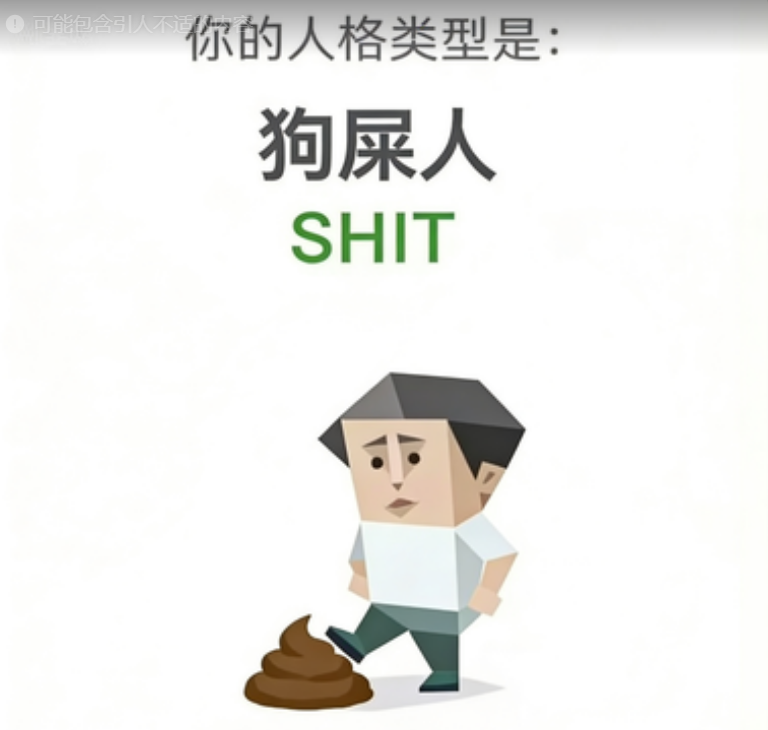
SHIT Reluctant Hero
SHIT is the cognitive outlier in the SBTI personality spectrum, with psychological structure showing unique "critical-constructive" paradoxical coupling. This personality isn't simple pessimism or accumulation of negative emotions, but a complex compound of highly developed reality-testing mechanisms and idealistic core. SHIT's nervous system has abnormal sensitivity to cognitive dissonance, automatically detecting minute gaps between environmental statements and objective reality. This detection capability may originate from defensive adaptation to deceptive social signals in evolutionary psychology, but evolves in modern contexts into persistent scanning of systemic hypocrisy.
Core Cognitive Architecture
SHIT's cognitive system rests upon "de-idealization" foundation, but this de-idealization isn't cynical abandonment—it's cognitive clearing surgery. SHIT's brain automatically strips rhetorical sugar-coating from social narratives, exposing the rough skeleton of power operations. This cognitive style typically develops from repeated "expectation-disillusionment" cycles in early development: when individuals repeatedly experience fractures between trusted objects' (parents, institutions, cultural symbols) idealized images and real behaviors, they develop preventive cognitive defense—actively lowering expectations to avoid disappointment. However, unlike true pessimists, SHIT's defense mechanism retains a key cognitive module: clear perception of "ought." SHIT can precisely describe how the world should be, providing reference frame for their criticism.
SHIT's paradoxical core lies in "affirmation through negation" behavioral logic. SHIT's persistent criticism isn't to prove the world hopeless, but to screen out truly worthwhile constructive materials from the ruins. This "destructive construction" mode gives SHIT unique value in innovation: they excel at identifying structural defects in existing systems, and accidentally open new possibility spaces while dismantling these defects. Neuroimaging studies show SHIT personality's prefrontal cortex activation patterns when processing negative information highly overlap with creative problem-solving tasks, indicating shared neural foundations between critical thinking and creative thinking in SHIT's cognitive architecture.
SHIT's emotional regulation mechanism shows "externalization-actionization" characteristics. When facing negative emotions (powerlessness, disappointment, anger), SHIT tends to transform them into critical speech or behavior targeting external systems, rather than inward self-attack or emotional rumination. This externalization strategy has dual functions: avoiding depressive self-focus on one hand, gaining symbolic mastery over chaotic reality through "naming" behavior on the other. However, this mechanism also has adaptive costs: SHIT may develop excessive dependence on negative emotions, because emotional activation has become the startup signal for their cognitive function, leading to cognitive stagnation or existential boredom in peaceful environments.
15-Dimension Typical Profile
SHIT's confidence builds upon cognitive ability rather than social recognition. They believe they "see clearly," this metacognitive confidence maintaining independence in group pressure. SHIT's self-esteem doesn't depend on external evaluation, but on internal confirmation of self-cognitive accuracy—"did I correctly identify reality's hypocrisy" becomes core self-esteem indicator.
SHIT has high clarity about their positioning as "system outlier." They are aware of structural tension with mainstream values, but this awareness doesn't accompany identity crisis—it's integrated as core component of self-concept. SHIT's "who am I" narrative typically includes role positioning such as "awakener" or "truth-teller."
SHIT shows significant alienation from traditional "success" values (wealth, status, power). This low value identification doesn't stem from capability deficiency, but from insight into power mechanisms behind these values. SHIT's value system centers on "authenticity" and "critical participation," rather than accumulative or competitive goals.
SHIT shows "ambivalent attachment" characteristics in intimate relationships: both craving deep connection and expecting betrayal or misunderstanding. This expectation isn't based on specific experience, but on cognition of universal human vulnerability. SHIT needs partners capable of "being criticized without defensiveness," this need filtering out highly secure or equally critical partners.
SHIT's emotional investment is regulated by "cognitive review" mechanism. Before entering deep emotional states, SHIT automatically scans for power asymmetries or potential hypocrisy in relationships. This review protects SHIT from exploitation, but also delays or blocks natural flow of emotions, causing "analysis paralysis" in relationships.
SHIT's psychological boundary maintenance has high alertness. They view dependence as potential power surrender, therefore showing extreme sensitivity to any form of control or manipulation. SHIT's independence is defensive independence—maintaining self-sufficiency to avoid being captured or exploited by systems.
SHIT's basic assumption about the world is "structural hypocrisy" rather than "benevolence." This low trust tendency enables rapid identification of deceptive signals, but may also cause "false positive" errors—misreading neutral or benevolent behavior as manipulation. SHIT's worldview is a "defensive realism."
SHIT's attitude toward rules is "strategically flexible." They refuse to internalize rules as moral obligations, viewing them as external constraints requiring legitimacy assessment. When rules are seen as unjust or hypocritical, SHIT will unhesitatingly find ways to bypass or violate them, without accompanying guilt reactions.
SHIT shows profound skepticism toward traditional life meaning frameworks (career achievement, family fulfillment, social contribution). This low meaning isn't from existential emptiness, but from insight into ideological functions behind these frameworks. SHIT is in the process of finding alternative meaning sources (art, knowledge, small-scale communities).
SHIT's motivation structure is dominated by "avoidance-failure," but this avoidance isn't passive fear reaction—it's active "refusal to participate." SHIT rationalizes their non-involvement by identifying systems' "inevitability of failure," this cognitive strategy protecting self-esteem but also limiting experiential richness.
SHIT's decision process takes "risk scanning" as prerequisite step. Before making choices, SHIT systematically enumerates possible negative outcomes, this "disaster rehearsal" serving as both anxiety management strategy and decision quality assurance mechanism. SHIT's decision speed is slower, but regret rate is lower.
SHIT's execution system is characterized by "pressure-driven." Without external pressure, SHIT may show significant procrastination or avoidance; but under crisis or deadline pressure, will explode with extremely high execution efficiency. This "intermittent sprint" mode relates to SHIT's perception of systemic hypocrisy—only urgency can prove action's necessity.
SHIT's social initiative has "selective" characteristics. They avoid mainstream social scenes, but show high activity in subcultural groups or critical communities. SHIT's social behavior is "seeking similar others" oriented, rather than social network expansion. Once potential similar others are identified, SHIT rapidly establishes deep connections.
SHIT has high sensitivity to interpersonal intrusion. They view unsolicited advice, emotional demands, or value imposition as boundary violations, responding with direct even aggressive methods. This "high wall" strategy filters out relationships respecting their autonomy, but may also lead to isolation.
SHIT's self-presentation has "situational splitting" characteristics. In mainstream environments, SHIT may display "pseudo-normal" masks conforming to social expectations; but in safe environments, rapidly switch to critically authentic self. This splitting isn't inauthenticity, but necessary adaptation to systemic hypocrisy.
Interpersonal Topology
SHIT typically occupies paradoxical "edge-center" positions in social networks: edge in mainstream networks, center in critical subgroups. This position makes SHIT "translators" or "messengers" between different systems—able to translate mainstream systems' operational logic into critical language, and vice versa. SHIT's relationship network shows "sparse-depth" structure: few highly trusted relationships coexisting with numerous functional or situational connections. SHIT shows significant rejection of "acquaintance" concept, binary dividing interpersonal relationships into "authentic relationships" and "fake relationships," lacking middle ground.
In intimate relationships, SHIT's core tension lies in "authenticity-acceptability" paradox. SHIT craves complete acceptance, but their fully authentic self-expression (including criticism, negative emotions, dissatisfaction with the world) often exceeds partners' acceptance range. High-functioning SHIT solves this tension through developing "layered authenticity" strategy: displaying "manageable authenticity" in early relationship stages, gradually releasing deeper criticism as trust accumulates. However, this strategy conflicts with SHIT's internal requirements for "authenticity," potentially leading to self-loathing or relationship burnout.
SHIT's conflict handling style is marked by "direct confrontation." SHIT refuses traditional conflict avoidance strategies (such as silence, topic shifting, false reconciliation), tending to escalate conflicts to "meta-communication" level—not just arguing specific issues, but arguing rules and premises of conflict itself. This "conflict about conflict" mode causes relationship rupture when partners lack equivalent communication capabilities, but can establish exceptionally clear interaction rules when partners possess them. SHIT needs to recognize differences between "winnable battles" and "draining battles," avoiding wasting energy on unchangeable systemic characteristics.
Career Niche Analysis
High-Fit Domains
- Investigative Journalism: Systematic exposure of power operations and conflicts of interest
- Auditing/Compliance: Identifying violations and inefficiencies in organizational processes
- Independent Creation: Critical expression in literature, art, music
- Academic Research: Especially ideological criticism, political economy
- Social Movements: Advocacy, organization, strategy planning
- Cybersecurity: Penetration testing, vulnerability mining (legitimization of systematic destruction)
Challenging Domains
- Customer Service: Conflict between emotional labor requirements and authenticity needs
- Sales/Marketing: Conflict between systematic persuasion and critical self-image
- Middle Management: Tension between executing superior orders and recognizing order stupidity
- Highly Ritualized Professions: Military, religion, and other fields requiring unconditional obedience
- Brand PR: Conflict between maintaining organizational image and impulse to expose organizational problems
SHIT needs to beware "critical burnout" in career development—cognitive resource depletion from long-term maintenance of high alert states. SHIT's critical capability is a limited cognitive resource requiring strategic allocation. Optimal career ecology is "intermittent deep involvement": allowing SHIT to invest full critical energy in specific projects, then enter recovery periods, rather than requiring continuous critical output. SHIT shows unique "antifragile" characteristics in entrepreneurship: excelling at discovering needs ignored by mainstream in market gaps, and gaining survival space through challenging existing players.
In organizational environments, SHIT typically experiences "honeymoon-disillusionment-confrontation-exit" cycles. SHIT needs to identify organizational cultures' "critical tolerance thresholds"—some organizations tolerate even reward critical thinking, while others view it as disloyalty. SHIT's optimal strategy is finding "constructive dissenter" roles: positions formally authorized to point out problems (such as internal audit, quality inspection, consultant), transforming criticism from marginal behavior into organizational function. SHIT leaders need deliberate practice of "affirmative feedback"—acknowledging progress while pointing out problems, this balance challenging their natural tendencies but crucial for team morale.
Developmental Risks and Shadow
SHIT's core risk lies in "critical hardening"—degeneration from instrumental criticism to identity criticism. When criticism becomes the only pillar of self-concept, SHIT falls into automatic mode of "criticizing for criticism's sake," refusing to acknowledge any positive development possibilities, because this would threaten their "see through everything" self-image. This hardening causes SHIT to degenerate from "sharp observer of reality" to "refusing-to-participate nihilist," losing ability to achieve constructive change through criticism. SHIT needs regular examination of their critical behavior's function: is this to reveal truth, or to maintain superiority of "I'm the only awake one"?
"Emotional cynicism" is another key risk. Long-term maintenance of distrust attitudes toward the world leads to adaptive changes in emotional systems: SHIT may lose ability to experience pure pleasure, trust, or hope, even when these experiences are objectively available. This emotional atrophy isn't active choice, but nervous system adaptation to continuous negative expectations. Preventive interventions include: deliberately recording and reflecting on "unbetrayed trust" instances, building counter-evidence library that "the world isn't always hypocritical"; and participating in activities requiring temporary suspension of criticism (such as improv theater, meditation, physical practice), to maintain emotional system plasticity.
In relationship dimensions, SHIT faces "dying alone" risk. Their extreme requirements for authenticity and high sensitivity to intrusion filter out most potential partners, leading to extremely restricted relationship choices. SHIT needs to develop "good enough relationship" concept—accepting partners' limitations in certain dimensions, rather than requiring all-round契合. This acceptance isn't compromise, but deeper understanding of human complexity: everyone has their hypocrisy, including SHIT themselves. SHIT also needs to beware "criticism as intimacy barrier" pattern—using criticism of partners to create emotional distance, avoiding vulnerability exposure.
SHIT's "constructive transformation" failure may lead to existential crisis. When SHIT long-term cannot transform their criticism into any constructive output, they experience comprehensive collapse of meaning—if the world indeed is a pile of shit as I see it, and I'm powerless to change anything, then what is the meaning of my existence? This crisis's resolution path doesn't lie in abandoning criticism, but in finding "small-scale construction" outlets: no need to save the world, just prove in a small scope (one community, one project, one relationship) that criticism can lead to improvement. This "local optimism" is necessary condition for SHIT maintaining psychological balance.
Integrative Development Path
Critical Awareness
Identify automatic nature of critical impulses, establish observation gap between "criticism-action." Practice pausing when criticism arises, asking: is this evidence-based evaluation, or defensive habitual reaction? Distinguish "criticism of things" from "attack on people."
Vulnerability Exposure
Experiment "non-critical existence" in safe relationships—sharing hopes, fears, needs without packaging them as analysis or sarcasm. Goal is establishing implicit memory that "I can be known without being judged," gradually expanding vulnerability expression range.
Constructive Experiment
Select a small-scale project (community garden, open-source contribution, mentorship), invest constructive energy and observe results. Goal is accumulating empirical evidence that "criticism can transform into improvement," combating nihilistic tendencies.
Complexity Accommodation
Develop "non-dual cognition"—accepting same objects can simultaneously possess hypocrisy and sincerity, selfishness and altruism, destructiveness and constructiveness. Abandon "all-good/all-bad" classification impulse, practice maintaining action capability in ambiguity.
Wise Cynicism
Shift from "refusing-to-participate cynic" to "selectively-participating cynic." Identify constructive domains worth investing in, accepting compromises and disappointments accompanying investment. Goal is becoming mature SHIT who "knows the world is a pile of shit, but still plants flowers in it."