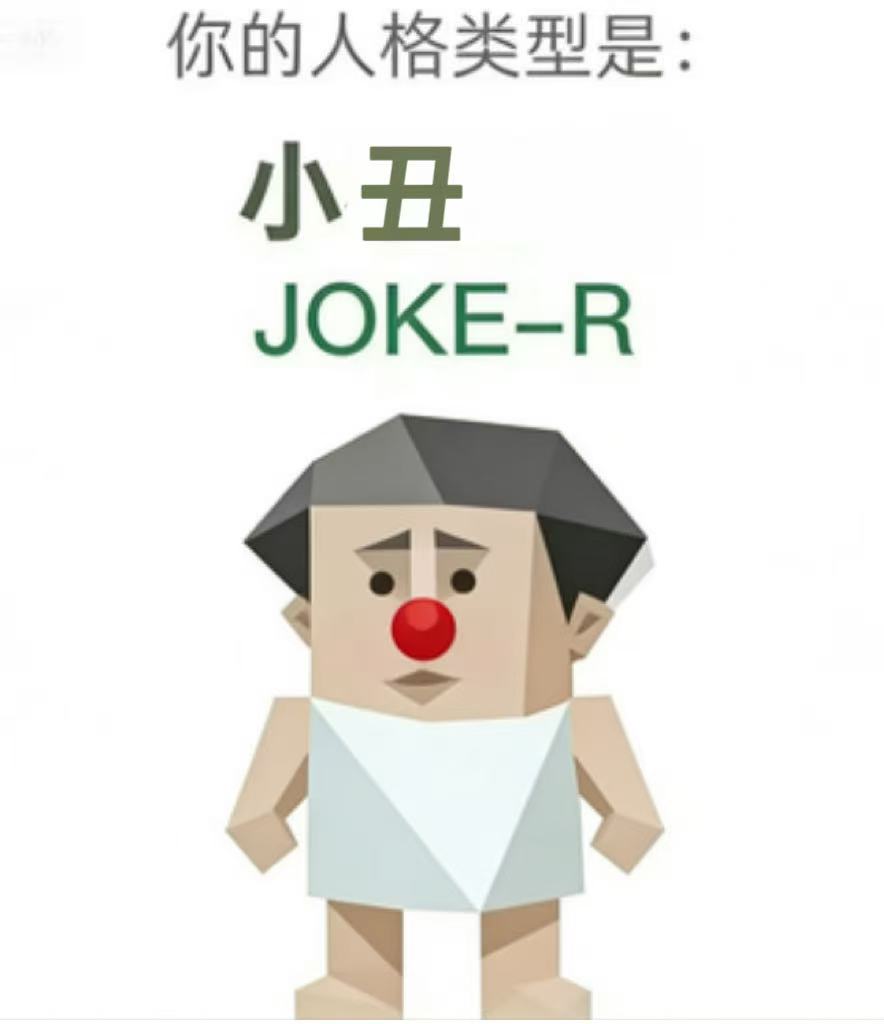
JOKE-R The Clown
JOKE-R is the emotional buffer device in the SBTI personality spectrum, with core mechanism being the transformation of potentially traumatic experiences into manageable narrative material through comedic reconstruction. This personality isn't simply "humor" or "optimism," but the externalization of a highly developed psychological defense fortress—JOKE-R experiences the world as an absurdist play requiring continuous commentary, with themselves as both actor and audience. This meta-position grants JOKE-R unique emotional regulation capabilities, but also creates structural tension between authentic self and performed self.
Comedy Defense Psychodynamics
JOKE-R's humor mechanism builds upon "emotional distancing" cognitive strategy. When facing potentially threatening stimuli, JOKE-R automatically activates "comedic reconstruction" program—transforming events from "something happening to me" into "something that can be told." This temporal folding (pushing present experience toward past-tense narrative) creates a cognitive buffer zone, allowing JOKE-R to complete defensive processing before emotional impact fully registers. Neuropsychological research shows JOKE-R personality's amygdala-prefrontal coupling pattern presents unique "delayed response" characteristics—emotional signals have already undergone linguistic/symbolic preprocessing before reaching conscious awareness.
This defense mechanism's development is typically associated with early environmental experiences of emotional invalidation. JOKE-R learned during growth: direct expression of pain won't receive expected responses, while packaging it as entertaining narrative can maintain connection and avoid rejection. Therefore, JOKE-R's humor isn't merely a personality trait, but an internalized relational survival strategy—ensuring position security in social fields by becoming "the funny one." This explains why JOKE-R often shows significantly different emotional tones when alone compared to public image—when there's no audience, comedy performance loses functional value, and suppressed emotional content begins to emerge.
JOKE-R's creativity stems from their unique "marginal perspective"—long-term occupation of social edge positions (both participating and observing) has developed JOKE-R's keen insight into group dynamics. JOKE-R can instantly identify tension points, power relations, and unspoken rules in situations, transforming them into comedic material. This "overdeveloped social cognition" is JOKE-R's core talent, but also constitutes their existential dilemma: when everything can be commented on, what is worth taking seriously? JOKE-R's core existential challenge is "meaning inflation"—through excessive deconstruction, all value symbols may lose their weight.
15-Dimension Typical Profile
JOKE-R's self-evaluation shows "performative self-esteem" characteristics—displaying confidence even arrogance in public domains, but experiencing profound self-doubt privately. This split stems from over-binding self-worth to external feedback (laughter, attention, recognition) rather than internal standards. When audiences are absent, JOKE-R easily falls into existential anxiety of "whether I'm worth existing."
JOKE-R's self-boundaries have high permeability and situational dependency. To adapt to different social situations, JOKE-R rapidly switches persona masks, leading to persistent delay in "authentic self" perception. JOKE-R often cannot answer questions like "what do you truly want," because their desire expression mechanism has been colonized by comedic reconstruction.
JOKE-R's value system centers on "connection maintenance" rather than traditional achievement or moral principles. JOKE-R will suppress personal positions to maintain group harmony, with "easygoing" appearance masking fear of conflict and sensitivity to rejection. This value configuration makes JOKE-R show adaptive difficulties in moral dilemmas requiring firm stances.
JOKE-R shows "ambivalent-avoidant" mixed patterns in attachment relationships. On one hand craving deep connection, on the other hand fearing rejection after true exposure. JOKE-R tests relationship tolerance through humor—gradually exposing "darker" content, observing whether the other still accepts. This testing behavior is both protection and self-sabotage.
JOKE-R's emotional investment is regulated by comedic mechanisms. When emotional intensity exceeds thresholds, JOKE-R automatically activates humor defense, transforming tender moments into jokes. This "emotional short-circuit" protects JOKE-R from vulnerability exposure risks, but also prevents true intimacy establishment. JOKE-R needs to learn staying in discomfort.
JOKE-R's boundary management shows "permeability" characteristics—physical boundaries may be clear, but emotional boundaries highly blurred. JOKE-R easily absorbs others' emotional states and transforms them into comedic material. This "emotional sponge" trait makes JOKE-R excellent at empathy, but also leads to high risk of emotional exhaustion.
JOKE-R's worldview takes "absurdism" as底色—world experienced as random event sequences lacking inherent meaning but full of comedic potential. This worldview provides existential buffering (since nothing has meaning, failure isn't so terrible), but may also lead to agency loss (since nothing has meaning, effort loses its rationale).
JOKE-R's attitude toward rules is "instrumental rebellion"—exploiting rules' loopholes and contradictions to create comedic effects, rather than truly challenging rules themselves. JOKE-R is the gentle satirist of the system, not the revolutionary. This stance allows JOKE-R to obtain relatively safe positions within the system, but also limits transformative potential.
JOKE-R's sense of meaning derives from "creating connection" behavior itself—through humor transforming strangers into audience, audience into community. This meaning generation is relational rather than individual, making JOKE-R easily experience meaning vacuum when alone. JOKE-R needs to develop internal meaning sources independent of audience.
JOKE-R's motivation structure is dominated by "avoidance-humiliation." Behavioral drivers are often avoiding embarrassment, avoiding awkward silence, avoiding being ignored, rather than pursuing clear positive goals. This defensive motivation makes JOKE-R show resilience in crisis situations (defusing tension through humor), but insufficient motivation in goal pursuit requiring long-term commitment.
JOKE-R's decision process is excessively influenced by "audience imagination." JOKE-R prioritizes decisions' "tellability" over actual utility—choosing the option that "can become a good story later" rather than the "most rational" one. This narrative-oriented decision style creates rich life experiences, but may also lead to suboptimal resource allocation.
JOKE-R's execution system is significantly affected by emotional fluctuations and external feedback. Efficient operation when receiving positive feedback, power failure when lacking audience or encountering cold reception. JOKE-R needs to develop "audience-free execution" capability—maintaining action without immediate feedback.
JOKE-R's social initiative has "situational dependency"—able to actively initiate interaction in familiar, supportive environments, but showing social anxiety in unfamiliar or high-pressure environments. JOKE-R's social behavior needs "script" support—clear roles, topics, or activity frameworks; pure open-ended socializing is enormously draining.
JOKE-R paradoxically shows high vigilance in interpersonal boundaries. Although seemingly easygoing and approachable, JOKE-R maintains strict control over "authentic self exposure." Humor becomes boundary management tool—maintaining appearance of closeness through generating laughter while preventing true understanding. This "intimacy at a distance" is JOKE-R's core defense structure.
JOKE-R's self-presentation has high "meta-authenticity"—the performance itself is authentic (authentically needing to perform), but systematic deviation exists between performance content and inner experience. JOKE-R's authenticity lies not in what is said, but in the authenticity of "needing to be watched" itself. Understanding this is key to approaching JOKE-R.
Creativity Structure and Shadow
JOKE-R's creativity stems from unique "cognitive dissonance tolerance" and "rapid reconstruction capability." JOKE-R can establish unexpected connections between seemingly unrelated concepts, the psychological foundation of humor generation. More importantly, JOKE-R's sensitivity to "inappropriateness"—ability to instantly identify taboos, awkwardness, and tension points in situations, transforming them into comedic tension. This sensitivity is both talent and burden, because it means JOKE-R is continuously exposed to society's micro-violences, constantly reminding them of marginal positions.
JOKE-R's shadow side is the "eternal cycle of tragicomedy." When comedy defense becomes automatic response, JOKE-R may lose ability to "take seriously"—not just toward external world, but toward themselves. Profound sadness, anger, or longing are transformed into jokes before reaching conscious awareness, leading to emotional processing blockage. Long-term, this blockage may manifest as chronic depression, substance abuse, or compulsive repetition of relationship patterns. JOKE-R needs to identify when their humor is creative expression versus escapist defense—former brings connection, latter maintains isolation.
JOKE-R plays the ancient "scapegoat-clown" role in groups—voluntarily undertaking group's embarrassment and shame to maintain collective cohesion. This role has functional value, but may also lead to JOKE-R's self-sacrifice. When JOKE-R forever becomes "that funny person," their broader emotional needs and identity possibilities are compressed. JOKE-R needs to learn refusing this role's momentary summons, allowing themselves to be "not funny," "not interesting," "not important" in some situations.
Career Niche Analysis
High-Fit Domains
- Comedy Creation: Stand-up, screenwriting, comedic acting—transforming defense mechanism into productivity
- Content Operations: Social media, viral marketing—keen sense for pop culture
- User Experience Design: Identifying user pain points and transforming into tellable stories
- Psychological Counseling (specific schools): Using humor to build therapeutic alliance, process defenses
- Mediation and Conflict Resolution: Defusing tension through humor, rebuilding communication
- Creative Advertising: Commercial application of unconventional thinking and unexpected connections
Challenging Domains
- Highly Structured Repetitive Work: Lack of improvisation space causes suffocation
- Authority Positions: Management roles requiring being taken seriously trigger internal conflict
- Deep Technical Roles: Long-term solitude and lack of immediate feedback drain motivation
- High-Risk Decision Positions: Tendency to humorize may undermine decision authority
- Traditional Bureaucratic Institutions: Suppression of informality limits expression space
JOKE-R's career development faces the "talent trap"—because of their talent in social lubrication and creative generation, easily fixed in "atmosphere maker" functional positions while deeper career aspirations are ignored. JOKE-R needs to beware equating "being liked" with "being respected," establishing value bases beyond humor in professional relationships. Long-term career satisfaction depends on finding ecological niches allowing coexistence of comedic talent and serious depth—such as black humor literature, satirical journalism, or educational forms combining comedy with insight.
In team collaboration, JOKE-R plays "emotional regulator" function—lowering group anxiety through humor, resolving conflicts, enhancing cohesion. However, when teams face true crises requiring serious response, JOKE-R's continuous joking may be experienced as inappropriate or逃避责任. JOKE-R needs to develop "situation reading" fineness—identifying when humor is service versus interference, and cultivating ability to be silent when necessary.
Developmental Risks and Crises
JOKE-R's core risk is "humor addiction"—psychological dependence on comedic defense developing to the point of being unable to shut down. When all experience must be humorized to be tolerated, JOKE-R loses ability to contact their authentic emotions. This "emotional aphasia" manifests as: able to describe emotions ("I'm depressed") but unable to experience emotions (feeling depressed bodily sensations), because the describing behavior itself has already substituted for experience. Long-term, this may lead to personality "hollowing out"—a shell composed of jokes, lacking substantial self-kernel internally.
"Audience dependence" is another key risk. JOKE-R's self-worth is excessively bound to external feedback (laughter, likes, attention), leading to extreme volatility in psychological state. When audiences are absent or feedback is negative, JOKE-R may experience dramatic self-collapse. This dependence also makes JOKE-R prone to falling into exploitative relationships—anyone willing to provide attention, regardless of quality, may become JOKE-R's attachment object. JOKE-R needs to establish "audience-free value"—confirming their worth as existence itself, independent of any performance or feedback.
The existential crisis JOKE-R faces is "dissolution of meaning." When everything is deconstructed as jokes, including JOKE-R's own pain and longing, the world loses weight. This "existential frivolity" may lead to two extreme reactions: one is falling into depression (when comedic defense fails, suppressed emotions emerge simultaneously), the other is developing into cynicism (taking deconstruction itself as ultimate value, becoming nihilist who denies everything). JOKE-R needs to find "reconstruction" capability—after deconstruction, able to re-grant certain things seriousness and importance, rather than forever staying at sarcastic safe distance.
Relationship dimension risk is "intimacy impossibility." JOKE-R's comedic defense protects them from harm while also preventing true being known. When JOKE-R always responds to tenderness through jokes, partners experience rejection frustration, while JOKE-R confirms the expectation that "no one truly understands me." This self-fulfilling prophecy cycle needs to be broken through risky authentic exposure—choosing not to be funny in certain moments, allowing awkwardness and silence to exist, letting relationships develop in uncertainty.
Integrative Development Path
Defense Awareness
Identify situations where humor impulse arises, establishing connection between "need to laugh" and "need to defend." Practice pausing when comedy impulse appears, asking: is the humor here for connection, or for isolation? For expression, or for escape?
Emotional Relearning
Rebuild connection with bodily sensations through somatic practices (such as mindfulness, dance, martial arts), bypassing linguistic defenses to directly experience emotions. Establish "emotional vocabulary-bodily sensation" mapping, restoring blocked experience channels.
Authenticity Experiment
Try non-humorous self-expression in low-stakes relationships, observing others' reactions. Gradually expand relationship range of "can be authentically known," establishing positive experiences of "exposure-acceptance," correcting core belief that "authentic self will be rejected."
Meaning Reconstruction
Identify and commit to few "non-jokifiable" core values or relationships, practicing serious treatment in these domains. Develop "selective depth"—able to maintain ironic distance in some situations, fully engaged in others.
Integrative Humor
Develop from defensive humor to inclusive humor—not only able to mock world and self, but also able to celebrate world and self. Humor becomes tool for connection rather than wall for isolation, maintaining openness while maintaining insight.