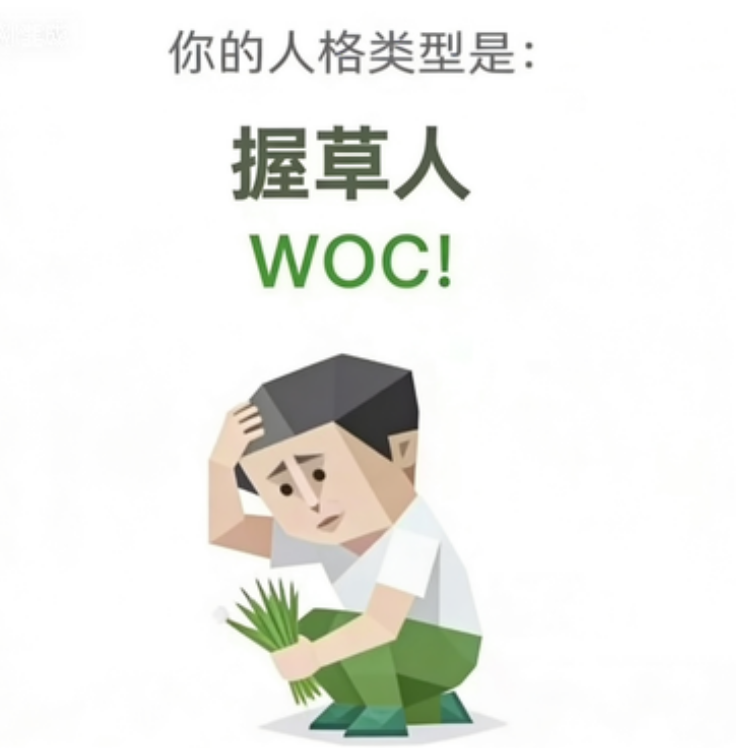
WOC! The Holy Shouter
WOC! personality is a unique "Dual-System Operator" in the SBTI spectrum, with a cognitive architecture showing significant dissociation between surface reactivity and deep stability. This personality type is not simply "emotionally expressive" or "overreacting", but a highly adaptive information processing strategy—using exaggerated external reactions to mark important information while maintaining the independent operation of the internal evaluation system. There is a special coupling pattern between the default mode network and salience network in WOC!'s brain, enabling rapid switching between "Performance Mode" and "Observation Mode" in social interactions. This ability serves as both a social lubricant and a cognitive protection mechanism.
Dual-System Cognitive Architecture
The core trait of WOC! personality lies in the parallel operation of its "Surface-Backstage" dual systems. The surface system generates immediate reactions required by social contexts—highly emotional expressions like "Whoa!", "Dude!", "What?!" These reactions are not fake, but socially calibrated currency designed to reduce interaction costs, build emotional resonance, and mark the importance of events. The backstage system continuously performs calm information processing, conducting causal analysis, risk assessment, and strategic calculation of the situation. This dissociation is not hypocrisy or defensiveness, but an optimization of cognitive efficiency: WOC! outsources emotional expression to an automated surface system, freeing up cognitive resources for deep processing in the backstage system.
Neurocognitive research shows that WOC! personalities have a lower amygdala response threshold than the population average, but higher prefrontal cortex regulation ability than average. This "high sensitivity-high regulation" configuration creates their unique behavioral pattern. WOC! produces rapid emotional responses to stimuli, but these responses are almost immediately monitored and adjusted by the prefrontal cortex. The result is that external observers often see "edited" emotional expressions—strong enough to convey information, but not enough to cause loss of control. This "emotional editing" ability allows WOC! to show amazing adaptability in high-stimulation environments, quickly matching the emotional rhythm of those around them while maintaining internal cognitive distance.
WOC!'s catchphrase "Whoa!" (or "Crap!") serves multiple functions. Linguistic analysis shows this expression acts as an interjection, filler word, topic shift marker, and resonance-seeking signal in WOC!'s linguistic corpus. More importantly, "Whoa!" acts as an "emotional placeholder", allowing WOC! to respond externally before completing internal evaluation, buying time for the backstage system to process information. This "react first, understand later" model stands in stark contrast to CTRL types' "understand first, react later" approach, reflecting WOC!'s unique adaptation strategy to social time pressure. Longitudinal data shows WOC! personalities excel in careers requiring rapid rapport-building (e.g., sales, live streaming, customer service), but may experience attention drift in tasks requiring long-term deep focus.
Typical 15-Dimension Profile
WOC!'s confidence is built on "adaptive competence"—believing they can handle various unexpected situations. This confidence does not stem from evaluation of specific abilities, but from conviction in the meta-ability of "reacting quickly no matter what happens". WOC! rarely experiences ability anxiety because their self-concept is process-oriented rather than result-oriented.
WOC! has clear metacognition about themselves, especially understanding the boundary between "performative" and "authentic" selves in social contexts. This clarity is not gained through introspection, but through accumulation of extensive social feedback. WOC! can accurately predict their reaction patterns in specific situations and select contexts accordingly.
WOC!'s value system shows context dependence, lacking cross-context consistent core anchors. WOC! prioritizes "quality of experience" over "goal achievement". This configuration provides flexibility but may lead to difficulty in committing to long-term goals. WOC! needs external structures (e.g., deadlines, social expectations) to maintain direction of action.
WOC!'s sense of security in intimate relationships is volatile. Their high reactivity can create strong emotional connections, but may also lead to over-monitoring of relationship stability. WOC! needs to learn to distinguish between "emotional intensity" and "relationship quality", avoiding misinterpreting calm periods as relationship crises.
WOC!'s emotional investment has a "breadth-first" characteristic—able to maintain moderate-intensity connections in multiple relationships, but rarely making deep investments in single relationships. This configuration provides emotional security but may lead to the "breadth trap" in relationships—having many acquaintances but few true confidants.
WOC! has a high degree of vigilance about psychological boundaries, and their "Whoa!" reaction is itself a boundary-marking behavior—using exaggerated reactions to define "this stimulus belongs to me" or "this stimulus is beyond expectations". WOC! experiences significant cognitive dissonance when relying on others, and needs to maintain a sense of security by keeping the psychological preparedness of "able to exit at any time".
WOC! tends to view the world as an open system full of surprises and possibilities, rather than a deterministic mechanical structure. This "possibility optimism" keeps WOC! open to novel experiences but may lead to underestimation of systemic risks. WOC!'s worldview is strongly narrative—weaving meaning through event sequences rather than deriving conclusions through abstract principles.
WOC!'s attitude toward rules is contextually pragmatic—rules are background noise in interactions, which can be creatively reinterpreted or bypassed when they hinder goals. This flexibility is an asset in innovative environments but may become an adaptation cost in highly standardized organizations. WOC! needs to develop "rule awareness" as a deliberate cognitive exercise.
WOC!'s sense of meaning comes from "experience density" rather than "goal achievement". WOC! constructs self-narrative through accumulating rich experiences. This meaning-making approach provides resilience but may lead to "experience hunger"—low tolerance for calm periods. WOC! needs to learn to extract depth from repetitive activities rather than just pursuing novel stimuli.
WOC!'s motivational structure is dominated by "approach-novelty", with a natural tendency toward novel stimuli. This configuration makes WOC! excel in early-stage entrepreneurship or project initiation, but may experience motivational decline in the maintenance phase. WOC! needs external accountability mechanisms to maintain commitment to long-term goals.
WOC!'s decision-making style is "intuitive-validation"—quickly forming initial judgments based on pattern recognition, then conducting rapid validation through limited information collection. This style is highly efficient in low-stakes situations, but may require introducing more systematic analytical procedures as a check in high-stakes irreversible decisions.
WOC!'s execution system has a "pulsatile" characteristic—alternating between short cycles of high-intensity bursts and relatively relaxed intervals. This pattern contrasts with "stable output" personalities. WOC! needs to learn to manage their energy cycles, handling complex tasks during peak periods and maintenance work during low periods.
WOC! is a natural initiator in social situations, and their high reactivity is itself a social invitation. WOC! builds connections through emotional contagion, a skill that allows rapid integration into unfamiliar environments. However, WOC! needs to be vigilant against "social burnout"—continuous external output may lead to depletion of internal resources.
WOC! has precise perception and regulation of interpersonal distance, able to quickly switch between intimacy and distance. This flexibility is a social asset but may lead to "insufficient relationship depth"—WOC! needs to deliberately practice sustained vulnerability exposure in specific relationships to build true intimacy.
WOC!'s self-presentation is highly contextually adaptive, but this is not inauthentic. WOC! views different versions of themselves in different contexts as complementary aspects of the same whole, rather than contradictory pretenses. The key is whether WOC! can integrate these different versions afterward to form a coherent self-narrative.
Social Topology & Relationship Dynamics
WOC! typically occupies the "emotional node" position in social networks—an emotional amplifier and information hub connecting different subgroups. This position is not gained through strategic social investment, but through accumulation of attention naturally attracted by high reactivity. WOC!'s relationship network shows a "multi-centered, low-density" structure: having multiple relatively independent social circles, but limited connection depth within each circle. This structure provides emotional security (not relying on a single relationship) and information advantages (cross-group information flow), but may lead to "social fragmentation"—lacking close bonds that provide deep support.
In the realm of intimate relationships, WOC! faces a core tension in the "novelty-stability paradox". WOC! has high needs for novel experiences in relationships, but long-term relationships inevitably enter predictable routines. High-functioning WOC! resolves this tension by viewing the relationship itself as a "joint exploration project"—creating new experiences with partners rather than seeking stimulation externally. Low-functioning WOC! may fall into a "relationship replacement cycle"—entering new relationships during the novelty phase and exiting during the stable phase, leading to fragmented relationship history and atrophy of deep intimacy capabilities.
WOC!'s conflict resolution style is characterized by "emotional marking-rapid shifting". WOC! immediately responds emotionally to conflicts ("Whoa, that's totally ridiculous!"), but this reaction functions to mark the importance of the event rather than express true anger intensity. WOC! then quickly seeks conflict resolution or diversion to avoid the cost of emotional escalation. This style is highly efficient in mild conflicts but may lead to "false resolution" in structural conflicts requiring deep processing—surface reconciliation without addressing root issues. WOC! needs to develop "emotional staying power"—consciously extending exploration of emotional content after marking emotions, rather than immediately seeking relief.
Career Niche Analysis
High-Fit Fields
- Live Streaming/Content Creation: Emotional contagion and atmosphere building in real-time interactions
- Sales/Business Development: Rapid rapport-building and needs discovery
- PR/Brand Communication: Crisis response and narrative construction
- Product Operations: Rapid response to user feedback and iterative optimization
- Event Planning: Experience design and on-site atmosphere control
- Consulting/Coaching: Promoting client awareness through mirroring reactions
Challenging Fields
- Deep Research Roles: Attention drift due to long-term monotonous work
- Highly Standardized Processes: Motivational exhaustion from repetitive tasks
- Independent Remote Work: Energy depletion due to lack of social feedback
- High-Risk Decision-Making Roles: Systematic questioning of intuitive decisions
- Long-Term Single-Client Relationships: Decreased investment due to lack of novelty
WOC! needs to be vigilant against the "breadth trap" in career development—due to rapid proficiency in multiple fields, they easily fall into a scattered state of "able to do everything but lacking deep accumulation". Long-term career satisfaction for WOC! depends on finding a "problem domain with continuous novel feedback"—static, highly repetitive environments lead to rapid burnout, while completely chaotic environments trigger anxiety. WOC!'s optimal career ecosystem is "rhythmic change": project-based work, cross-functional collaboration, and periodic role transitions.
In leadership dimensions, WOC! exhibits a "charismatic-participatory" leadership style. WOC! motivates teams through emotional contagion and narrative ability, rather than structural power or professional authority. This style is extremely effective in creative teams and crisis response teams, but may experience reduced effectiveness in phases requiring strict execution or long-term maintenance. WOC! leaders need to establish "institutional memory"—transforming personal charisma into organizational processes to ensure that fluctuations in personal energy do not cause drastic oscillations in team performance.
Developmental Risks & Shadow Traits
The core risk of WOC! personality is "reactivity dependence"—relying on external feedback as the main source of self-worth. When WOC! is in a low-feedback environment for a long time, they may experience "existential vertigo"—loss of self-sense when there is no object to react to. This dependence makes WOC! particularly vulnerable to the "like economy" of social media, easily falling into an addictive cycle of "performance-feedback-craving more feedback". WOC! needs to develop a "self without an audience"—a sense of self that can be maintained without external attention.
"Emotional labor overload" is another key risk. WOC!'s continuous external reactions are a high-energy-consuming form of emotional labor; long-term maintenance may lead to "emotional numbness"—disconnection between surface reactions and internal experiences. Preventive interventions include: regular "social fasting"—deliberately reducing external interactions to restore internal resources; and developing "non-performative hobbies"—such as solitary reading, solo sports, and other activities not dependent on external feedback.
In the cognitive dimension, WOC! faces the risk of "atrophy of deep thinking ability". Long-term rapid reaction patterns may lead to decreased tolerance for slow, linear, abstract thinking. WOC! may experience "understanding hunger"—eagerness to quickly grasp key points but avoiding complex knowledge requiring patient accumulation. Preventive interventions include: deliberate practice of "slow cognition"—such as reading long texts, learning skills requiring gradual accumulation (e.g., musical instruments, languages), and engaging in unstructured free writing.
In extreme cases, WOC!'s "dual-system dissociation" may evolve into "dissociative adaptation"—an excessively large gap between the surface self and true self, leading to fragmented identity. When WOC! finds themselves performing in all situations and cannot determine "which one is the real me", they may experience an existential crisis. Maintaining the coherence of a "core narrative"—an integrated story about who they are, what they value, and where they come from—is crucial for WOC!'s mental health.
Integrated Development Path
Reaction Awareness
Identify automatic reaction triggers and establish an observation gap between "stimulus and response". Practice pausing when emotional reactions arise and asking: Is this reaction needed by the situation, or is it my true feeling?
Depth Tolerance
Deliberately expose yourself to slow-paced, low-stimulation situations, starting with short periods (e.g., 30 minutes of phone-free solitude) and gradually expanding the tolerance window. The goal is to build implicit memory of "safety even without feedback".
Core Narrative Construction
Integrate scattered self-versions and build cross-context consistent self-identity through autobiographical writing, long-term psychotherapy, or deep conversations. Distinguish the boundary between "adaptive performance" and "authenticity".
Relationship Depth Experiment
Select 1-2 relationships for "deep investment" experiments—deliberately exposing vulnerability, tolerating calm periods in relationships, and testing the possibility of "connection without novelty".
Wisdom Integration
Develop "contextual wisdom"—making context-sensitive choices between reaction and reflection, breadth and depth, performance and authenticity. Shift from "always reacting" to "wisely choosing when to react".