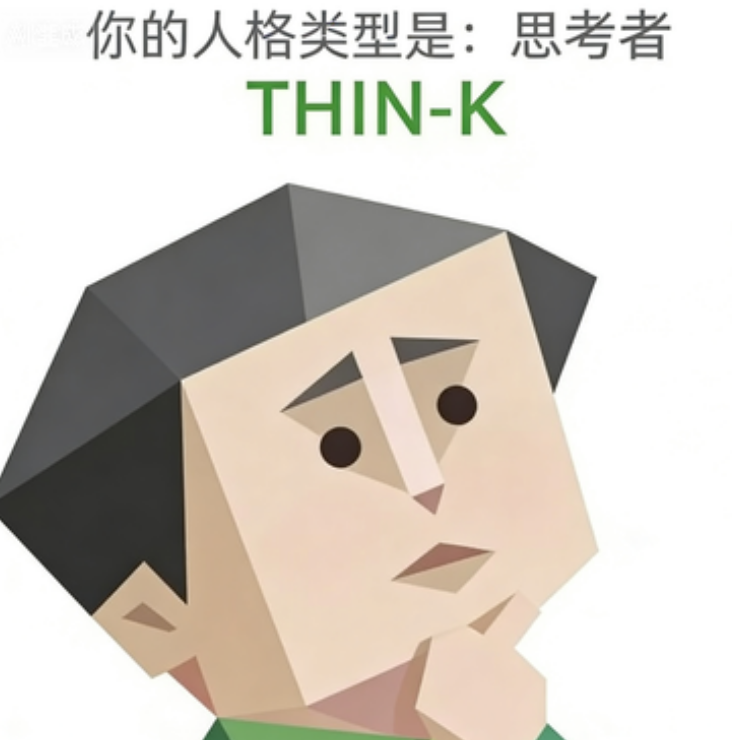
THIN-K The Thinker
THIN-K is the cognitive geek in the SBTI personality spectrum, with a nervous system seemingly optimized for information processing. This personality isn't simply "smart" or "nerd" pop culture labels, but a metacognitive stance treating the world as puzzles waiting to be solved. THIN-K's brain shows abnormally high functional connectivity between default mode network and executive control network, enabling continuous unconscious cognitive processing even in resting states—manifesting as unstoppable thinking impulses and aversion to cognitive closure.
Core Cognitive Architecture
THIN-K's cognitive system rests upon three nested hierarchical levels: information ingestion layer, pattern analysis layer, and metacognitive monitoring layer. The information ingestion layer manifests as greed for information sources and harshness toward information quality. THIN-K isn't simply a "knowledge enthusiast," but has highly selective filtering mechanisms for cognitive raw materials. Their brain has extremely low tolerance for information noise, actively avoiding fragmented, emotional, or logically incoherent information inputs—not from arrogance, but based on cognitive economics calculations: the cognitive cost of processing low-quality information exceeds potential benefits. THIN-K's information diet typically shows depth over breadth, long-form text over short content, raw data over second-hand interpretation characteristics.
The pattern analysis layer is THIN-K's core competitive advantage. THIN-K's brain automatically performs multi-dimensional拆解 on received information: argument structure identification (premise-inference-conclusion), evidence strength assessment (sample size-methodology-conflicts of interest), implicit assumption excavation (unstated premises-value presets-framing effects). This analysis process is often automated and unshutoffable in THIN-K, even involuntarily activating in social situations, causing THIN-K's frequent "mind wandering" in conversations—seemingly listening while actually analyzing the logical validity of the other's argument. This cognitive habit makes THIN-K excel in academia, research, and strategic analysis, but may also lead to cognitive overload in social interactions and emotional alienation.
The metacognitive monitoring layer constitutes THIN-K's self-regulation system. THIN-K doesn't just think, but thinks about their thinking—monitoring whether their cognitive processes contain biases, blind spots, or logical loopholes. This "second-order cognition" capability enables highly self-corrective thinking, but may also lead to "analysis paralysis"—infinite looping overthinking before decision points. THIN-K's signature catchphrase "let me think" isn't a procrastination strategy, but necessary startup time for their cognitive system. THIN-K needs physical time to run their multi-level analysis programs; forced acceleration leads to significantly degraded decision quality and increased post-hoc rumination.
15-Dimension Typical Profile
THIN-K's confidence builds upon cognitive ability rather than social recognition. Their self-evaluation is highly bound to "am I correct" rather than "am I popular." This configuration makes THIN-K show significant independence when facing authority or majority opinions, but may also lead to excessive fear of "being wrong" and cognitive defensiveness.
THIN-K has highly metacognitive awareness of their own cognitive preferences, thinking habits, and capability boundaries. But this clarity is dynamic model rather than fixed essence—THIN-K continuously updates self-cognition, treating it as a hypothesis system requiring constant correction. This "self as hypothesis" stance may lead to excessive fluidity in identity.
THIN-K's value system anchors on "truth/understanding," but this pursuit may be mediated by instrumental rationality. THIN-K needs to beware valuing "thinking" itself—thinking for thinking's sake rather than for understanding's sake—leading to cognitive hedonism and action paralysis.
THIN-K's security in intimate relationships shows contradictory nature. Intellectual understanding needs are extremely high, but emotional dependence needs are suppressed. THIN-K may "problemize" partners—analyzing relationship dynamics rather than experiencing relationships—leading to intellectualization and de-emotionalization of intimate relationships.
THIN-K's emotional investment is often misunderstood as coldness. Actually, THIN-K's emotional experience intensity isn't low, but expression channels are blocked by cognitive processing. THIN-K needs "translation time" to convert emotional experiences into language or action; this delay in fast-paced socializing may be experienced as detachment.
THIN-K's psychological boundary maintenance has cognitive-level necessity—social interactions interrupt their ongoing background cognitive processing. THIN-K's independence needs aren't emotional but cognitive: solitude is necessary condition for maintaining thought continuity.
THIN-K's basic assumption about the world is "understandable but not yet understood," rather than "benevolent" or "hostile." This cognitive realism makes THIN-K hold wait-and-see attitudes toward human nature, neither optimistic nor pessimistic, but continuously collecting evidence to correct their social cognition models.
THIN-K's attitude toward rules is epistemological: rules are hypotheses to be tested rather than established facts. THIN-K will follow rules they logically endorse, but will continuously question rules' rationality foundations. This "critical compliance" may be experienced as rebellion in conservative environments.
THIN-K's sense of meaning derives from "understanding" behavior itself—solving puzzles, seeing patterns, approaching truth. This meaning generation mechanism works well during knowledge exploration periods, but may experience overload collapse of meaning system when facing existential boundaries (death, suffering, irrationality).
THIN-K's motivation structure is dominated by "avoidance-error." Fear of making mistakes drives continuous information gathering and analysis, but may also lead to decision delays and accumulated opportunity costs. THIN-K needs to develop "good enough" decision standards to break perfectionism cycles.
THIN-K's decision process shows typical "maximizing" characteristics—seeking optimal solutions rather than satisfactory ones. This decision style performs excellently in information-complete, time-abundant, high-stakes situations, but may lead to "analysis paralysis" in rapidly changing or information-incomplete environments.
THIN-K's execution system is dominated by "plan-analysis" mode. THIN-K excels at designing complex systems and strategies, but may underestimate friction and surprises in execution processes. THIN-K needs to cooperate with "action-oriented" personalities to compensate for their execution-analysis gap.
THIN-K's social initiation cost is extremely high. Social interaction is a cognitively intensive task for THIN-K, requiring continuous multi-thread processing (content understanding-emotion recognition-response generation). THIN-K tends toward deep one-on-one exchanges rather than broad social networking.
THIN-K's psychological boundary maintenance has cognitive protective functions. Excessively intrusive social contact interferes with their internal cognitive processes, leading to thought fragmentation. THIN-K needs physical and psychological space to maintain cognitive system stable operation.
THIN-K's self-presentation has high situational adaptability, but this isn't social performance—it's cognitive humility. THIN-K adjusts expression complexity according to audience cognitive levels. This "cognitive empathy" capability makes THIN-K excellent knowledge disseminators.
Cognitive Niche and Social Function
THIN-K occupies "cognitive hub" positions in social systems—information flow filters, complex problem dismantlers, decision quality gatekeepers. This position isn't obtained through social skills or power games, but naturally accumulated through irreplaceable cognitive functions. In the age of information overload, THIN-K's screening and evaluation capabilities have extremely high social value, but may also lead to "cognitive aristocracy" mentality—equating thinking ability with moral superiority or social rank.
In collaborative environments, THIN-K typically plays "quality controller" role—identifying logical loopholes in plans, predicting potential risks in execution, proposing overlooked alternative solutions. This function is crucial in innovation teams and strategic departments, but may also lead to THIN-K being experienced as "naysayer" or "delayer." THIN-K needs to develop "constructive criticism" expression—not just pointing out problems but providing improvement paths; not just analyzing risks but assessing probabilities and coping strategies.
THIN-K's leadership style is based on "cognitive authority" rather than "charismatic authority." THIN-K leaders gain team trust through their analytical depth and judgment accuracy, not through emotional inspiration or vision depiction. This leadership style works well in technical teams and knowledge-intensive organizations, but may encounter adaptation difficulties in situations requiring rapid mobilization, emotional motivation, or ambiguous decision-making. THIN-K leaders need to recognize situational differences between "good enough" and "optimal," avoiding excessive analysis in crises requiring quick action.
Career Niche Analysis
High-Fit Domains
- Academic Research: Theory construction, literature review, hypothesis testing
- Strategic Consulting: Complex problem dismantling, multi-scenario analysis
- Data Science: Pattern recognition, causal inference, predictive modeling
- Legal/Policy Analysis: Argument evaluation, loophole identification, risk assessment
- Technical Writing/Science Communication: Visualization and dissemination of complex concepts
- System Architecture: Design and optimization of complex systems
Challenging Domains
- High-Pressure Sales: Rapid decision-making and emotional persuasion requirements
- Emergency Medicine: Time pressure and action priority
- Customer Service: Repetitive interaction and emotional labor
- Early-Stage Entrepreneurship: Information incompleteness and rapid trial-and-error
- Politics/PR: Ambiguous situations and relationship games
THIN-K faces core tension in career development between "depth-breadth" trade-offs. THIN-K's cognitive preferences tend toward vertical deep drilling in single fields, but contemporary career markets increasingly reward cross-domain integration capabilities. THIN-K needs to strategically develop "T-shaped capability structure"—maintaining cognitive depth in one core field while building sufficient conceptual maps in adjacent fields for cross-boundary dialogue.
THIN-K's career burnout typically stems from "cognitive alienation"—when work content degrades into repetitive information processing rather than true knowledge exploration, THIN-K experiences meaning depletion. Preventive strategies include: regularly entering "cognitive challenge zones"—learning entirely new domain knowledge to activate neuroplasticity; finding "cognitive partners"—colleagues or communities capable of peer intellectual exchange; and reserving "cognitive private plots"—pure knowledge exploration projects outside of work.
Developmental Risks and Cognitive Traps
THIN-K's primary risk is "intellectual arrogance"—equating cognitive ability with survival wisdom or moral superiority. THIN-K may develop implicit elitism, equating "not understanding" with "not worth understanding," equating "not thinking" with personality devaluation of "non-thinkers." This attitude not only limits THIN-K's social learning opportunities, but may also lead to cognitive echo chamber effects—only communicating with equal cognitive level individuals, losing contact with diverse thinking patterns.
"Analysis paralysis" is THIN-K's signature functional disorder. When facing irreversible decisions or information-incomplete situations, THIN-K's default coping strategy—collect more information, conduct more analysis—may fail, leading to decision delays and accumulated opportunity costs. THIN-K needs to develop "decision boundary" awareness—identifying "good enough" decision standards, establishing "stop analyzing" trigger mechanisms, and accepting the distinction principle of "reversible decisions made quickly, irreversible decisions made carefully."
In relationship dimensions, THIN-K faces "emotional intellectualization" risk—transforming emotional experiences into analysis objects rather than directly experiencing and expressing them. This defense mechanism reduces emotional vulnerability in the short term, but long-term may lead to atrophy of emotional capabilities and impoverishment of intimate relationships. THIN-K needs deliberate practice of "non-intellectualized moments"—pausing analysis in specific situations, purely feeling without evaluating, without naming, without explaining.
"Existential overload" is a crisis THIN-K may encounter in later life stages. When THIN-K applies their cognitive capabilities to existential issues (death, freedom, loneliness, meaninglessness), they may fall into existential anxiety caused by overthinking. THIN-K needs to recognize the boundaries of cognitive tools—certain experiences (mystery, awe, love) resist analysis; attempting to understand them actually causes their loss.
Integrative Development Path
Cognitive Humility
Recognize the gap between "knowing" and "understanding," acknowledging limitations of cognitive tools. Practice pausing judgment in uncertain situations, tolerating "I don't know" cognitive states without anxiety.
Emotional Reconnection
Develop body awareness and emotion recognition capabilities, establishing cognitive-emotional bidirectional channels. Practice pausing when analysis impulse arises, asking "how do I feel right now" rather than "how do I understand this moment."
Decision Boundary Setting
Establish "good enough" decision standards and "stop analyzing" trigger mechanisms. Practice making commitments under information-incomplete conditions, and accepting post-decision uncertainty rather than continuous rumination.
Action Integration
Break "thinking-action" sequential mode, develop "thinking in action" capability. Establish non-cognitive self-experience through physical practices (sports, crafts, improvisation).
Wisdom Balance
Develop situational wisdom of "when to think, when to stop thinking." Shift from "always analyzing" to "wisely choosing when to analyze," establishing dynamic balance between cognitive depth and existential breadth.